
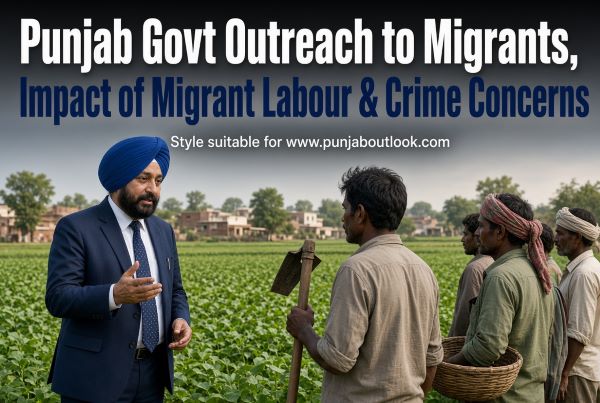
While this inflow supports farm operations and industry, it also shapes wage levels, employment opportunities for native residents, local security concerns, and questions around identity verification.Migrant labour has historically kept agricultural labour costs relatively low for cultivators, helping Punjab farmers maintain high net incomes per acre even as local labour markets tighten. Paddy-cultivating households in the state have recorded some of the highest net returns in India, yet their labour costs per acre remain comparable to those in lower-income states. Wheat cultivators in Punjab and Haryana have similarly faced lower labour costs than counterparts in the migrants’ home states.
Farmers often prefer migrants for their availability during peak seasons, longer working hours, and willingness to accept competitive rates.This cost advantage comes with trade-offs for local workers. Studies and farmer surveys have documented downward pressure on wages for specific operations: paddy transplanting charges declined by around 30 percent, wheat harvesting by about 19 percent, and permanent labour contracts by roughly 27 percent in the presence of migrant inflows, according to earlier research. Many local labourers report reduced job prospects and restrained wage growth in overlapping low-skill agricultural and casual work, prompting some to shift toward non-farm occupations. Broader analysis of Indian migration patterns indicates that while overall migrant inflows can raise wages for non-migrants in formal sectors through complementarity (especially for higher-skilled workers), the informal sector which dominates much of Punjab’s farm and casual labour markets often sees adverse employment effects for natives, partly due to employer preference for migrants.The wage-suppressing role of regular migrant supply became clear during the COVID-19 lockdowns, when many migrants temporarily returned home.
Wages for paddy transplantation rose by more than 50 percent on average (from roughly ₹2,979 per acre to ₹4,391 per acre) across surveyed villages, even after some local workers from closed non-farm sectors entered the market. Availability still fell short of previous levels, confirming the impact of migrant labour on wage levels. In industrial clusters like Ludhiana’s textile and apparel sector, migrants also form a substantial share of the workforce. Migrants themselves typically earn more in Punjab than in their origin areas—seasonal rates around ₹4,500 per acre for recent paddy work have been described as attractive allowing them to send remittances home while contributing to Punjab’s production. Estimates put the number of migrant workers in the state well over a million, with some industry voices noting that a large majority of labour in certain sectors comes from UP or Bihar.Alongside these economic dynamics, public concerns have grown over crimes involving some migrant workers. High-profile incidents have fuelled tension, including the September 2025 alleged rape and murder of a five-year-old boy in Hoshiarpur by a migrant worker from Uttar Pradesh, which triggered protests, village panchayat resolutions seeking restrictions on outsiders, and clashes in several districts.
Other reported cases include organised burglary rings involving groups of migrants from Bihar in Ludhiana, violent robberies by domestic helpers or farmhands in Amritsar, and inter-group fights. Police data cited in some reports indicate a roughly 20 percent rise in violent altercations linked to migrant groups in key districts such as Ludhiana, Jalandhar, and Bathinda over a nine-month period, with increases in incidents involving murder or attempted murder and looting. Residents and some community leaders have voiced worries that certain migrants provide false addresses, making them harder to track after offences, and that a minority may have prior criminal backgrounds.It is important to note that comprehensive official statistics from the National Crime Records Bureau or Punjab Police do not establish that migrant workers as a whole are disproportionately responsible for the state’s overall crime rates relative to their population share. Crime occurs across communities, and there have also been incidents of violence directed against migrants. Still, the high-visibility cases and local reports of rising conflicts have strained the long-standing symbiotic relationship between Punjab’s economy and migrant labour, leading to calls for better verification, monitoring, and accountability.Police verification of migrant identities forms a key part of these accountability efforts.
Officers primarily rely on identity documents most commonly Aadhaar cards, along with voter ID, PAN cards, driving licences, or passports—presented at local police stations or Saanjh Kendras. Aadhaar remains widely accepted for many police services, though alternative documents have been emphasised at times due to data-protection guidelines. The process typically includes examining the documents and claimed permanent address, recording details (sometimes with a photograph), and conducting field inquiries by beat officers who may visit workplaces, rented rooms, or labour camps and speak to neighbours, landlords, or employers. Local crime records are checked for any history in the area.For more thorough checks, especially those requested by employers or landlords for tenant, servant, or employment verification, police may seek antecedent reports from the migrant’s home district or state. Under the Inter-State Migrant Workmen (Regulation of Employment and Conditions of Service) Act, 1979, contractors employing five or more inter-state workers must register the establishment, obtain licences, and furnish worker particulars to authorities in both home and host states; workers are often issued a passbook containing employment details. Employers and farmers are frequently urged to complete formal police verification before hiring.
In response to security concerns or specific incidents, district administrations may order registration of migrant workers, requiring submission of name, addresses, employer details, and ID copies within a set timeframe. Challenges persist: forged or incomplete documents, slow cross-state clearances, false addresses, and the absence of a single real-time national database for all inter-state migrants can limit effectiveness. Practices intensify after high-profile cases, with some village panchayats demanding valid documents and completed police verification as a condition for allowing migrants to stay.Taken together, the evidence shows that migrant labour functions as a cost-containment mechanism for Punjab’s farm sector and certain industries, supporting cultivator returns while moderating wage growth and limiting opportunities for many local unskilled workers. At the same time, specific crimes attributed to some migrant workers have heightened insecurity and social friction, underscoring the importance of robust identity verification. Public outreach by elected representatives that is viewed as actively encouraging settlement intensifies existing debates over whether such approaches adequately balance social inclusion with the employment, livelihood, and security concerns of native residents and small businesses. Shortages produce sharp upward pressure on wages, while unresolved issues of verification, tracking, and crime reporting continue to shape public attitudes toward the large migrant workforce on which much of the state’s economy still relies.
Disclaimer: This article and accompanying images are for informational and illustrative purposes only. Some visuals may be AI-generated or digitally enhanced and may not depict actual events or persons.Views expressed are based on publicly available information and analysis