
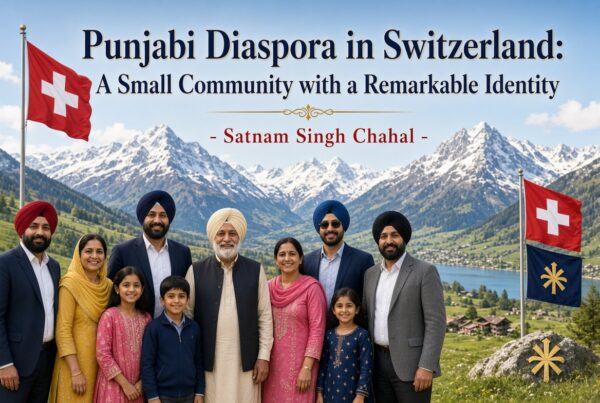
Switzerland may be known around the world for its mountains, watches, banking sector and multicultural society, but within this European country there is also a small yet meaningful Punjabi diaspora that has gradually built a life of its own. The Punjabi presence in Switzerland is closely connected with the wider Indian diaspora and, particularly, with the Sikh community. Though the community is relatively small compared with Punjabi populations in Canada, the United Kingdom, the United States or Australia, its contribution to Swiss multicultural life is significant.
The wider Indian diaspora in Switzerland is estimated by the Indian government at about 27,300 people, including more than 8,750 persons of Indian origin. Indians are concentrated particularly around Zurich, Geneva, Basel, Baden, Bern and Lausanne and are active in professional fields including engineering, information technology, pharmaceuticals, healthcare and research. The community also includes senior executives, academics, doctors, engineers, students and people working in international organisations.
Within this broader Indian community, Sikhs and Punjabis have developed a distinctive cultural and religious identity. Estimates of the Sikh population vary because Switzerland’s official population statistics do not always identify Sikhs separately by religion. Swiss sources have generally placed the Sikh population somewhere around 500 to 1,000, with the community spread across different parts of the country.
The history of Sikhs in Switzerland has not always been easy. During the 1980s and early 1990s, Switzerland received a much larger number of Sikh asylum seekers. At one stage, estimates reached approximately 3,000. Many were ultimately not granted refugee status and subsequently moved to Canada or other countries.The early Sikh migrants faced many of the difficulties normally experienced by newcomers: finding employment, accommodation and places of worship. Their visible religious identity sometimes created additional challenges. The turban, uncut hair and beard made Sikhs immediately recognisable, and some newcomers had to overcome unfamiliarity and misconceptions about their faith and appearance.Yet the story of the Swiss Sikh community is ultimately not simply a story of migration and hardship. It is also a story of perseverance, adaptation and integration.
In the early years, Sikhs sometimes gathered in private homes and rented premises for prayers. One of the important figures in the early history of the community was Swiss scholar Christoph Baumann, who welcomed Sikh migrants and provided them with a place to pray. His interaction with the community eventually contributed to greater understanding of Sikhism in Switzerland.Over time, the community established permanent places of worship. Swiss sources identify gurdwaras in places including Däniken, Langenthal, Bassersdorf/Zürich and Geneva. The gurdwaras have become much more than places for religious worship. They function as community centres where families meet, children learn about Sikh history and religion, Punjabi culture is preserved and visitors from other backgrounds are welcomed.The gurdwara therefore represents something particularly important for the Punjabi diaspora: a bridge between the homeland and the new country.
For the Punjabi diaspora, perhaps one of the greatest challenges is maintaining the Punjabi language among younger generations. Children born or raised in Switzerland naturally become fluent in local languages such as German, French or Italian, depending on where their families live. Punjabi can consequently become a language used primarily at home or within the gurdwara.This makes cultural education especially important. The Sikh community in Däniken, for example, has explicitly worked to provide children with education about Sikh religion, history and Punjabi language.This effort is not simply about preserving an old language. It is about preserving a connection between generations. A child who can speak Punjabi with grandparents in Punjab, understand Sikh prayers and participate in Vaisakhi celebrations is maintaining a cultural bridge that otherwise could weaken with every generation.
The future of the Punjabi diaspora in Switzerland increasingly belongs to the second and third generations.These young people are Swiss in many ways. They attend Swiss schools, speak the country’s languages, pursue Swiss careers and participate in Swiss society. At the same time, many remain connected to Punjabi culture through their families, gurdwaras, music, food, festivals and religious traditions.This creates a modern Punjabi-Swiss identity rather than a choice between two identities.The story of young Sikhs wearing the turban illustrates this evolution particularly well. Swiss broadcaster SRF has documented young Sikhs who regard the turban not only as a religious obligation or family tradition but also as a statement that Sikh identity has a permanent place in Swiss society.
One of the most remarkable aspects of the Swiss Sikh experience is the community’s emphasis on integration. Swiss reporting has described the Sikh community as generally well integrated into society. At the same time, Sikhs continue to maintain distinctive traditions and institutions.This demonstrates an important principle for the wider Punjabi diaspora: integration does not necessarily mean cultural disappearance.A Punjabi can become a successful Swiss professional while remaining connected to Punjab. A Sikh child can grow up speaking Swiss German while learning Punjabi at home. A young woman or man can participate fully in Swiss society while celebrating Vaisakhi and visiting the gurdwara.The strength of a diaspora is often measured not by how completely it abandons its roots, but by how successfully it carries those roots into a new generation.
Despite its successful integration, the Sikh community has faced questions surrounding religious freedom, employment, education and the visibility of Sikh identity. Swiss reporting has highlighted difficulties experienced by some young Sikhs in obtaining apprenticeships and challenges connected with maintaining Sikh practices in schools and workplaces.The turban remains one of the most visible symbols of Sikh identity. For some Sikhs it is simply part of everyday religious life; for others it has become a powerful symbol of belonging and perseverance.The challenge for Switzerland is therefore the same challenge faced by many modern democracies: how to maintain social cohesion while allowing minorities to preserve legitimate religious and cultural practices.
For many members of the Punjabi diaspora, Switzerland may be home, but Punjab remains emotionally powerful.Family relationships, visits to Punjab, weddings, religious celebrations, Punjabi music, food and memories of villages and cities continue to connect the community with its ancestral homeland. Modern technology has made this connection even stronger. WhatsApp, social media and video calls allow families in Switzerland and Punjab to remain in daily contact.At the same time, the relationship is increasingly two-way. The Punjabi diaspora sends money, knowledge, education and professional expertise back to Punjab. It also carries Punjab’s cultural identity into Swiss society.The diaspora therefore becomes an informal ambassador for Punjab.
The Punjabi community in Switzerland may not be numerically large, but numbers alone do not measure a diaspora’s importance.Its real strength lies in the institutions it has built, the families it has established, the young generation it is educating and the cultural identity it is preserving. The establishment of gurdwaras, community associations and cultural activities demonstrates that the Punjabi-Sikh presence has moved beyond temporary migration toward permanent settlement and community building.Switzerland itself has become increasingly multicultural. The Swiss government’s current information notes that foreign residents make up about 27% of the population, reinforcing the country’s multicultural character.Within that multicultural Switzerland, the Punjabi diaspora represents a small but distinctive thread.
The next chapter will be written by the younger generation.The question is not whether Punjabi identity will remain exactly as it was in Punjab. It will inevitably change. The Punjabi spoken by a child in Zurich may sound different from the Punjabi spoken in Jalandhar. A young Sikh in Geneva may understand Swiss culture as naturally as Punjabi culture. Families may celebrate Vaisakhi in Switzerland while also participating fully in Swiss civic life.That is not necessarily cultural loss. It can be cultural evolution.The Punjabi diaspora in Switzerland has demonstrated that a community does not need to be enormous to have a voice. From early migrants praying in private homes to established gurdwaras and second- and third-generation Swiss Sikhs, the journey reflects determination, adaptation and cultural resilience.Punjab may be thousands of kilometres away, but for the Punjabi diaspora in Switzerland, Punjab is not simply a place on a map. It is a language, a memory, a faith, a family connection and an identity carried across generations.The Swiss Punjabi story is therefore not merely about migration. It is about how a small community can build a new home without forgetting where it came from.
Disclaimer: This article and accompanying images are for informational and illustrative purposes only. Some visuals may be AI-generated or digitally enhanced and may not depict actual events or persons.Views expressed are based on publicly available information and analysis