
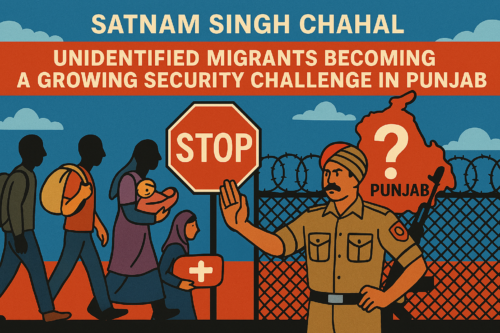
 Punjab has historically been one of India’s most prosperous agricultural and industrial states, attracting lakhs of workers from different parts of the country. Every year, men and women from Uttar Pradesh, Bihar, Jharkhand, West Bengal, Odisha, Chhattisgarh, Rajasthan, Madhya Pradesh, Assam and several other states arrive in Punjab to work in agriculture, factories, construction, transportation, hotels, restaurants, domestic services and small businesses. Their labour has played an important role in addressing Punjab’s workforce shortage and supporting economic growth. The contribution of these hardworking and law-abiding citizens deserves recognition and respect.
At the same time, Punjab is confronted with a growing administrative and security challenge. While workers continue to enter the state in large numbers, there is no universally implemented system ensuring that every temporary resident, tenant, labourer, or seasonal worker is promptly registered and verified. The issue is not migration itself; it is the absence of an effective verification mechanism that enables law enforcement agencies to know who is residing where, particularly in a border state facing complex security challenges.
Punjab occupies a unique position in India’s national security architecture. It shares an international border with Pakistan and has, for decades, faced threats related to narcotics trafficking, illegal arms smuggling, organized crime, gang activity, and attempts by anti-national elements to exploit weaknesses in security. These realities make accurate records of temporary residents and tenants an important tool for policing and public safety, rather than merely an administrative formality.
The overwhelming majority of migrant workers come to Punjab only to earn an honest livelihood and support their families. They work long hours in fields, factories, brick kilns, warehouses, transport companies and construction sites, making valuable contributions to Punjab’s economy. There is no evidence that migrant workers as a group are responsible for crime, and it would be unfair and incorrect to make such a claim. However, law-enforcement agencies have repeatedly observed that individuals involved in organized crime sometimes exploit gaps in identity verification and documentation to conceal themselves among larger populations of temporary residents. This is why verification systems are designed to identify individuals, not to stigmatize entire communities.
Punjab Police have increasingly emphasized tenant verification and identity checks as preventive policing measures. In early 2026, the police conducted a statewide tenant verification campaign covering more than a thousand locations, verified thousands of tenants, and detained a number of suspicious individuals for further examination. The operation formed part of a broader campaign against organized gangs and criminal networks.
Punjab already provides mechanisms for tenant verification through its citizen services, and district administrations periodically issue directions requiring landlords to complete verification procedures. These measures are intended to help police maintain accurate records and assist investigations whenever serious crimes occur.
The need for verification becomes even more important because the nature of crime has changed dramatically over the past decade. Punjab no longer faces only conventional offences such as theft or burglary. Organized gangs today operate across multiple states, frequently changing locations and identities. Criminal investigations increasingly involve interstate movement, fake identities, cyber fraud, extortion, narcotics trafficking, illegal weapons, financial crimes, and cross-border smuggling. Police officers often have to coordinate with agencies across India to trace suspects who move quickly from one state to another.
Crime and Security Timeline
2018–2020: Punjab continued to battle narcotics trafficking, illegal arms smuggling, interstate theft gangs, and organized criminal networks. Law-enforcement agencies repeatedly highlighted the importance of maintaining accurate records of tenants and temporary residents to assist investigations.
2021: Several incidents involving gang rivalries, extortion, and targeted shootings drew public attention. Police strengthened intelligence-sharing and interstate coordination to track organized criminal groups operating across state borders.
2022: Punjab Police intensified operations against organized crime, drug traffickers, and illegal arms suppliers. Investigations in several cases involved suspects moving across different states, illustrating the importance of reliable identity records.
2023: Special anti-gang and anti-drug campaigns resulted in arrests of members of interstate criminal networks allegedly involved in narcotics trafficking, robbery, vehicle theft, and extortion. Police increasingly relied on intelligence-based operations and coordination with other states.
2024: Authorities continued recovering heroin, illegal firearms, and explosives while also dealing with the rising challenge of cybercrime and financial fraud. Organized criminal networks increasingly used temporary accommodation, false identities, and interstate mobility to avoid detection.
2025: Security agencies investigated several alleged espionage, smuggling, and organized crime cases linked to cross-border activity. Anti-smuggling operations along Punjab’s international border resulted in multiple recoveries of narcotics, weapons, and explosives.
2026: Punjab Police expanded operations against organized gangs, foreign-based criminal networks, and smuggling syndicates. Large quantities of heroin, illegal firearms, and explosives were recovered in separate operations, while statewide tenant verification drives sought to improve records of temporary residents and support ongoing investigations.
A comprehensive verification system should therefore be viewed as an instrument of good governance rather than as a measure directed against any particular community. Employers, contractors, landlords, labour suppliers and local authorities all have a role in ensuring that temporary workers are registered through lawful procedures. Digital registration, tenant verification, employer-maintained records, inter-state police coordination and the use of existing national verification platforms can strengthen public safety while protecting the dignity and rights of genuine workers. India already has legal frameworks governing inter-state migrant workers and police antecedent verification systems that support these objectives.
Punjab’s economy will continue to depend upon migrant labour for years to come. The challenge before policymakers is therefore not to discourage lawful migration but to ensure that every resident permanent or temporary can be identified through transparent, fair and constitutional procedures. A robust verification system can improve policing, speed up criminal investigations, deter misuse of false identities, and reinforce public confidence, while continuing Punjab’s long tradition of welcoming honest workers from across India.
Disclaimer: This article and accompanying images are for informational and illustrative purposes only. Some visuals may be AI-generated or digitally enhanced and may not depict actual events or persons.Views expressed are based on publicly available information and analysis.