
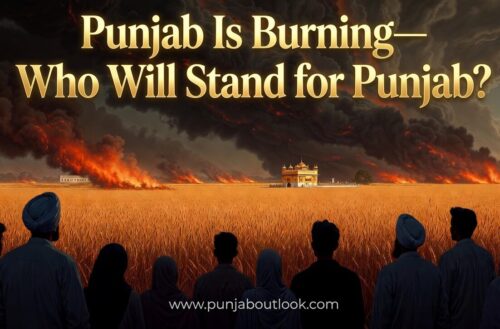
 Punjab is facing a crisis that the Bhagwant Mann government can no longer hide behind political slogans, press conferences and selective crime statistics. The issue is no longer simply about migration or the arrival of workers from other States. The real issue is whether Punjab has lost control over the process through which people enter, settle, work and establish communities across the State and whether the government has any serious strategy to deal with the social, security and demographic consequences.
For decades, Punjab welcomed workers from other parts of India. They came to work in agriculture, factories, construction, shops, restaurants and other sectors. Their contribution to the economy cannot be denied. But what was once largely seasonal labour migration has, in many places, developed into permanent settlement. The State has allowed this transformation to continue without a comprehensive policy for verification, urban planning, policing, housing, integration and public security.
That failure now has consequences.
Residents in different parts of Punjab are increasingly complaining about groups of people gathering at streets, crossings and public places, drinking alcohol, shouting, creating disturbances and making ordinary families, particularly women, uncomfortable. Videos circulating on social media have added fuel to these concerns, with allegations involving fights, drug activity, intimidation and other forms of criminal behaviour. Every viral video is not evidence. Every allegation is not a conviction. But when complaints repeatedly emerge from different locations, the government has a responsibility to investigate rather than dismiss them. The question for Bhagwant Mann@bhagwantmann is therefore straightforward: what exactly is his government doing about it?
The Government Cannot Outsource Law and Order to WhatsApp
Punjab’s citizens should not have to become detectives.Yet this is increasingly what appears to be happening in some communities. Residents are reportedly checking the identities and backgrounds of people living around them because they believe the administration is not doing enough.This is an extremely dangerous development.When citizens lose faith in the police, they begin relying on social media. When they lose faith in official verification, they start conducting their own inquiries. When they believe complaints are ignored, anger begins replacing confidence in institutions.That is how a law-and-order problem can become a social crisis.The Bhagwant Mann government should understand this before it is too late.
The responsibility for identifying criminals belongs to the police not to neighbourhood groups, political activists or social-media users.If someone is involved in narcotics, arrest that person.If someone is involved in organised crime, investigate the network.If someone is illegally possessing weapons, prosecute them.If someone is harassing women or creating public disorder, take action.But do not wait for a video to go viral before the State notices the problem.
The Drug Question Cannot Be Buried
Punjab has already suffered a devastating social and economic cost because of drugs.The State does not need another generation destroyed by narcotics while politicians continue to make speeches about a “war on drugs.”If criminal networks are using interstate connections to bring drugs into Punjab, the government must expose those networks. If drugs are being distributed through particular neighbourhoods, the police must identify the suppliers. If outsiders are involved in criminal networks, they must be prosecuted. If Punjabis are involved, they must be prosecuted as well.There can be no double standard.The origin of a criminal is irrelevant.The crime is what matters.But the government must also answer a more uncomfortable question: does Punjab actually know who is living in its vulnerable neighbourhoods and whether individuals with criminal histories are moving between States?
If the answer is yes, where is the data?
If the answer is no, why not?
Bhagwant Mann Cannot Have It Both Ways
The Punjab government cannot simultaneously claim that law and order is under control and ignore growing public complaints about crime, drugs, street disturbances and insecurity.It cannot celebrate police achievements when convenient and remain silent when citizens ask difficult questions.It cannot claim to have a sophisticated intelligence system while ordinary residents are circulating videos and conducting their own investigations.It cannot promise a drug-free Punjab while refusing to explain how interstate drug networks are being identified and dismantled.And it cannot speak endlessly about the safety of women while allowing women to believe that certain streets and public places are becoming unsafe.Governance is not about announcements.Governance is about whether people feel safe when they step outside their homes.
A Timeline of Administrative Failure
The 2000s: Punjab increasingly depended on migrant labour. Workers from several States became an essential part of agriculture, construction, industry and services. The government treated the phenomenon primarily as an economic issue.
2010–2015: Seasonal migration increasingly turned into permanent settlement. Families began establishing themselves in Punjab. Housing colonies and informal settlements expanded. But comprehensive long-term planning remained inadequate.
2015–2020: Urban expansion and industrialisation increased the demand for labour. Migrant populations grew around industrial centres and cities. Questions concerning tenant verification, sanitation, policing and public infrastructure became increasingly important.
2020–2023: Punjab’s drug crisis and organised crime became major political issues. Governments promised aggressive action against narcotics. Yet the State continued struggling with drug distribution, gang violence and illegal weapons.
2023–2025: Social media increasingly became the first source through which residents learned about local crime. Videos of fights, public drinking, disturbances and allegations of drug activity spread rapidly. The gap between what citizens were seeing online and what they were hearing from official institutions became increasingly visible.
2025: Punjab experienced another devastating flood crisis while continuing to face economic, drug and law-and-order pressures. The State’s administrative machinery was already under enormous strain. Concerns about population changes and public security continued to grow.
2026: The issue has reached a new stage. Citizens are increasingly asking who is living in their neighbourhoods, whether proper verification has taken place, whether criminal backgrounds are being checked and whether police intelligence is keeping pace with demographic change.This is no longer a question that can be postponed.
Where Is the Punjab Police?
The Punjab Police cannot be expected to solve every problem overnight. But it must answer whether it has an effective system for identifying repeat offenders, monitoring organised criminal networks and coordinating with police forces in neighbouring States.Punjab shares borders with several States and has extensive economic and transport connections with northern India. Criminal networks do not respect State boundaries.Why should Punjab’s police investigation stop at the border?
If a criminal moves from one State to another, the police must be able to identify him.If a drug supplier operates across several States, intelligence agencies must follow the network.If organised crime is being financed outside Punjab, investigators must follow the money.The solution is not suspicion of every migrant.The solution is better intelligence, better policing and better inter-State coordination.
Women Should Not Have to Negotiate With Street Crowds
The government should pay particular attention to complaints from women.A woman should be able to walk through a marketplace, residential street or bus stand without feeling threatened by groups of men drinking, shouting or creating disturbances.Families should not have to plan their movements around the presence of intimidating groups.This is not a cultural war.It is a law-and-order issue.If public drinking is illegal in a particular circumstance, enforce the law.If harassment occurs, register the case.If intimidation occurs, investigate.If a public gathering becomes a nuisance or threatens public safety, intervene.
The government already has laws.What it needs is the political will to enforce them.
The Political Silence Is Becoming More Dangerous Than the Problem
Why are Punjab’s political leaders not demanding a comprehensive migration, crime and verification audit?Why are elected representatives not asking for district-wise figures?Why is there no transparent public debate about tenant verification?Why is the government not publishing statistics on interstate criminal networks?Why are opposition parties not forcing the government to answer these questions in the Assembly?And why does every discussion about migration immediately become a political fight instead of an evidence-based conversation about governance?Punjab cannot afford this political cowardice.
A government that refuses to collect and publish data creates a vacuum.
And vacuums are quickly filled by rumours.
The Solution Is Not Hate. It Is Law.
Punjab must not become divided between “locals” and “outsiders.”
That would be both unjust and dangerous.
The State needs one law for everyone.
A migrant worker who works honestly and obeys the law deserves protection.
A Punjabi citizen involved in crime deserves prosecution.
A migrant involved in crime deserves prosecution.
A powerful person involved in crime deserves prosecution.
A politically connected criminal deserves prosecution.
That is what equality before law means.
The government must therefore stop treating the issue as an identity question and start treating it as a governance question.
The Five Questions Bhagwant Mann Must Answer
The Chief Minister owes Punjab clear answers to five basic questions.
First: Does the government have accurate information about migrant workers and tenants living in Punjab’s towns, cities and villages?
Second: How many serious criminal cases in Punjab involve persons who moved into the State from elsewhere, and what are the major categories of those offences?
Third: How many interstate narcotics networks have been identified and dismantled during the present government?
Fourth: What action is being taken against landlords and establishments that fail to comply with applicable verification requirements?
Fifth: What concrete measures are being taken to ensure that women and families feel safe in neighbourhoods where residents have repeatedly complained about public drinking, harassment and street disturbances?
These are not unreasonable political questions.
They are questions of governance.
Punjab Needs a Security and Demographic Audit
The State government should immediately commission a comprehensive district-wise audit covering population movement, tenant verification, migrant-worker registration where legally applicable, narcotics cases, organised crime, illegal weapons, repeat offenders, public-order complaints and police response.
The findings should be presented publicly.
If the data shows that public fears are exaggerated, the government should say so.
If the data shows serious problems, the government must act.
Either way, Punjab deserves facts.
The Real Failure Is Not Migration—It Is Misgovernance
Punjab’s historic openness should not be turned into an excuse for administrative negligence.
People will continue to move in search of work. Economic migration will continue. Cities will continue to grow.
The government’s job is to manage that reality.
Instead, Punjab increasingly appears to be reacting to problems after they become viral.
A video appears.
Public anger rises.
Politicians issue statements.
Police announce an investigation.
Then the matter disappears.
This is not governance.
This is crisis management.
Punjab needs prevention.
A Warning to the Mann Government
Bhagwant Mann came to power promising a new political culture and a government that would protect ordinary people.
That promise must now be tested on the streets.
Not in advertisements.
Not on social media.
Not in political rallies.
On the streets.
Can a woman walk home safely?
Can a family complain to the police and expect action?
Can residents trust that criminal backgrounds are being properly investigated?
Can Punjab stop drug networks before they destroy another generation?
Can the government manage demographic change without creating social tension?
These are the questions that matter.
Punjab does not need a campaign against people from other States.
Punjab needs a campaign against criminals, drug traffickers, organised crime, public disorder and administrative failure.
The government must make it absolutely clear that every law-abiding person is welcome—but nobody, regardless of birthplace, political connections or economic status, is above the law.
Because if the government continues to ignore genuine public concerns, the danger is not merely that crime will increase.
The greater danger is that ordinary people will stop trusting institutions.
And once trust in the police, administration and government collapses, rebuilding it can take years.
Punjab is not asking for walls. Punjab is asking for law.
Punjab is not asking for discrimination. Punjab is asking for verification.
Punjab is not asking for vigilantism. Punjab is asking for policing.
And above all, Punjab is asking one simple question of the Bhagwant Mann government:
Who is watching Punjab’s streets—and why does it increasingly feel as though nobody is?