
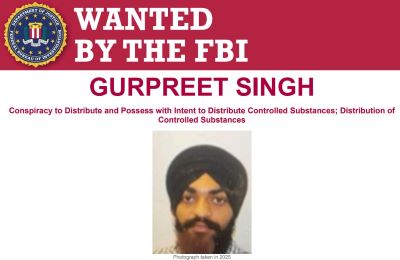
 LOS ANGELES/CHANDIGARH — The Federal Bureau of Investigation has placed Gurpreet Singh on its Organised Crime Most Wanted list in connection with an alleged transnational criminal network associated with the Jaggu Bhagwanpuria Organised Crime Group, a development that highlights the growing reach of India-linked organised crime investigations into the United States. The FBI’s current Organised Crime Most Wanted listing includes Gurpreet Singh among its fugitives.
The case forms part of a much larger federal investigation into the Bhagwanpuria organisation. According to a federal indictment filed in the U.S. District Court for the Central District of California, the Jaggu Bhagwanpuria Organised Crime Group allegedly operated in the Central District of California and elsewhere and was involved in activities including extortion, kidnapping and trafficking in controlled substances. The indictment identifies Jaggu Bhagwanpuria, Gurlal Singh and several other defendants as alleged members or associates of the organisation.
The allegations are particularly significant because they show how criminal networks based in or connected to Punjab are alleged to have developed an international operating structure. Rather than remaining confined to local gang disputes, the U.S. case describes an organisation whose alleged activities crossed borders and affected interstate and foreign commerce.
The name Gurpreet Singh requires particular attention because it is relatively common and several individuals with that name appear in criminal investigations involving Punjab-based gangs. The FBI’s current Organised Crime Most Wanted page, however, specifically lists GURPREET SINGH as a wanted individual.
The federal indictment connected to the Bhagwanpuria investigation separately names defendants including Jaggu Bhagwanpuria, Gurlal Singh, Sahibdeep Singh, Gurdev Singh, Amritpal Singh Bal, Nitish Kaushal, Harshpreet Singh, Amarbír Singh, Hardeep Singh and Major Singh. The indictment says these individuals were members or associates of the alleged Bhagwanpuria OCG.
Because of the number of people with similar names appearing in different criminal investigations, reports should distinguish carefully between Gurpreet Singh wanted by the FBI and other individuals named Gurpreet Singh in unrelated Punjab cases.
A timeline of the developement case
January 2025 — International pressure on Punjab-linked gangs intensifies
During 2025, Punjab and international law-enforcement agencies continued targeting overseas-linked gangster networks. Punjab Police operations increasingly focused on foreign-based handlers, weapons trafficking, extortion and organized criminal modules allegedly operating through local associates.
August 2025 — Weapons networks linked to gang rivalry targeted
Punjab Police announced multiple arrests in Amritsar involving alleged associates of organized crime groups and recovered sophisticated firearms and ammunition. Police said some networks had connections with foreign-based gangsters and that weapons were being moved through cross-border channels.
November 2025 — Bhagwanpuria network remains active in Punjab
Punjab’s Anti-Gangster Task Force and Batala Police arrested an alleged member of the Jaggu Bhagwanpuria gang and recovered two pistols and ammunition. Investigators said the accused was operating under the direction of a foreign-based handler.
January 9, 2026 — Major Punjab crackdown
Amritsar Police announced that they had busted a module allegedly linked to Jaggu Bhagwanpuria and prevented a planned targeted killing and extortion attempt. Five people were arrested and weapons and vehicles were recovered. Police said the group was allegedly receiving directions from foreign-based gangsters.
January 15, 2026 — Tanda murder becomes part of a wider international investigation
A shopkeeper, Balwinder Singh, was shot dead at his hardware store in Tanda, Punjab. Subsequent investigations became intertwined with allegations involving gangsters and an alleged effort to use the murder investigation to pressure a family based in California.
April 2026 — Alleged transnational extortion activity
According to reporting based on the U.S. indictment, Punjab Police inspector Gurinderjit Singh Nagra allegedly became involved with members of the Bhagwanpuria network in an attempt to pressure a California-based family by threatening to implicate relatives in the Tanda murder case. U.S. prosecutors later alleged that the extortion demand reached approximately $400,000.
May 24, 2026 — Punjab police publicly announce arrests
Nagra and another senior police official publicly announced the arrests of two alleged shooters in the Tanda murder case. According to U.S. prosecutors, this formed part of a broader alleged effort to pressure the California family. The federal case later alleged that the family had been threatened with being named as conspirators in the murder.
June 2026 — U.S. federal investigation reaches indictment stage
Federal grand juries returned indictments involving several India-linked organized crime organizations. The Bhagwanpuria indictment described the alleged criminal enterprise as an organization involved in extortion, kidnapping and controlled-substance trafficking operating in California and elsewhere.
July 7–8, 2026 — Operation Hard Ball becomes public
U.S. authorities announced a major international crackdown involving three India-linked organized crime organizations. According to federal authorities and reporting from the operation, 37 defendants were charged across three indictments and 24 people were arrested in the coordinated operation involving the United States, Canada and Europe.The operation demonstrated that American investigators were no longer treating these organizations merely as overseas gang problems. The alleged criminal activity had developed an operational footprint inside the United States.
July 2026 — Gurpreet Singh appears on FBI Organized Crime Most Wanted list
The FBI’s Organized Crime Most Wanted page currently lists Gurpreet Singh among its wanted fugitives. This places the case directly within the FBI’s transnational organized-crime enforcement framework.
The significance of the case goes beyond one individual.For years, Punjab’s gangster problem was largely discussed as a domestic law-and-order challenge. Gangsters fought rival gangs, issued threats, demanded extortion money and used social media to project their influence.The American investigations suggest something much larger: a criminal ecosystem capable of operating across jurisdictions.The alleged model involves individuals in India, overseas gang members, local associates, transportation networks, financial channels and, according to the federal allegations, criminal activity extending into the United States.The Bhagwanpuria indictment explicitly states that the alleged organization affected interstate and foreign commerce.That language matters because it moves the case beyond the traditional image of a Punjab gangster operating within a particular district or state.
The Central District of California has emerged as a particularly important location in the federal investigation.According to the indictment, the Bhagwanpuria OCG operated in the Central District of California and elsewhere.California’s enormous South Asian population, extensive transportation infrastructure and connections to Canada and Mexico make the region strategically important for international criminal investigations. U.S. authorities have increasingly focused on alleged India-linked criminal networks operating through California.The July 2026 Operation Hard Ball investigation also involved numerous locations across California and other parts of the United States. Authorities described an international structure involving narcotics trafficking, extortion and violence.
The arrest and prosecution of individual gang members may only reveal one layer of the network.The more difficult questions concern the handlers, financiers, facilitators, communication channels, transporters and local contacts allegedly supporting these organizations.How much money moved through these networks?
How were criminal proceeds transferred between countries?Who provided logistical support?How were drugs allegedly moved?Who supplied weapons?How were threats communicated?
And, most importantly, did criminal networks succeed in establishing relationships with legitimate businesses, corrupt officials or other intermediaries?These questions will likely become increasingly important as American prosecutors continue pursuing the cases.
The case also raises uncomfortable questions for Punjab.If foreign investigators are able to trace alleged criminal activity from California back to individuals and networks in Punjab, Indian authorities will face increasing pressure to investigate the entire chain rather than arresting only the visible foot soldiers.The alleged involvement of a serving Punjab Police inspector in a separate extortion conspiracy connected by prosecutors to the Bhagwanpuria network has already raised serious concerns. Nagra was subsequently arrested in Punjab after the U.S. allegations became public.The development has created an extraordinary situation: an investigation originating in the United States is generating criminal and administrative consequences inside Punjab.
There is also an important distinction that must not be lost.The alleged criminal activities of individuals or gangs must not be equated with the Punjabi or Sikh community as a whole.Millions of Punjabis and Sikhs in North America live, work and contribute peacefully to their communities. The allegations against particular individuals concern alleged criminal conduct, not an entire ethnic, religious or immigrant population.At the same time, legitimate community leaders have every reason to demand transparency when organized criminal networks attempt to exploit Punjabi identity, diaspora connections or community relationships for illegal purposes.
The FBI’s decision to list Gurpreet Singh among its Organized Crime Most Wanted fugitives means the case remains active from the American law-enforcement perspective.The federal indictments will now move through the U.S. judicial process, where prosecutors will have to prove the allegations beyond a reasonable doubt. The defendants are presumed innocent unless and until proven guilty in court.The broader investigation could also expand.More arrests, additional charges, international extradition proceedings and further financial investigations could follow as American authorities attempt to dismantle the alleged networks rather than simply prosecute individual members.
The Gurpreet Singh case is therefore not simply another FBI wanted notice.It is another indication that Punjab’s gangster problem has become an international organized-crime challenge.The alleged Bhagwanpuria network is described by U.S. prosecutors as operating across borders, while the FBI has placed Gurpreet Singh on its Organized Crime Most Wanted list.For Punjab, the question is no longer simply how many gangsters are active inside the state.
The more consequential question is:
How many criminal networks have developed the ability to operate from Punjab, communicate across continents, move money and drugs internationally, recruit local associates and potentially exploit institutions thousands of miles away?That is the question that the FBI’s investigation and the expanding U.S. cases against India-linked organized crime—will increasingly force Punjab and Indian authorities to answer.
Disclaimer: This article and accompanying images are for informational and illustrative purposes only. Some visuals may be AI-generated or digitally enhanced and may not depict actual events or persons.Views expressed are based on publicly available information and analysis.