
 Editor’s Note :Punjab Police has shown commendable aggression in recent times — from large-scale dismissals of corrupt personnel to relentless operations under the “Yudh Nashian Virudh” campaign. Yet, repeated incidents of drug smuggling inside jails and involvement of serving officers raise serious questions about internal accountability. The presence of “black sheep” not only erodes public trust but also directly undermines the force’s hard-fought gains against the drug mafia. We believe that Punjab Police has the potential to become a model force, but this can happen only through sustained, merit-based reforms, technology-driven transparency, and zero tolerance for corruption at every level. The people of Punjab are watching. The force that once fought militancy bravely must now win the battle against internal decay to truly serve and protect.
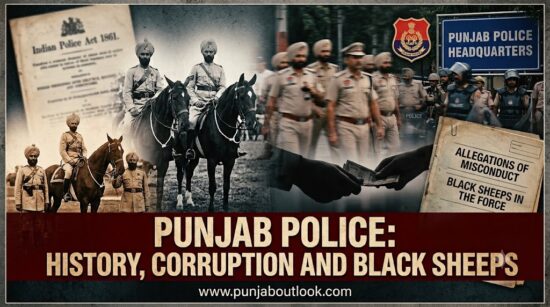
Punjab Police traces its origins to the British colonial era. It was formally organized under the Indian Police Act of 1861, following the Revolt of 1857, as part of efforts to establish a structured civil police force across British India. The force initially focused on maintaining law and order in the province, which included parts of present-day Haryana and Himachal Pradesh. Over time, it developed specialized units for investigation, armed police, and intelligence.
Post-Independence, Punjab Police played a pivotal role in nation-building. After Partition in 1947, the force dealt with massive refugee movements and communal tensions. In the following decades, it expanded with the creation of the Punjab Armed Police and modernization of training. The 1980s and 1990s insurgency period tested the force severely, with heavy casualties among officers while combating militancy. The successful counter-insurgency operations of the 1990s restored normalcy but left a legacy of both valor and controversies regarding human rights.
In the 21st century, Punjab Police has focused on modernization and specialized challenges. It has grown into a large force with thousands of officers and personnel across districts, central jails, and specialized wings (Intelligence, Crime, Traffic, etc.). Key priorities include combating organized crime, terrorism remnants, drug trafficking, and cybercrime. Recent leadership under DGP Gaurav Yadav has emphasized technology adoption (CCTV, digital records), community policing, and aggressive campaigns like “Yudh Nashian Virudh” against narcotics. The force has also undertaken internal reforms, including purges of “black sheep” involved in corruption.
Today, Punjab Police operates under the state government with the Director General of Police as the head. It comprises civil police, armed battalions, and specialized units. The force has been actively involved in high-profile operations against drug smugglers, gangsters, and internal misconduct. Challenges remain, including manpower shortages in some areas, public trust issues linked to past events, and the ongoing battle against the drug menace that has shaped much of its recent narrative. The department continues to evolve with training reforms, welfare measures, and integration of technology for better service delivery.
Police corruption remains a significant challenge in India, though official statistics show mixed trends. The Transparency International Corruption Perceptions Index (CPI) 2025 ranks India 91st out of 182 countries with a score of 39/100 — a slight improvement of one point from the previous year — but the score has hovered in a narrow range for over a decade, indicating stagnant public perception of public-sector corruption, including within police forces.
National Crime Records Bureau (NCRB) data on cases under the Prevention of Corruption Act (primarily handled by state Anti-Corruption Bureaus) reveals a modest decline. In 2023, 4,069 cases were registered, down 1.7% from 4,139 in 2022. About 71% were “trap” cases where officials were caught taking bribes, and 14% involved criminal misconduct. Police arrested 4,759 people in these cases, with 976 convictions secured from chargesheets and departmental action taken against 638 others. Maharashtra led with 812 cases, followed by Karnataka, Rajasthan, and Tamil Nadu; Punjab recorded between 200 and 287 cases.
In Punjab, police corruption often surfaces in the context of the drug trade. The state police department has pursued visible “zero-tolerance” actions against “black sheep,” including the dismissal of 52 personnel (from constables to inspectors) in a single week in February 2025 for corruption, malpractice, and related issues. Regular cases involve officers demanding bribes in investigations or allegedly facilitating smuggling networks, as highlighted by incidents like the Hoshiarpur jail scandal. These actions suggest both prevalence and proactive internal cleansing efforts.
Police-specific data is not always disaggregated in NCRB reports, as corruption cases cover public servants broadly. However, frontline police roles involving discretion in arrests, investigations, and daily public interactions make them frequent subjects of bribery and extortion complaints. Low conviction rates relative to registered cases point to evidentiary hurdles, delays, and possible influence. Perceptions surveys consistently rank police corruption as a notable public concern.Causes include low pay in lower ranks, high workload, political interference, weak oversight, and opportunities arising from high-stakes crimes like drug trafficking. Impacts are severe: eroded public trust, compromised law enforcement (especially anti-drug drives), perpetuation of crime cycles, and human rights issues such as biased or abusive policing.Efforts like trap operations, mass dismissals in Punjab, technology adoption (CCTV, digital records), and training show intent to curb the problem. Sustained progress requires systemic reforms — better remuneration, independent accountability mechanisms, faster prosecutions, and stronger whistleblower protections. While registered cases have dipped slightly, persistent perceptions and high-profile incidents underscore that police corruption continues to undermine effective governance and public safety.
Punjab Police has undertaken visible and large-scale dismissals of personnel accused of corruption and misconduct, particularly in recent years amid the state’s aggressive anti-drug campaign. A prominent example occurred in February 2025 when Director General of Police (DGP) Gaurav Yadav announced that 52 police officials across various districts were dismissed from service over the preceding 7–10 days. This action followed explicit directions from Chief Minister Bhagwant Singh Mann emphasizing transparency, accountability, and integrity in public service.
The 52 dismissed personnel spanned multiple ranks, reflecting issues at both supervisory and grassroots levels. The breakdown included 1 Inspector, 5 Assistant Sub-Inspectors (ASIs), 4 Head-Constables, and 42 Constables (the largest group, comprising about 81% of the total). Reasons cited were corruption, malpractice, criminal activities, prolonged absenteeism, and involvement in cases where FIRs had been registered against them. District-level police chiefs identified these individuals through a focused internal exercise, leading to swift departmental action under relevant rules (including Article 311 provisions for major penalties in certain cases).
These dismissals form part of a broader “zero-tolerance” policy against “black sheep” in the force, especially those linked to drug networks or extortion. Punjab Police statements and actions frequently highlight efforts to purge elements facilitating smuggling or misusing authority, aligning with the state’s “Yudh Nashian Virudh” (War Against Drugs) initiative. Similar purges have occurred periodically, though the February 2025 batch stands out for its scale and speed in a short window. DGP Yadav reinforced the message that corrupt elements, regardless of rank, would face strict action.
Complementary data from the Punjab Vigilance Bureau (VB) provides wider context on corruption enforcement. Between March 2022 and May 2026, the VB registered 1,055 corruption cases and arrested 1,111 accused statewide. In 2025 alone, trap operations led to 144 officials (including 43 from Punjab Police) and 43 private persons being caught accepting bribes, with 113 criminal cases registered. Earlier, in 2024, 173 persons were apprehended in bribery cases. Police personnel consistently appear among those nabbed, underscoring their frontline exposure to opportunities for graft.
Analysis of these details reveals both the scale of the challenge and the administration’s proactive response. The heavy concentration of dismissals at the constable level points to vulnerabilities in day-to-day policing, where discretion in interactions with the public, investigations, and anti-drug operations is high. Lower ranks may face pressures from political influences, low pay relative to risks, or direct involvement in illicit networks. The inclusion of higher ranks (inspectors and ASIs) indicates problems are not limited to the bottom tier. Swift, mass actions serve as a strong deterrent and signal of leadership intent, potentially boosting morale among honest officers while aiming to restore public trust eroded by incidents like internal drug facilitation in jails.However, limitations exist in these figures. Departmental dismissals are administrative measures and do not always equate to criminal convictions, which require court processes through the VB, CBI, or regular courts often slower and more resource-intensive.
Some actions may also stem from absenteeism or other misconduct rather than pure financial corruption. Cumulative long-term statistics on total annual dismissals or trends are not always publicly aggregated in detail, making it harder to assess whether such purges represent a sustained decline in corruption or periodic crackdowns. Broader NCRB data on Prevention of Corruption Act cases shows Punjab in a mid-to-high range nationally, consistent with its prominent drug-related challenges.Overall, the dismissal details illustrate Punjab Police’s efforts to address internal corruption head-on, particularly in the context of drug enforcement failures linked to “black sheep.” While these actions demonstrate accountability and reform momentum under the current leadership, sustained impact will depend on complementary measures like better training, oversight mechanisms, competitive compensation, technology for monitoring, and faster judicial outcomes for criminal cases. Continued transparency in reporting such actions and their outcomes will help evaluate long-term effectiveness in cleaning up the force.
Referance:timesofindia.indiatimes.com,punjabpolice.gov.in,thehindu.com,newindianexpress.com,transparency.org,youtube.com
Disclaimer: This article and accompanying images are for informational and illustrative purposes only. Some visuals may be AI-generated or digitally enhanced and may not depict actual events or persons. Views expressed are based on publicly available information and analysis.