
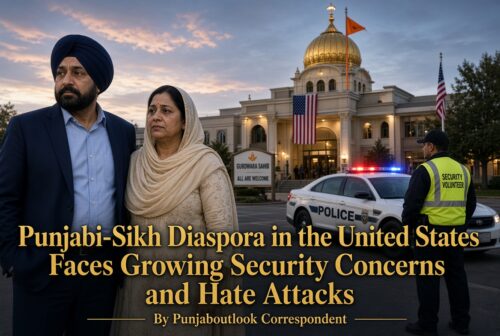
The Punjabi and Sikh diaspora in the United States has built an impressive story of hard work, entrepreneurship, farming, trucking, professional achievement and community service. From California’s Central Valley to New York and the Midwest, Punjabi and Sikh Americans have established businesses, gurdwaras, charitable institutions and political organisations while contributing significantly to American society.
Yet the community is also confronting a complicated set of challenges. These include hate crimes and discrimination, threats against visible Sikh Americans, transnational intimidation, extortion, organised crime connected to some India-based criminal networks, political polarisation, and concerns that the actions of a relatively small number of individuals can unfairly damage the reputation of an overwhelmingly law-abiding community. The distinction is important. A criminal is responsible for his or her own conduct; an entire ethnic or religious community should never be blamed for it. At the same time, community leaders cannot ignore criminality simply because it is uncomfortable to discuss.
Hate and Violence Remain a Serious Concern
Federal hate-crime data show that anti-Sikh incidents remain a significant concern. The FBI recorded 214 anti-Sikh hate-crime incidents in 2021, according to analysis published by the Sikh Coalition. The FBI’s later statistics recorded 181 anti-Sikh incidents in 2022 and 156 in 2023. For 2024, the reported figure was 153 anti-Sikh victimisations, with Sikhs remaining among the most-targeted religious communities in the country. These figures also have limitations because hate-crime reporting varies considerably among law-enforcement agencies. For Sikh Americans, the turban and uncut hair can make them particularly visible targets for people acting out of ignorance, racism or religious prejudice.
The Other Side of the Security Problem
There is another security concern that deserves equally serious attention: criminal organisations that operate across borders and sometimes exploit Punjabi and wider Indian diaspora communities.
In May 2024, the FBI’s Sacramento office publicly warned of an extortion scheme targeting people with family or business connections to India. The FBI said victims were threatened with violence or death and that some people who ignored demands subsequently experienced shootings at their homes or vehicles.
In July 2026, U.S. authorities announced a major international crackdown involving India-based organized-crime groups. Federal prosecutors alleged that networks associated with Lawrence Bishnoi and Jaggu Bhagwanpuria were involved in extortion, shootings, targeted killings, drug trafficking and other crimes affecting diaspora communities. The allegations are contained in federal indictments and remain matters for the courts.Such cases create a difficult challenge for Punjabi and Sikh community organizations: how to protect the community from criminals while ensuring that the criminal behavior of a few is never used to stigmatize millions of peaceful people.
A Five-Year Timeline of Major Concerns
2021 — Indianapolis FedEx tragedy:
On April 15, 2021, eight people were killed at a FedEx facility in Indianapolis, including four Sikh workers. The Sikh Coalition pressed authorities to examine whether anti-Sikh bias played a role.
2021 — Anti-Sikh hate reaches a disturbing level:
FBI data for 2021 recorded 214 anti-Sikh hate-crime incidents, a substantial increase over the previous year. The Sikh Coalition cautioned that reporting limitations meant the actual picture could be incomplete.
2022 — Sikh taxi driver attacked in New York:
On January 3, a Sikh taxi driver at JFK Airport was assaulted. Police treated the case as a hate crime after the attacker reportedly used anti-Sikh and xenophobic language.
2022 — Violent threats against Sikh advocates:
A Texas man later prosecuted federally was accused of leaving threatening messages against employees of a Sikh civil-rights organization in September 2022. The threats included threats to injure or kill them.
2023 — Growing concerns about transnational threats:
The U.S. Justice Department disclosed an alleged plot to assassinate a U.S.-based Sikh separatist leader in New York. Prosecutors alleged that an Indian government employee directed the plot through an intermediary. The Indian government has denied involvement in such allegations.
2023 — Sikh teenager attacked in New York:
In October, a 19-year-old Sikh man was assaulted on an MTA bus, with his turban reportedly specifically targeted and xenophobic language used. The incident was investigated as a possible hate crime.
2024 — California shooting targeting Sikh activist:
On August 11, 2024, Satinder Pal Singh Raju, a Sikh activist associated with the Khalistan movement, was targeted in a drive-by shooting on Interstate 505 in Northern California. The FBI and California Highway Patrol investigated the incident. No connection to other cases was established publicly at the time.
2024 — FBI warns Indian-American community about extortion:
The Sacramento FBI warned that people with family or business ties to India were being targeted by extortionists, including threats of shootings and physical violence.
2024 — Threat concerns around Yuba City Sikh parade:
The FBI warned of potential violence involving rival gangs around the Yuba City Sikh Parade. Importantly, the FBI said the threats were unverified, demonstrating the need to distinguish warnings from confirmed attacks.
2025 — Hate and backlash following Florida truck crash:
After the August 2025 Florida truck crash involving India-born Sikh driver Harjinder Singh, Sikh truckers reported increased harassment and hostile rhetoric. Community leaders warned against blaming an entire Sikh community for the actions of one individual.
2025 — Federal hate-crime case reaches sentencing:
In June 2025, a Texas man was sentenced to 26 months in prison after pleading guilty to federal charges involving violent threats against employees of a Sikh nonprofit and others based on religion.
2026 — Organized-crime investigation expands:
In July 2026, U.S. authorities announced 24 arrests in an international operation targeting India-based criminal networks. Prosecutors alleged racketeering, extortion, targeted killings, narcotics trafficking and other crimes.The FBI subsequently added Satinderjeet Singh, also known as Goldy Brar, to its Ten Most Wanted Fugitives list in connection with allegations including racketeering, targeted killings, extortion and narcotics offenses. These remain allegations contained in federal proceedings.
The Community’s Reputation Must Be Protected
The Punjabi-Sikh community therefore faces two security fronts.One is external discrimination hate, racism, religious profiling and attacks against people because they wear a turban or visibly practice Sikhism.The second is criminal exploitation from within or around the broader diaspora extortion, organized crime, drug trafficking and violent disputes involving particular individuals or criminal networks.The answer cannot be collective blame.The answer is stronger law enforcement, better cooperation between gurdwaras and police, confidential reporting mechanisms, youth education, responsible social-media use and zero tolerance for criminals who attempt to hide behind ethnic, religious or political identities.Community organizations should also make it clear that Sikh identity is not a shield for criminality and political disagreement is not a justification for violence.
A Community at a Crossroads
The American Punjabi-Sikh community has much to be proud of. Farmers, truckers, entrepreneurs, doctors, engineers, teachers, lawyers, elected officials, students and volunteers have helped build the community’s reputation over generations.That reputation should not be allowed to be damaged either by hate crimes directed against Sikhs or by criminal elements exploiting the community’s networks.
The message should be equally clear in both directions:
No Sikh should be attacked because of his turban, faith or identity — and no criminal should be allowed to invoke Sikh or Punjabi identity to excuse violence, extortion or organized crime.The future of the diaspora depends not only on economic success but also on public trust, community responsibility, accountability and the ability to stand together against both discrimination and criminality.
Disclaimer: This article and accompanying images are for informational and illustrative purposes only. Some visuals may be AI-generated or digitally enhanced and may not depict actual events or persons.Views expressed are based on publicly available information and analysis