
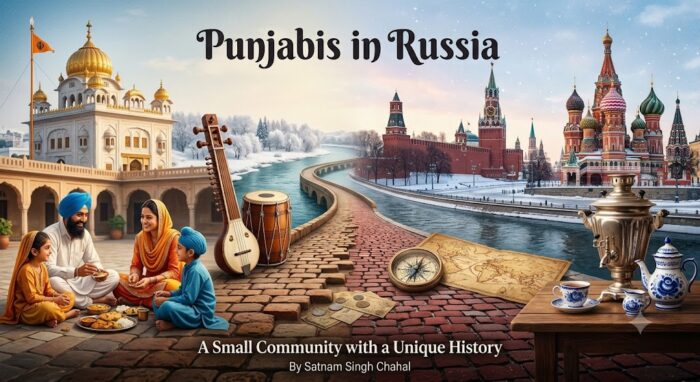
 Russia is not among the countries usually associated with large Punjabi immigrant communities, such as Canada, the United Kingdom, the United States, or Australia. Nevertheless, a small but significant Punjabi presence exists in Russia, particularly in major cities such as Moscow and Saint Petersburg. Over the years, Punjabi students, businesspeople, professionals, and members of the Sikh community have helped strengthen cultural and economic ties between India and Russia.
The relationship between Punjabis and Russia dates back several decades. During the Soviet era, educational and cultural exchange programs between India and the Soviet Union brought Indian students, including many from Punjab, to Russian universities. These exchanges helped establish the first modern Punjabi connections with Russia. After the collapse of the Soviet Union in 1991, opportunities for trade, education, and business encouraged a new wave of Indian migrants to explore Russia as a destination.
Today, the Punjabi population in Russia remains relatively small compared to other countries. A significant portion of the Sikh population consists of Punjabi-origin families and Afghan Sikhs who settled in Russia seeking better economic opportunities and security. Estimates suggest that the Sikh community numbers only a few hundred to around one thousand individuals across the country. Most are concentrated in Moscow, where community and religious activities are centered.
Religion plays an important role in maintaining Punjabi identity in Russia. Moscow is home to the Gurdwara Nanak Darbar, which serves as the primary religious and cultural center for Sikhs living in Russia. The gurdwara not only provides a place of worship but also acts as a gathering point where Punjabis celebrate Gurpurabs, Vaisakhi, and other important Sikh festivals. Through these events, younger generations remain connected to Punjabi language, culture, and traditions despite living far from their ancestral homeland.
Many Punjabis in Russia are engaged in business, trade, education, and professional services. Some operate import-export businesses involving Indian goods, while others work in information technology, medicine, engineering, and academia. Indian students pursuing medical and technical education in Russian universities also form an important part of the broader Indian community. According to estimates from India’s Ministry of External Affairs, more than sixty thousand Indians reside in Russia, although only a fraction of them are Punjabis.
The history of Punjabis in Russian territories may extend even further back than many people realize. Historical accounts and community traditions suggest that Punjabi traders travelled through Central Asia and into parts of the Russian Empire centuries ago, participating in trade networks that connected South Asia with Europe and Central Asia. Some historical references even mention Sikh traders and places of worship in the Russian city of Astrakhan, a key trading hub along old commercial routes.
Despite their small numbers, Punjabis in Russia have managed to preserve their identity while integrating into Russian society. They participate in cultural events, promote Indian traditions, and contribute to the strengthening of India-Russia relations. Their story demonstrates how Punjabi communities, regardless of size, continue to establish themselves across the globe while maintaining strong connections to their roots.
As globalization continues and educational and economic exchanges between India and Russia expand, the Punjabi presence in Russia may continue to grow. Though modest in size, the community stands as another example of the remarkable global reach of Punjab and its people, whose entrepreneurial spirit and cultural resilience have enabled them to make homes in every corner of the world.
Disclaimer: The photographic elements used in the accompanying graphic are for symbolic and illustrative purposes only. The individuals depicted do not imply actual endorsement, involvement, or association with substance