
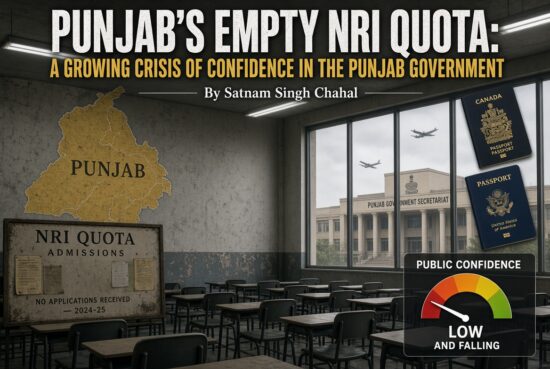
 The shortage of eligible candidates for NRI quota seats in Punjab’s medical and dental colleges is not merely an admission problem—it should be treated as a serious warning signal about the confidence of the Punjabi diaspora in the state. The latest merit list released by Baba Farid University of Health Sciences (BFUHS) reportedly has only 63 candidates competing for 431 NRI quota seats across Punjab’s 28 medical and dental colleges. When more than 85 per cent of a quota created specifically for NRIs remains without eligible applicants, the government must ask a difficult question: Why are NRIs increasingly reluctant to invest their money, trust and future in Punjab?
The numbers are striking. Of the 431 seats, 214 MBBS seats are spread across 12 medical colleges, while 217 BDS seats are available across 16 dental colleges. Against these 431 seats, only 63 candidates have appeared on the merit list. In simple terms, Punjab has roughly seven NRI seats for every eligible candidate. This is not a minor shortage that can be dismissed as a temporary admission fluctuation. It deserves a serious examination of the factors driving away potential NRI students.
The financial stakes are enormous. NRI quota seats have traditionally been one of the most important revenue streams for private medical and dental colleges. An NRI student reportedly pays approximately US$110,000 for an MBBS seat and US$44,000 for a BDS seat, substantially higher than fees under government or management quotas. With hundreds of seats potentially remaining vacant, private institutions could face a major revenue shock. The government may eventually lower eligibility thresholds, conduct additional counselling rounds or convert unfilled seats into other categories—but none of these measures addresses the fundamental question of why the NRI pool has become so shallow.
For years, Punjab has depended heavily on its diaspora. NRIs have built houses, invested in property, established businesses, supported educational institutions, funded religious and charitable projects and sent billions of dollars back to their families. The Punjabi diaspora has remained one of Punjab’s greatest economic and social assets. Yet confidence cannot be demanded through speeches or emotional appeals. Confidence is earned through good governance, transparency, security, predictable policies and respect for investors and citizens living abroad.
The present NRI quota situation should therefore be viewed as a confidence indicator. If Punjabi families living in North America, Europe, Australia and elsewhere are prepared to spend enormous sums on their children’s education, but increasingly hesitate to send those children to Punjab, policymakers should not simply blame students, changing immigration patterns or overseas opportunities. The government must examine whether Punjab itself has become less attractive in the eyes of the diaspora.
There is also a wider psychological factor. Parents living abroad make educational decisions not only on the basis of fees. They consider security, quality of education, transparency in admissions, infrastructure, career prospects, administrative efficiency and the overall environment in which their children will study. An NRI parent spending more than US$100,000 on an MBBS education expects a system that provides confidence from admission to graduation. Any perception of uncertainty can quickly push families toward alternatives elsewhere in India or abroad.
This is where the Punjab Government needs to look beyond the immediate admission figures. A government cannot simultaneously claim that Punjab is welcoming investment from the diaspora while ignoring warning signs that the diaspora is becoming reluctant to invest in Punjab. If the NRI quota is empty, the empty seats should not merely be converted into general seats and the issue forgotten. The empty seats should become the starting point of an investigation into the declining confidence of NRIs.
The problem also raises questions about the government’s broader NRI engagement policy. Punjab has a huge global Punjabi population, but diaspora relations cannot be reduced to NRI meetings, conferences, delegations and ceremonial events. The diaspora wants functioning institutions, quick resolution of property disputes, protection from fraud, transparent recruitment and admissions, efficient policing and predictable government policies. An NRI should feel that Punjab is a safe place to invest, study and return—not a place where every transaction requires extraordinary caution.
The government should therefore conduct a comprehensive NRI Confidence Survey covering education, property, business, policing, investment, immigration-related services and public administration. It should also invite representatives of Punjabi diaspora organisations to independently examine why NRI participation in professional education has fallen so sharply.
The immediate response should not be another round of cosmetic counselling. Punjab needs a NRI Confidence Restoration Mission. The government should establish a transparent mechanism for recording NRI grievances, publish disposal timelines, strengthen protection against property fraud, improve police response to NRI complaints and create predictable policies for diaspora investment and education.
The medical and dental colleges also have a role to play. If the cost of education is extremely high, students and parents will naturally compare Punjab with institutions elsewhere. Colleges must demonstrate that the education, clinical exposure, infrastructure and career opportunities justify the premium being charged. A high NRI fee without a corresponding perception of value will inevitably weaken demand.
Most importantly, the Punjab Government should resist the temptation to treat the figures as merely an administrative inconvenience. 431 seats and only 63 candidates is a statistic—but behind that statistic lies a question of trust. If the diaspora is losing confidence, the consequences can extend far beyond medical colleges. Today it may be empty NRI medical seats; tomorrow it could be declining property investment, fewer business ventures and reduced willingness among overseas Punjabis to participate in Punjab’s development.
Punjab cannot afford to lose the confidence of the people who have historically remained among its strongest supporters from thousands of miles away. The Punjabi diaspora has money, skills, networks and a deep emotional connection with its homeland. But emotional attachment has limits when governance becomes unpredictable.
The empty NRI quota should therefore be treated as Punjab’s warning bell. Instead of asking how to fill the vacant seats, the government should first ask why the seats are empty. Instead of blaming the candidates, it should examine the system. And instead of celebrating diaspora engagement on stages, it should rebuild confidence on the ground.
Because an empty NRI quota is not just an empty classroom seat—it may be an empty vote of confidence in Punjab.
Disclaimer: This article and accompanying images are for informational and illustrative purposes only. Some visuals may be AI-generated or digitally enhanced and may not depict actual events or persons.Views expressed are based on publicly available information and analysis