
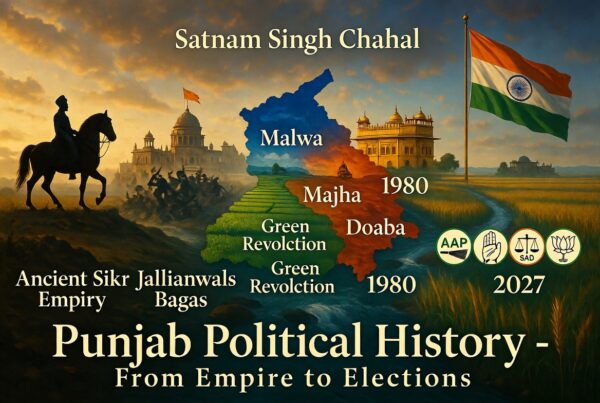
 Punjab’s political history is a rich tapestry of empires, religious reform, agrarian movements, identity struggles, and modern electoral battles. From the ancient Indus Valley roots and the rise of Sikhism in the 15th century to the powerful Sikh Empire under Maharaja Ranjit Singh (1799–1839), the region has long been a cradle of political innovation and resistance. The British annexed Punjab in 1849 after the Anglo-Sikh Wars, turning it into a key province that played a vital role in India’s freedom struggle, including the Jallianwala Bagh Massacre in 1919.
Post-Independence and Reorganization (1947–1966):
The 1947 Partition was traumatic for Punjab, dividing the province along religious lines with massive violence, displacement, and loss of life. East Punjab became part of India, initially including areas that later formed Haryana and Himachal Pradesh. The Shiromani Akali Dal (SAD), founded in 1920 as a Sikh political and religious organization, led the Punjabi Suba movement demanding a Punjabi-speaking state. This culminated in the 1966 linguistic reorganization, creating the present-day Punjab, Haryana, and transferring areas to Himachal Pradesh, with Chandigarh as a shared capital.
Congress Dominance and Akali Rise (1960s–1970s):
In the newly formed Punjab, Congress initially held sway, but Akali Dal emerged as a strong regional force representing Sikh and rural interests. Akalis formed coalition governments in 1967 and 1969 but faced instability. The 1970s saw Parkash Singh Badal rise as a key leader. The Green Revolution transformed Punjab into India’s breadbasket, boosting its economy but also creating new social tensions around land, water, and caste.
The Turbulent 1980s–1990s: Militancy and Crisis:
This period marked one of Punjab’s darkest chapters. Demands for greater autonomy (Anandpur Sahib Resolution), economic grievances, and perceived central interference fueled the rise of militancy and the Khalistan movement. The storming of the Golden Temple in Operation Blue Star (1984), followed by the assassination of Prime Minister Indira Gandhi and anti-Sikh riots in Delhi, escalated violence. Thousands died in insurgency and counter-insurgency operations through the early 1990s. Normalcy gradually returned by the mid-1990s under leaders like Beant Singh (Congress), though the scars remain deep.
Post-Militancy Recovery and Coalition Era (1990s–2010s):
After peace was restored, Punjab saw alternating governments between Congress and SAD-BJP alliances. Parkash Singh Badal led stable Akali-BJP coalition governments in 1997, 2007, and 2012, focusing on development, infrastructure, and moderation. The party shifted emphasis from pure Panthic (Sikh identity) issues to broader “Punjabiyat” and inclusive politics. Congress returned to power in 2002 and 2017 (under Captain Amarinder Singh). Issues like farmer distress, drugs, unemployment, and sacrilege incidents continued to shape voter sentiments.
The AAP Era and Recent Shifts (2022 Onwards):
The 2022 Assembly elections marked a seismic change with the Aam Aadmi Party’s landslide victory (92 seats), ending the traditional Congress-Akali bipolarity. AAP capitalized on anti-incumbency, promises of welfare, and governance reforms. As of mid-2026, AAP under Chief Minister Bhagwant Mann remains in power, bolstered by recent civic polls, while Congress, SAD, and BJP reposition themselves for the 2027 elections. SAD has faced decline post its BJP alliance breakup over farm laws, and BJP is trying to expand beyond urban Hindu bases.
Key Themes Throughout History:
Punjab politics has always revolved around identity (Sikh Panthic vs. composite Punjabi), agrarian economy, caste/community dynamics (Jat Sikhs, Dalits, Hindus), and centre-state relations. Regional variations — Malwa, Majha, and Doaba — influence outcomes significantly. From empire-building and anti-colonial resistance to militancy and welfare-driven democracy, Punjab’s journey reflects resilience amid challenges.