
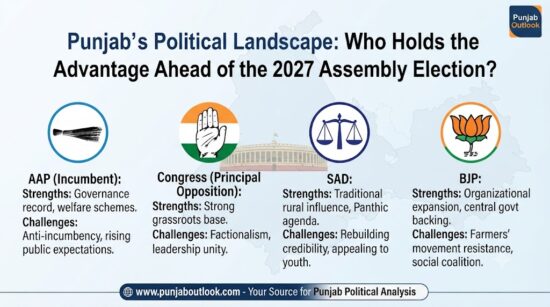
 Punjab’s political landscape is entering a crucial phase as every major party attempts to strengthen its position ahead of the 2027 Assembly election. Although nearly a year remains before the campaign reaches full momentum, the strategies adopted today will significantly influence the final outcome. At present, no political party can claim to have an undisputed advantage, as each faces its own opportunities and challenges.
The ruling Aam Aadmi Party (AAP) continues to benefit from being in government, giving it administrative control and the ability to implement welfare programmes and development projects. However, every government also faces anti-incumbency. Rising public expectations regarding employment, agriculture, law and order, drug trafficking, industrial growth, and fiscal management mean that the government’s performance will be under close scrutiny. If the electorate feels that promises have not translated into visible improvements, AAP could face a tougher contest than it did in 2022.
For the Congress, the biggest challenge is organisational unity rather than public acceptance. The party remains one of Punjab’s strongest political forces and retains a sizeable vote base across rural and urban constituencies. However, the continuation of factionalism—particularly between supporters of Amarinder Singh Raja Warring and former Chief Minister Charanjit Singh Channi—could undermine its electoral prospects. Unless the leadership succeeds in bringing all influential leaders onto one platform, Congress risks losing valuable organisational strength at the grassroots level. A united Congress could emerge as the principal challenger to AAP, but a divided Congress would benefit its opponents more than itself.
The Shiromani Akali Dal (SAD) faces perhaps the most difficult rebuilding process in its history. Once the dominant regional force in Punjab politics, the party has struggled to recover from electoral setbacks and the erosion of its traditional support base. The Akali Dal continues to enjoy influence in sections of rural Punjab and among loyal supporters, but it must convince younger voters that it offers a fresh vision rather than relying solely on its historical legacy. Rebuilding credibility, expanding leadership, and reconnecting with grassroots workers will be essential if it hopes to regain political relevance.
The Bharatiya Janata Party (BJP) has steadily expanded its organisational presence in Punjab, but converting organisational growth into electoral victories remains a significant challenge. The party continues to face resistance in many rural constituencies, particularly after the farmers’ movement, although it may strengthen its position in selected urban areas. Whether the BJP can broaden its social coalition beyond its traditional urban support will largely determine its future electoral performance.
Several regional leaders and smaller political formations could also influence the election by affecting vote shares in closely contested constituencies. In Punjab’s first-past-the-post electoral system, even relatively small shifts in vote percentage can determine who wins individual seats. Therefore, alliances, candidate selection, and local leadership may prove just as important as statewide political narratives.
Another major factor will be the youth vote. Employment opportunities, education, migration, entrepreneurship, drug abuse, and economic development remain among the issues most frequently raised by younger Punjabis. Political parties that present practical, credible solutions rather than relying solely on political rhetoric are likely to gain an advantage among first-time and younger voters.
Punjab’s electorate has repeatedly demonstrated that it is willing to bring about major political change when dissatisfied. The victories of different parties over successive elections illustrate that voters are prepared to reward performance and punish perceived failures. Consequently, no party can assume that past electoral success guarantees future victories.
As Punjab moves closer to the 2027 election, the political contest is likely to become increasingly competitive. AAP must defend its governance record, Congress must resolve its internal divisions, the Shiromani Akali Dal must rebuild public confidence, and the BJP must expand its appeal beyond its existing support base.
Ultimately, the election may not be decided solely by campaign slogans or political personalities. It will depend on which party can demonstrate organisational unity, credible leadership, effective candidates, and convincing solutions to Punjab’s pressing economic and social challenges. The coming months will reveal whether any party can establish a decisive advantage—or whether Punjab is headed for another closely fought and unpredictable election.
Disclaimer: This article and accompanying images are for informational and illustrative purposes only. Some visuals may be AI-generated or digitally enhanced and may not depict actual events or persons.Views expressed are based on publicly available information and analysis.