
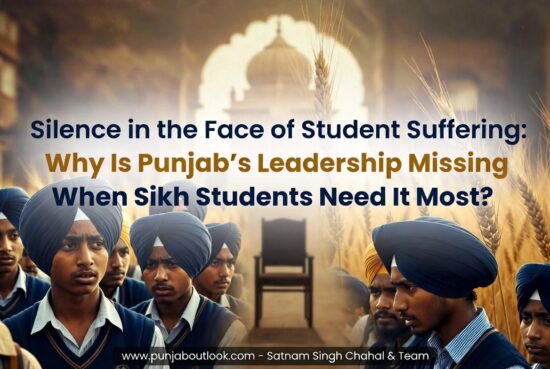
 Punjab has always taken pride in being the land of sacrifice, education, and fearless voices. From the Gurdwara Reform Movement to student-led struggles for justice, Sikh youth have repeatedly stood at the forefront of defending democratic values and community rights. Yet, when Sikh students at Panjab University have alleged intimidation, police action, detentions, and disciplinary proceedings over peaceful protests, many in Punjab’s political leadership have appeared far less vocal than expected. The question being asked by many is simple: Why does Punjab’s leadership speak loudly on national issues but remain comparatively restrained when Sikh students in one of the state’s most historic institutions raise concerns about their rights?
The recent controversy surrounding a seminar on Sikh history and the subsequent protests highlighted deep divisions on campus. Student groups claimed the event promoted a particular ideological perspective and organized demonstrations. Reports indicate that some students faced detention, police intervention, and disciplinary action following the protests. Regardless of one’s views on the protest itself, the principles at stake are significant. Universities should remain places where ideas can be debated openly, and peaceful disagreement should be addressed through dialogue rather than confrontation. If students believe their identity or history has been misrepresented, their concerns deserve to be heard through transparent institutional processes.
Punjab’s political parties frequently describe themselves as defenders of Punjab’s rights, Punjabi identity, and Sikh interests. However, critics argue that these commitments should also extend to protecting students’ democratic rights when controversies arise on university campuses. Public concern grows whenever there is a perception that political calculations outweigh principled engagement. Panjab University has historically been more than an educational institution. It has symbolised Punjab’s intellectual heritage, and debates over its governance and autonomy have repeatedly sparked widespread public discussion. Previous student movements over university autonomy and representation demonstrated how strongly many people across Punjab feel about the institution’s future.
Many observers believe that Punjab’s elected representatives, regardless of party affiliation, should have taken a more visible role in ensuring that dialogue replaced confrontation. This does not necessarily mean endorsing every slogan or protest tactic. It means defending constitutional values such as freedom of expression, due process, and the right to peaceful assembly.The silence has also created political questions. If leaders are willing to issue statements on incidents occurring outside Punjab, why should controversies involving Sikh students within Punjab’s own premier university receive less public attention? Such perceptions risk weakening public confidence in political leadership.
This issue goes beyond one protest or one university event. It touches on the broader responsibility of governments and political leaders to ensure that educational institutions remain spaces where students can express concerns peacefully without fear of disproportionate consequences. At the same time, all stakeholders—including students and university authorities—share responsibility for maintaining peace, respecting the law, and resolving disputes through constructive engagement.Punjab’s future depends on its youth. Their concerns should neither be ignored nor politicized. Whether one agrees with the students’ demands or not, their voices deserve to be heard with fairness, transparency, and respect.A confident democracy does not fear questions from its students. It answers them
Disclaimer: This article and accompanying images are for informational and illustrative purposes only. Some visuals may be AI-generated or digitally enhanced and may not depict actual events or persons.Views expressed are based on publicly available information and analysis.