
 “Almost all government policy is wrong, but frightfully well carried out.”— Sir Humphrey Appleby, “The Whisky Priest,” Yes, Minister
The Special Intensive Revision of electoral rolls is, in its statutory conception, unimpeachable. I have said so in this column repeatedly, and I say it again here: cleaning electoral rolls of the dead, the duplicated, and the departed is not an assault on democracy — it is a precondition of it. But statutory soundness at the top of a policy does not guarantee soundness in its execution at the bottom, and it is time to name what is happening at the bottom plainly. SIR is being executed with genuine bureaucratic efficiency. It is also, in its present algorithmic design, producing senseless impairment of the electoral roll — flagging citizens who have never left their constituency, never changed their name, and never done anything except exist in a country where record-keeping in 2002 was approximate by nature.
The numbers behind the pun
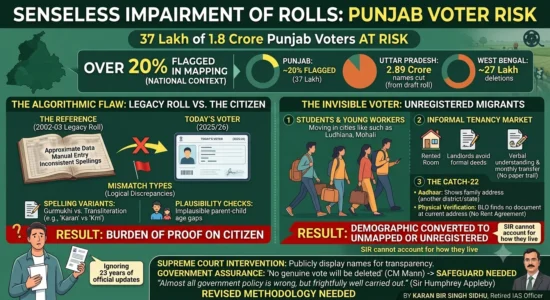
Punjab’s own pre-SIR mapping exercise has flagged what officials call “logical discrepancies” in roughly one voter in five — over 37 lakh of 1.8 crore mapped electors, with several constituencies crossing 40 percent. West Bengal’s SIR produced roughly 27 lakh deletions; Uttar Pradesh’s draft roll cut 2.89 crore names on grounds including “not traceable,” “shifted,” and “duplicate.” These are not clerical footnotes. They are a meaningful fraction of the electorate being placed under a presumption of doubt.
What is producing this scale of flagging is not fraud detection. It is an algorithm comparing 2025 entries against a 2002–2003 “legacy” roll and treating any mismatch — a transliterated spelling, a parent-child age gap the software considers implausibly narrow, a grandparent-grandchild gap it considers implausibly close — as a “logical discrepancy” requiring the citizen to come forward and prove continuity. None of these flags bears on the three conditions Section 19 of the Representation of the People Act actually requires: citizenship, age, and ordinary residence. A voter whose father’s name was rendered differently in Gurmukhi transliteration eighteen years ago has not thereby become less of a citizen, less resident, or less eighteen. The algorithm cannot tell the difference between fraud and forgetfulness, so it flags both, and the burden falls on the citizen to sort out which one applies to him.
An old inaccuracy laundered into a new disqualification
Punjab’s own 2002–03 rolls were assembled under the same uneven conditions as every legacy roll in the country: manual entry, inconsistent transliteration across Punjabi, Hindi, and English, approximated ages where birth certificates did not exist. Nobody treated that roll as infallible in 2003. Yet in 2026, that same approximate document has been elevated into the reference point against which every citizen’s current registration is algorithmically judged, while ignoring the subsequent corrections and updating that has been carried out by the ECI’s own machinery in accordance with the law and its prescribed procedures in the years since. An error absorbed into the system twenty-three years ago has been reissued as evidence of discontinuity today. This is not cleaning the roll. This is laundering an old inaccuracy into a new disqualification.
The execution machinery itself — Booth Level Officers trained to a checklist, District Election Officers under pressure to close mapping numbers, a technology stack that flags first and explains later — is working with real diligence. Punjab has already taken disciplinary action against fifty BLOs and six supervisors for lapses. That is not an idle bureaucracy; it is one executing its brief seriously. The trouble is that the brief itself — a legacy base year chosen for administrative convenience, treated retroactively as a gold standard it was never designed to be — builds the error into the method before a single BLO ever knocks on a door.
The voter the algorithm cannot see at all
There is a second, quieter failure sitting beneath the “logical discrepancy” problem, and it may be the more consequential one. It concerns not the voter whose old record doesn’t match, but the voter who has no usable record to offer in the first place.
Punjab’s population — like urban India generally — is mobile in ways the SIR design does not anticipate. Students move cities for college and stay in rented rooms for years. Young workers shift between Ludhiana, Mohali, Chandigarh, and beyond, chasing employment, occupying one rented flat after another. Home ownership among this cohort is the exception, not the rule. And the rented accommodation they occupy typically comes with no formal tenancy deed at all — landlords, wary of tenancy law and the modest but real protections it extends to long-staying tenants, simply decline to register one. A verbal understanding and a monthly transfer is the entire paper trail.
This leaves a large and growing category of citizens with no worthwhile proof of address for the place they actually, ordinarily reside in. Their Aadhaar card — if it has been updated at all — usually still carries a family address in another district or another state, because updating it requires exactly the kind of landlord cooperation that is unavailable. A Booth Level Officer conducting physical verification at the address a tenant currently occupies will therefore find a name that matches nothing: not the current Aadhaar, not any rent agreement, not any prior electoral entry at that address. The SIR’s own data architecture has no field for “genuinely resident, but undocumented by design of the rental market.” Such a person is not migrated, not deceased, not duplicated — the three categories the exercise is built to catch — but is nonetheless invisible to it in both directions. He cannot be verified at his current address for want of a document the market will not give him, and he is not present at his family’s address because he does not live there.
This is not a fringe case. It is the modal condition of an entire generation of student and worker migrants in urban Punjab, and the SIR’s reliance on documentary proof of residence — precisely the proof that informal tenancy makes structurally unavailable — risks converting an entire demographic into either the unmapped or the silently unregistered, through no fault, forgetfulness, or fraud of their own. A revision exercise that cannot account for how a large share of the young, mobile, working population actually lives is not testing residence. It is testing paperwork that the rental economy was never designed to produce.
What redeems the exercise — and what does not
The Supreme Court’s intervention in January, directing the Commission to publicly display the names of voters facing deletion over logical discrepancies, was a necessary transparency correction — one the design should have carried from the outset rather than needing a judicial nudge to supply. Chief Minister Bhagwant Mann’s public assurance that no genuine vote will be permitted to be deleted is the right political instinct, but an assurance is not a safeguard; the safeguard is whatever changes are actually made to how the algorithm classifies a discrepancy before the citizen is made to prove himself against it.
None of this is an argument against SIR. It is an argument that the Election Commission owes the country a plain answer to a plain question: why has a legacy roll, known at the time of its own creation to be imprecise, been converted into the fixed benchmark against which today’s citizens are measured, with the burden of proof running the wrong way? Where disproportionate deletions cluster in the rural landscape — at a moment when the streaming ban on Satluj, the Diljit Dosanjh film revisiting Jaswant Singh Khalra and Punjab’s militancy years, has already reopened old wounds across the state — they risk feeding subterranean grievances that the Commission’s own machinery may not be positioned to foresee or measure at this time — a risk better forestalled by methodological correction now than addressed after the fact. Until the underlying question is answered — not with reassurance, but with a published, revised methodology that treats a spelling variant as a spelling variant rather than a citizenship doubt — the acronym will keep earning its unkind alternative reading.