
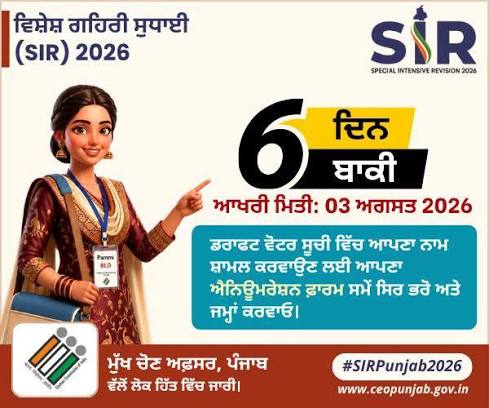
 The Special Intensive Revision (SIR) of electoral rolls was presented as an exercise to ensure that every eligible citizen remains on the voters’ list and that ineligible names are removed. The Election Commission says precisely that its objective is to ensure that “no eligible citizen is left out while no ineligible person is included.”
But a democratic exercise designed to clean electoral rolls must not itself become a source of fear, confusion or disenfranchisement.
The latest controversy has intensified after prominent public figures, including former Union minister and senior lawyer Kapil Sibal, reportedly received notices in connection with the Delhi SIR process. Reports say notices have been issued where electoral details could not be properly mapped or where discrepancies were identified.
Congress leader Vikas Bansal reacted sharply on social media, questioning what ordinary citizens could expect if even prominent citizens are asked to respond to such notices. His post alleged that genuine voters could lose their names while “fake” names might be added, and called for the SIR process to be cancelled. That is a political criticism, not an established finding.
The larger question, however, deserves serious public attention: how can India conduct a voter-roll revision without putting genuine voters at risk?
The numbers make the question particularly important. In Delhi, reports indicate that about 47.6 lakh names were removed from the draft electoral roll, with the Election Commission classifying people among categories such as absent, shifted, deceased or duplicate. The Commission has also emphasized that deletion from the draft does not by itself mean permanent loss of voting eligibility; affected voters have an opportunity to file claims and objections.
That distinction is crucial.A voter whose name disappears from a draft list should not automatically be treated as an illegal voter. Equally, a person who receives a notice should not automatically be portrayed as having failed to establish citizenship. The Supreme Court has specifically observed that a person’s citizenship under the Citizenship Act does not cease merely because that person is ineligible for registration on the electoral roll following SIR.
This is where transparency becomes indispensable.If a voter receives a notice, the notice should clearly state why it was issued, what discrepancy has been identified, what documents are required, where the voter must respond, and what appeal or correction mechanism is available. Citizens should not have to navigate an opaque administrative process simply to protect their constitutional right to vote.
The Supreme Court is scheduled to hear a petition concerning transparency in Delhi’s SIR process, including requests for disclosure of the names and reasons behind notices issued to voters. The petitioners have questioned the lack of clarity surrounding classifications such as “logical discrepancies” and “unmapped” voters.There is another important principle: the burden of correcting government records should not fall disproportionately on the weakest citizens.
Poor families, elderly people, migrants, women, people who have moved between states, and citizens whose birth or family records are incomplete may face greater difficulty producing historical documents. Reports have already highlighted concerns about documentation barriers affecting vulnerable communities in Delhi.
The Election Commission has undertaken SIR on a massive scale. In Phase III alone, more than 3.94 lakh Booth Level Officers were assigned to conduct house-to-house verification involving approximately 36.73 crore electors. Such a gigantic exercise inevitably requires strong safeguards against administrative error.The remedy, therefore, is neither blind acceptance nor blanket rejection of SIR. The remedy is accountability.
Every deleted name should have a traceable reason. Every notice should be understandable. Every genuine voter should have a simple opportunity to respond. Every objection should be decided within a fixed timeframe. Political parties should be able to audit the process. Independent observers and civil-society organizations should be able to identify patterns of wrongful exclusion.And most importantly, no genuine Indian citizen should lose the right to vote because of an avoidable paperwork or mapping error.
Electoral rolls certainly need periodic revision. Dead voters, duplicate entries and genuinely ineligible names should not remain indefinitely on electoral rolls. But cleaning the voters’ list and protecting the voter are not opposing objectives—they are supposed to be two sides of the same democratic responsibility.The real test of SIR will therefore not be how many names are removed.
The real test will be how many genuine voters remain protected, how transparently every disputed case is handled, and whether every eligible citizen can confidently walk into a polling booth and find his or her name on the list.Because in a democracy, the voter should never feel that exercising the right to vote has become an examination in which the citizen must prove his or her existence to the State
Disclaimer: This article and accompanying images are for informational and illustrative purposes only. Some visuals may be AI-generated or digitally enhanced and may not depict actual events or persons.Views expressed are based on publicly available information and analysis