
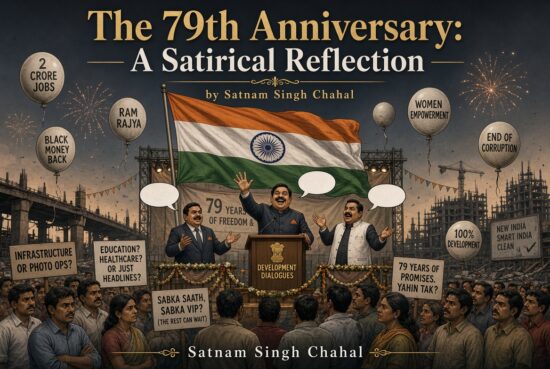
 Seventy-nine years of independence—what a magnificent achievement! Seventy-nine years is a long time. A person can grow old in 79 years, governments can come and go, political parties can change their colours, promises can be recycled, slogans can be redesigned, and yet some problems remain so loyal that they refuse to leave us.
Every year on Independence Day, the nation dresses itself in patriotic colours. Flags are raised, speeches are delivered, patriotic songs are played, and leaders remind citizens how fortunate they are to live in a free country. The television screens become flooded with images of sacrifice, development, progress and national pride. For a few hours, everything looks perfect. Even the potholes seem patriotic.
But after the speeches end and the microphones are switched off, ordinary citizens return to their real Independence Day reality. Farmers are still protesting for their rights. Young people are still searching for jobs. Students are still struggling with an uncertain future. Families are still worried about inflation. Citizens demanding justice are sometimes welcomed with barricades, water cannons and tear gas—as if asking for democratic rights has suddenly become a national security threat.
The Constitution promises equality. Politics often promises something else.
We are told that every citizen is equal before the law. A beautiful principle. Unfortunately, equality sometimes appears to have different queues. The powerful seem to receive the VIP queue, the politically connected get the express lane, while ordinary citizens are politely requested to wait outside until the next election.
Elections, of course, are the great festival of democracy. Every five years, politicians rediscover the people. Suddenly the voter becomes the most important person in the country. Roads are inspected, villages are visited, folded hands appear everywhere, and promises arrive faster than monsoon clouds.Then the election is over.The voter goes back to being a voter.The politician goes back to being a politician.And the promises go into a carefully maintained political museum, where they remain available for display during the next election campaign.
Punjab has perfected this comedy of promises. Governments arrive with grand announcements, foundation stones, ambitious schemes and impressive timelines. Sometimes the foundation stone survives longer than the project. Sometimes even the foundation stone disappears, leaving citizens wondering whether they attended an inauguration or a magic show.The speeches always mention development. Development, however, seems to have developed a habit of arriving late.Jobs are another favourite subject. Every government promises employment. Every political party promises opportunities. Every election manifesto promises a brighter future for young people. Yet thousands of educated youngsters continue to look beyond Punjab and even beyond India for opportunities.
Perhaps the greatest irony is that Punjab produces talent at one end and exports it at the other.The state educates its young people, trains them, watches them struggle for employment—and then watches them leave. The world gets Punjab’s doctors, engineers, students, entrepreneurs and skilled workers. Punjab gets their memories and, sometimes, their remittances.And then we celebrate ourselves as a developed society.What a wonderfully efficient system.Our democracy also has an interesting relationship with dissent. Governments love peaceful citizens—as long as those citizens are peacefully agreeing with them. The moment citizens begin asking uncomfortable questions, the definition of “peaceful” sometimes becomes remarkably flexible.
Disclaimer: This article and accompanying images are for informational and illustrative purposes only. Some visuals may be AI-generated or digitally enhanced and may not depict actual events or persons.Views expressed are based on publicly available information and analysis