
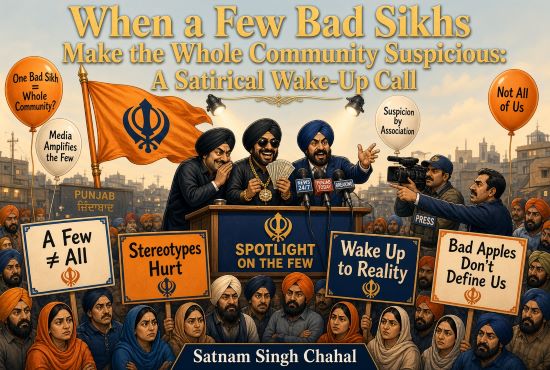
 No doubt, Sikhs have a proud history of courage, sacrifice, service and standing up for the weak. The Sikh tradition teaches that the person who is strong should protect the vulnerable, feed the hungry, help the needy and work for the welfare of all humanity. The world has seen Sikhs rushing toward disasters, serving langar, helping strangers and risking their own lives to save others. This is the Sikh image that deserves respect.
But unfortunately, a community’s reputation is not damaged only by its enemies. Sometimes, the biggest damage comes from people wearing the community’s own identity.A criminal does not become a saint merely because he has a turban. A corrupt politician does not become honest because he quotes Gurbani. A violent person does not become a defender of Sikhi because he carries a Sikh name. And wearing Sikh symbols is not a character certificate.
Here comes the uncomfortable truth: a few people who happen to be Sikh by birth, appearance or religious identity—and some who proudly present themselves in Sikh uniform—can damage the reputation of millions of innocent Sikhs. The irony is almost comic. The Sikh community tells the world, “We protect you.” A few criminals make people quietly ask, “From whom?”
That is not merely an image problem. It is a credibility problem. Imagine a Sikh entering a room where people have already seen stories of gang violence, extortion, drugs, shootings or criminal cases involving individuals identified as Sikhs. Most people will understand that an individual criminal does not represent an entire community. But human psychology does not always follow logic.One person’s crime can create a question mark over thousands of innocent faces.
“A criminal carries his own crime, but unfortunately the community sometimes carries the criminal’s reputation.”
This is where the Sikh community needs some serious self-reflection instead of immediately blaming everyone else.Whenever something negative happens, our first reaction is often: “They are targeting Sikhs.”Sometimes they may be.But sometimes, perhaps we need to ask another question:
“Are we doing enough to stop those damaging our own image?”
This is the conversation that is often avoided.Sikhs are very good at defending the community after a controversy explodes. They are very good at releasing statements, organising meetings, holding press conferences, changing profile pictures and arguing on social media.
But prevention?
That seems to be a department waiting for somebody else to open.We have enough committees to fill several parliamentary buildings, enough WhatsApp groups to crash a small country’s internet, enough social-media warriors to win twenty imaginary wars before breakfast—and yet somehow we still struggle to achieve basic unity.
“Sikhs can organise a langar for 50,000 strangers, but organising 500 Sikhs around one common political objective can become a national emergency.”
That is the bitter joke.
The Sikh community possesses enormous economic, intellectual, religious and international resources. Sikhs are successful in business, agriculture, medicine, law, technology, academia, the military and countless professions across the world. There is talent everywhere.What is missing is not talent.What is missing is coordinated power.
And politics is where this weakness becomes painfully visible.A community can be respected socially, admired culturally and celebrated for charity—but if it has no organised political influence, others will make decisions on its behalf.That is the rule of politics.Politics does not award medals for good intentions.Politics rewards organisation, numbers, discipline, leadership and sustained participation.
“Langar can feed the hungry. Charity can help the poor. But political power decides who writes the rules.”
This does not mean Sikhs should seek power to dominate anyone. Absolutely not. The Sikh political tradition, at its best, has been about justice, dignity, protection of the weak and equal rights for all.But the community needs enough political influence to protect its legitimate interests and ensure that its voice cannot simply be ignored.The first requirement, however, is unity.And there lies our biggest comedy.Sikhs can divide over almost anything.
Which party?
Which leader?
Which jathedar?
Which organisation?
Which committee?
Which gurdwara?
Which historical interpretation?
Which social-media post?
Which person gets credit for the langar?
By the time everyone has finished arguing about who deserves the credit, the actual issue has packed its suitcase and left.
“Our greatest national sport may not be hockey. It may be forming committees to oppose the committee formed by the previous committee.”
But joking aside, this fragmentation has consequences.When Sikhs fight among themselves, others gain space.When Sikh institutions fight, public confidence falls.When Sikh political leaders attack one another more fiercely than they challenge policies affecting the community, ordinary Sikhs become frustrated and disengaged.When criminal elements are defended merely because they carry a Sikh identity, the community’s moral authority suffers.There should be absolutely no double standards.If somebody commits a crime, Sikhs should be the first to condemn it.Not after checking his party.Not after checking his family.Not after checking his political connections.
Not after asking whether he belongs to “our group.”
Crime should be called crime.Corruption should be called corruption.Violence should be called violence.And a Sikh who damages the Sikh image should not receive a free pass because he happens to wear a turban.
“The turban is a symbol of responsibility, not an immunity card.”
At the same time, Sikhs must be careful not to fall into another trap: collective guilt.A criminal Sikh does not make every Sikh a criminal.A corrupt Sikh politician does not make every Sikh corrupt. A violent individual does not define an entire faith.The community must reject the criminal without surrendering its dignity.That distinction is extremely important.The answer to negative stereotyping cannot be silence. It must be better conduct, stronger institutions, clearer leadership and a willingness to hold our own people accountable.The Sikh community needs an internal clean-up—not because Sikhs are uniquely bad, but precisely because the Sikh tradition has set such a high moral standard.If we claim to represent the teachings of the Gurus, then our behaviour must make that claim believable.
We cannot lecture the world about justice while protecting criminals because they are “our people.”
We cannot demand accountability from governments while excusing corruption within our own institutions.We cannot complain that others are dividing Sikhs while constantly dividing ourselves.And we cannot demand political power while refusing to stand together politically.
“Unity does not mean everyone thinks alike; unity means everyone knows what must not be sacrificed.”
The community also needs to rethink the relationship between religion and politics.Sikh politics should not be reduced to personalities, family interests, temporary alliances or election-time calculations. It should be based on principles: justice, equality, minority rights, federalism, religious freedom, constitutional protection, economic opportunity, education, jobs and dignity.Young Sikhs especially need to enter public life.Doctors, lawyers, academics, entrepreneurs, students, farmers, professionals and community leaders cannot permanently leave politics to professional politicians and then complain that politicians do not represent them.
“If good people permanently leave politics, they should not be surprised when politics is permanently occupied by others.”
Political power also requires votes.That sounds obvious, but apparently obvious things sometimes require repeated explanation.Sikhs need voter awareness, political education, strategic participation and greater cooperation across party lines on issues of genuine community interest. They do not all have to vote for one party. They do not even have to agree on every issue.But there must be some common red lines.There must be issues on which the community says collectively:
“This matters.”
“This cannot be ignored.”
“This requires accountability.”
“This affects the future of our children.”
That is how communities build influence in democratic societies.Not through shouting.Not through social-media battles.Not through endless internal accusations.Through organisation.Through discipline.Through political maturity.And most importantly, through character.The Sikh image cannot be protected by public relations alone.No amount of advertising can permanently repair a reputation damaged by repeated bad behaviour.The strongest public relations campaign is still a good human being.The strongest advertisement for Sikhi is still a Sikh who behaves with honesty, courage, compassion and dignity.The strongest defence against stereotypes is not another argument on Facebook.
It is conduct.So perhaps the Sikh community needs a simple new formula:
Clean the image.
Clean the institutions.
Clean the politics.
Clean the leadership.
Then build the power.
Because political power without moral credibility can become dangerous.And moral credibility without political power can become vulnerable.Sikhs need both.They need to remain the community the world knows for courage, generosity, service and justice. But they also need the political organisation necessary to ensure that their legitimate concerns are heard.The future cannot be built by living permanently in the glory of the past.The Sikh community has an extraordinary history.The question is whether it can build an equally strong political and social future.So let us stop pretending that unity means everybody must agree.
Let us stop pretending that wearing a Sikh identity automatically makes somebody a representative of Sikh values.Let us stop defending the indefensible.Let us stop treating every criticism as an attack on the entire community.And let us stop waiting for somebody else to organise us.Because the world does not need another speech about how great Sikhs once were.It needs evidence of how responsibly Sikhs are building their future today.
“A community is not judged only by the heroes it produces; it is also judged by what it does with the villains it produces.”
And perhaps the funniest and saddest line of all is this:
Sikhs have conquered mountains, crossed oceans, built businesses, fed millions and served humanity everywhere—but somehow we are still struggling to conquer the small mountain called “unity.”
That mountain must now be climbed.Because without unity, political power will remain a dream.Without political power, legitimate Sikh concerns can continue to be ignored.And without moral discipline, even the political power we gain may become another disappointment.The time has come for Sikhs to protect not only their religious identity, but also the reputation attached to it.
Let the turban once again mean courage.
Let the kirpan mean responsibility.
Let the gurdwara mean service.
Let Sikh politics mean justice.
And let Sikh unity mean strength.
That would be a real victory not over another community, but over our own weaknesses.