
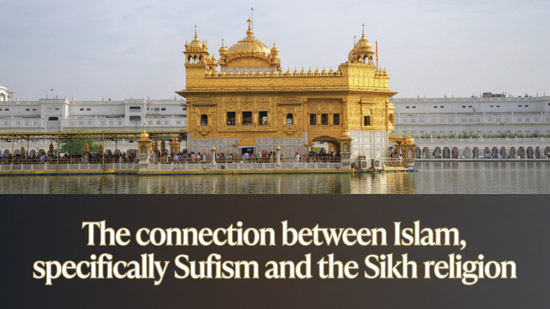
 The connection between Islam, specifically Sufism and the Sikh religion is rooted in a shared vision of devotion to the One Supreme Creator, human equality, and spiritual unity. Rather than focusing on ritualistic divisions, early Sikh Gurus and Muslim mystics engaged in profound dialogues of love, humility, and remembrance of God. This harmonious bridge is permanently enshrined in the holy scripture, the Sri Guru Granth Sahib.
From the very founding of Sikhism, relationships with Muslim companions, scholars, and mystics played a notable role. Guru Nanak Dev Ji’s lifelong companion and travel companion was Bhai Mardana, a Muslim musician who played the rebab while the Guru recited divine hymns. Throughout history, several Sufi saints and Muslim thinkers appreciated the universal message of Sikhism, recognising that the core of true religion transcends external dogmas. Sufism, with its emphasis on direct experiential love of God, inward purity, and the rejection of empty rituals, shared deep spiritual parallels with the teachings of the Sikh Gurus.
Muslim Saints and Bani in the Guru Granth Sahib
The Sri Guru Granth Sahib is unique among world scriptures for its inclusive compilation. It contains not only the Bani (divine hymns) of the Sikh Gurus but also the spiritual compositions of various medieval saints and poets (Bhagats and Sufis) from diverse Hindu and Muslim backgrounds. Among the prominent contributors of Muslim background whose poetry is integrated into the Guru Granth Sahib are Sheikh Farid and Kabir (though Kabir’s background is often associated with both Hindu and Muslim traditions, his poetry heavily critiques formalistic elements of both major religions).
Baba Sheikh Farid (1173–1265): A revered 13th-century Sufi mystic of the Chishti order, Baba Farid’s spiritual poetry in the Punjabi language deeply resonated with Guru Nanak Dev Ji. During his travels, Guru Nanak collected Farid’s hymns from his successor, Sheikh Ibrahim.
The Contribution: Within the Guru Granth Sahib, Baba Farid’s contribution includes several hymns (in Rags Aasa and Suhi) and 112 Sloks (couplets). His verses focus intensely on the transience of human life, the inevitability of death, the pain of separation from the Divine, and the necessity of constant prayer.
A Unique Dialogue: Sloks of Farid and the Gurus
One of the most remarkable features of the Guru Granth Sahib is how the Sikh Gurus engaged directly with Baba Farid’s poetry.When compiling the scripture, Guru Arjan Dev Ji (the fifth Sikh Guru) placed clarifying Sloks written by the Sikh Gurus directly alongside Baba Farid’s couplets. Rather than altering Farid’s words, the Gurus added complementary verses that expanded or elevated the spiritual perspective.
Example of Interaction: Baba Farid would write on the necessity of rigorous ascetic discipline or physical austerity to find God. In response, subsequent Gurus (such as Guru Amar Das or Guru Arjan Dev) would insert a companion verse emphasizing that true detachment and union with the Divine do not require abandoning the world or torturing the body, but rather keeping the mind pure while living as an ordinary householder.This back-and-forth dialogue within the scripture illustrates a harmonious meeting of minds—a respectful, loving conversation between Sufi mysticism and Gurmat philosophy unified under the love of the One God.
Disclaimer: This article and accompanying images are for informational and illustrative purposes only. Some visuals may be AI-generated or digitally enhanced and may not depict actual events or persons.Views expressed are based on publicly available information and analysis.