
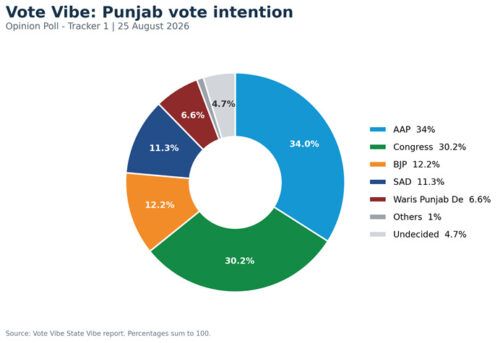
Figure 1. Punjab vote intention in the Vote Vibe survey.
Source: Vote Vibe State Vibe report
Political parties have a simple relationship with opinion polls. When the numbers suit them, the poll is scientific. When they do not, the methodology is doubtful. A survey is useful, but it is only a snapshot. It is not the result, and not the last word. The Vote Vibe State Vibe report released on August 25, 2026 covers Punjab, Uttar Pradesh and Uttarakhand. In Punjab, AAP gets 34 per cent and Congress 30.2. BJP is at 12.2, SAD at 11.3 and Akali Dal (Waris Punjab De) at 6.6 per cent. Another 4.7 per cent are undecided.My first reading is quite simple. AAP is ahead, but only just. A gap of 3.8 percentage points over Congress is not a wave. It is not even a comfortable lead. Punjab remains open.
AAP also has the advantage of perception. Vote Vibe says 36.7 per cent expect AAP to win, against 26.8 per cent for Congress. This matters. Closer to polling day, many voters move towards the party they think will form the government.AAP’s real strength is Bhagwant Mann. He is the preferred chief minister for 40.1 per cent, ahead of Channi at 20.6 and Sukhbir Badal at 11.7 per cent. Mann is six points above AAP’s vote share. He is carrying the party more than the party is carrying him.
There is another number AAP should not brush aside. Satisfaction with the government is 40 per cent, against 35.4 per cent dissatisfied. For sitting MLAs, it falls to 32.2 per cent, while dissatisfaction rises to 45.3 per cent. Much of the anger is local.Ticket distribution can therefore become AAP’s biggest headache. It may replace unpopular candidates, but denied tickets create rebels. In a close seat, a rebel does not have to win. He only has to damage the official candidate.
Drugs are Punjab’s biggest issue in the survey at 25.7 per cent. Unemployment and migration follow at 24.3 per cent. Inside a Punjabi home these worries meet: one child has no job, another plans to leave, while the family fears drugs, gangsters and easy money. Drugs and law and order are intertwined.
I had raised this warning much earlier. In my Hindustan Times article, ‘Gangsters or terrorists? Punjab needs courage to call them what they are’, I argued that law and order could become the main issue of the 2027 election. I still believe so. Welfare schemes matter. But when traders receive extortion calls and shootings become regular news, the voter asks a basic question: is the State in control?
Vote Vibe becomes more revealing when compared with the earlier People’s Pulse ‘Mood Punjab Da’ report. People’s Pulse placed AAP at 37 per cent and Congress at 31. Vote Vibe gives them 34 and 30.2. The broad picture is the same: AAP first, Congress second, and a much closer contest than in 2022.
People’s Pulse projects 58-63 seats for AAP and 36-43 for Congress. Vote Vibe gives no seat projection. Perhaps that is sensible. In a five-cornered election, where the vote is concentrated matters as much as the statewide percentage.
The disagreement is over the smaller parties. People’s Pulse gives WPD 14 per cent, BJP 8 and SAD 6. Vote Vibe gives BJP 12.2, SAD 11.3 and WPD only 6.6. One makes WPD the third force; the other puts it fifth. That can change several seats in Majha and Malwa.
The leadership figures also need care. Both put Mann around 40 per cent, but People’s Pulse gives Channi 33 while Vote Vibe gives him 20.6. The options differed. Vote Vibe leaves out Opposition leader Partap Singh Bajwa; People’s Pulse includes Amritpal Singh, while Vote Vibe does not. Change the names and the answer can change.
The common findings matter. AAP is ahead. Congress is close enough to overtake it. Mann remains popular, but many AAP MLAs do not. The freebies and the women power are helping AAP. That is the position today, not necessarily the position after candidates are announced.
SAD’s Panthic space is under pressure from WPD. Even at the lower estimate, WPD can affect several seats. BJP’s 12.2 per cent in Vote Vibe is above its 2022 Assembly share, but below the 18.56 per cent it received in the 2024 Lok Sabha election. People’s Pulse puts it at 8 per cent.
The methods differ. People’s Pulse conducted 8,000 face-to-face interviews across all 117 constituencies. Vote Vibe gives a combined telephone sample of over 6,000 for three states, without a Punjab breakup. That gap matters. Precise decimals are still not election results.
UP and Uttarakhand: BJP ahead, but not secure
In Uttar Pradesh, Vote Vibe gives the BJP alliance 41.8 per cent and the SP alliance 38.7. Yogi Adityanath leads Akhilesh Yadav as the preferred chief minister. Yet BJP and SP are tied at around 41 per cent when people are asked who will win. UP is competitive, and many sitting MLAs face dissatisfaction.In Uttarakhand, BJP leads Congress 40.9 to 36.7 per cent. Pushkar Singh Dhami is the leading CM choice at 28.2 per cent. Here too, the local MLA appears to be a bigger problem than the government.
Conclusion of Punjab and my take: Punjab is interesting, yet still open
Punjab is interesting, yet still open. A SAD-BJP alliance, if it happens, with splinter groups such as SAD (Punar Surjit), can alter the equation. It may move urban and rural voters alike, cutting into AAP, Congress and Waris Punjab De. In a close election, even two or three points can change many seats.Congress has the largest un-utilised political space. I have always argued that its latent power will show only when it sets its house in order. It should read the leadership survey carefully, especially Channi’s popularity. If the internal squabbling ends, Congress can move from being seen as a party fighting itself to a serious challenger, even the possible winner. That matters: a lot of people vote for the perceived winner.
BJP, on its own, still has to work very hard. It must understand Punjab better and make inroads through the emotional route, not just organisation, arithmetic or central schemes. SAD alone is not a potent force today. Waris Punjab De, in my assessment, will get a higher vote share than these surveys predict. AAP leads, yes—but this election is not settled yet.