
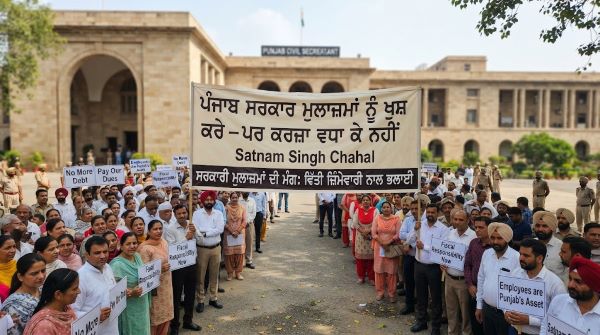
The Punjab government deserves credit whenever it takes steps to provide relief to its employees. Government employees are an important part of the state’s administrative machinery, and their salaries, pensions, allowances and other legitimate dues should be paid on time. Keeping employees satisfied is essential for efficient governance. However, the larger question is: should every financial commitment to employees be met by taking fresh loans, or should the government first improve its own financial management and increase its income?
This question has become increasingly important as Punjab continues to face serious fiscal pressures. According to the 2026-27 budget analysis, Punjab has projected net borrowings of about ₹38,471 crore, while its revenue deficit is estimated at ₹21,955 crore. The state is also expected to spend approximately ₹90,335 crore on committed expenditure, including salaries, pensions and interest payments—around 72% of its estimated revenue receipts.There is nothing wrong with spending money on employees. In fact, employees who have worked for the state deserve timely salaries, legitimate allowances and proper service benefits. But there is a fundamental difference between responsible employee welfare and borrowing simply to maintain a recurring expenditure structure.
The Punjab government should therefore ask itself a simple question: If additional money is required to make employees happy, why can’t the government first reduce unnecessary expenditure and increase its own revenue?Punjab has considerable potential to generate additional income without continuously increasing the debt burden. Better tax administration, stronger enforcement against tax evasion, improved collection of existing revenues, transparent management of government properties, professional utilisation of public assets and stronger economic activity can all contribute to increasing the state’s own resources.The state’s own tax revenue for 2026-27 is projected at about ₹70,851 crore, while its own non-tax revenue is estimated at ₹15,687 crore. Interestingly, the revised estimate for 2025-26 showed own non-tax revenue substantially higher than the original budget estimate, partly because of revenue from the sale of land and property. This indicates that there is room for Punjab to examine its revenue-generating capacity much more seriously.
At the same time, the government must conduct a comprehensive review of expenditure. Every department should be asked to identify spending that is unnecessary, avoidable or capable of being reduced without affecting essential public services. Government publicity, excessive administrative expenditure, unnecessary ceremonies, consultants, travel, promotional activities and other non-essential spending should face strict scrutiny.The principle should be simple: cut waste before cutting employee benefits, and increase revenue before increasing debt.
The government cannot expect ordinary citizens to continuously pay higher taxes and charges while the state itself keeps relying on borrowing to finance its obligations. Borrowing may be justified when it creates productive assets—such as irrigation infrastructure, roads, industry, education facilities or other projects capable of generating long-term economic benefits. But borrowing to finance routine recurring expenditure creates a different problem because the loan has to be repaid from future revenues.Punjab’s financial position makes this distinction particularly important. The 2026-27 budget projects total expenditure of ₹2.60 lakh crore, including debt repayment of approximately ₹93,726 crore. The Comptroller and Auditor General’s monthly accounts also show the continuing scale of revenue expenditure on salaries, pensions, interest and subsidies.
The government should also develop a Punjab Revenue Enhancement Plan with measurable annual targets. Every major department should have a target for improving revenue collection and reducing leakage. Government-owned land and commercial properties should be properly inventoried and professionally managed. Tax compliance should be strengthened through technology rather than harassment of honest taxpayers. Mining, liquor, transport, registration, GST and other revenue-generating sectors should be monitored transparently.At the same time, Punjab needs a serious investment strategy. The ultimate solution to the state’s financial problems is not simply borrowing more money; it is creating an economy that generates more employment, investment, business activity and tax revenue. Industrial investment, agriculture diversification, tourism, information technology, services and the enormous potential of the Punjabi diaspora can all play a role in strengthening the state’s economic base.
Employees should not be made victims of financial mismanagement. If the government has made commitments to them, those commitments should be honoured. But employees should also understand that Punjab’s financial resources ultimately come from taxpayers and economic activity. A financially unstable government cannot provide sustainable benefits indefinitely.The Bhagwant Mann government therefore needs to balance employee welfare with fiscal responsibility. Making employees happy is good governance. Making them happy by continuously increasing the state’s debt, however, is not a sustainable economic policy.Punjab needs a government that can say: “We will pay our employees fairly, but we will first control unnecessary expenditure, stop revenue leakage, improve collections, create new sources of income and use every public rupee responsibly.”
The real achievement would not be merely announcing another benefit financed through borrowing. The real achievement would be creating enough additional state revenue to pay for employee welfare without putting another burden on the next generation of Punjabis.Punjab’s employees deserve financial security today. Punjab’s children deserve financial security tomorrow. A responsible government must protect both.The real achievement would not be merely announcing another benefit financed through borrowing. The real achievement would be creating enough additional state revenue to pay for employee welfare without putting another burden on the next generation of Punjabis
Disclaimer: This article and accompanying images are for informational and illustrative purposes only. Some visuals may be AI-generated or digitally enhanced and may not depict actual events or persons.Views expressed are based on publicly available information and analysis