
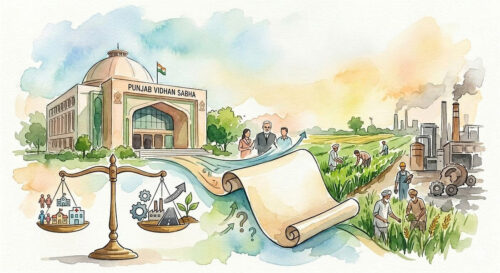
 Punjab’s Budget for 2026–27 should neither be dismissed as routine pre-election signalling nor embraced as a decisive fiscal breakthrough. Both responses would be simplistic. The truth lies somewhere in between. This is a serious budget framed under constraint, reflecting both the compulsions of electoral politics and the realities of a state struggling to balance welfare commitments, development needs, and fiscal repair. It deserves neither applause without scrutiny nor criticism without understanding.
At first glance, the numbers are ambitious. The Finance Minister has projected Punjab’s Gross State Domestic Product at ₹9,80,635 crore for 2026–27, up from ₹8,91,487 crore in 2025–26, implying growth of roughly 10 per cent. Total expenditure is budgeted at ₹2,60,437 crore. The effective revenue deficit has been placed at 2.06 per cent of GSDP, the fiscal deficit at 4.08 per cent, and the debt-to-GSDP ratio is claimed to have declined from 48.25 per cent in March 2022 to 44.47 per cent as of January 2026.
These figures are not insignificant. Indeed, taken together, they seek to present a picture of a state inching towards fiscal correction without abandoning social commitments or developmental priorities. But every budget is only as credible as the assumptions on which it rests. In Punjab’s case, those assumptions deserve careful examination. If growth holds near the projected rate and transfers from the Centre materialise broadly as expected, the state may well sustain a modest but meaningful recovery. If either of those pillars weakens, the apparent comfort in the deficit and debt numbers could quickly erode.
That, in essence, is the central truth of this budget: it is not unserious, but it is contingent.
A budget that cannot be dismissed
To characterise this budget as mere political theatre would be unfair. There is visible developmental intent in both the allocations and the administrative architecture accompanying them. The proposed capital expenditure outlay of ₹18,381 crore for 2026–27 is substantial by Punjab’s standards. The government also claims that cumulative capital expenditure over its first four years reached ₹32,353 crore, more than double that of the previous dispensation. Such claims may, of course, invite political contestation, but they cannot be brushed aside without examination.
Equally important is the fact that the budget does not merely announce schemes; it attempts to embed them within implementation mechanisms. The Rangla Punjab Vikas Scheme is proposed to be monitored through geo-tagging. Property registration and land-related services are being pushed through digital systems. Industrial facilitation is to be supported by time-bound single-window approvals and an online interface. These may sound procedural, even mundane, but in public administration procedures are often the difference between rhetoric and delivery. A state does not develop merely because money is allocated; it develops because the machinery of government is able to translate intention into action.
This budget appears to recognise that truth.
The welfare orientation of the budget is also politically intelligible and administratively unsurprising. Punjab today has a welfare compact that is no longer episodic; it is embedded. Successive governments may differ in emphasis, language, or targeting, but none can afford to step outside the broad framework of subsidy, social support, and public provisioning that now shapes the social contract. In that sense, the question is not whether the government should maintain welfare commitments, but whether it can do so while simultaneously preserving fiscal stability and investing in future growth. This budget attempts exactly that balancing act.
One may debate the scale, sequencing, or efficiency of particular schemes, but it would be wrong to suggest that the government has simply produced a document of slogans. There is evidence here of effort, of prioritisation, and of administrative seriousness. The more difficult question is whether that seriousness is enough.
The problem is not intention; it is durability
In public finance, good intentions are not enough. A state budget must be judged not simply by what it seeks to do, but by whether it can sustain what it promises. Punjab’s long-term problem is not the absence of schemes. It is the weakness of durable fiscal space.
For decades, Punjab has carried structural burdens that no annual budget can magically dissolve: a high debt stock, a heavy committed expenditure profile, a politically sensitive subsidy regime, modest industrial dynamism compared to its potential, and continuing stress in agriculture and public service delivery. In such a setting, even a well-meaning budget must be read with caution. Numbers can look orderly on paper while concealing large underlying fragilities.
This is why the projected 10 per cent growth assumption assumes such importance. If the state economy expands near that level, then many of the ratios in the budget will appear manageable, or at least defensible. If it does not, then the fiscal deficit, revenue deficit, and debt burden will all look less benign. Ratios improve not only because governments borrow less or spend better, but also because the denominator grows. When a fiscally strained state projects improvement, one must always ask how much of that improvement comes from policy and how much from assumed nominal growth.
Punjab may well achieve respectable growth; that cannot be ruled out. But such growth cannot simply be presumed into existence. Agriculture remains vulnerable, manufacturing has yet to regain the momentum Punjab once took pride in, and the services economy, though expanding, is not always enough to compensate for structural weaknesses elsewhere. In that context, growth projections are not innocent accounting devices. They are the foundation on which the budget’s fiscal narrative rests.
A welcome pragmatic turn on industry
One of the more encouraging features of the budget is its approach to industry. Punjab has for too long suffered from an odd combination of industrial nostalgia and administrative hesitation. It continues to speak the language of enterprise, but too often with the methods of delay. Industrial revival in Punjab will not come through grand declarations alone; it will require policy stability, faster approvals, easier land-use decisions, better logistics, predictable incentives, and fewer avoidable frictions between investor and state.
The new Industrial Policy 2026 appears, at least on paper, to move in that direction. Its emphasis on sector-specific incentives, land-use flexibility, dispute resolution, MSME support, logistics improvement, and digital clearances through the Fast Track Punjab Portal suggests pragmatism rather than posturing. The sectoral allocation of ₹2,805 crore, including ₹500 crore in fiscal incentives, indicates that the government is willing to back its industrial messaging with resources.
This matters because Punjab’s fiscal future cannot be secured through welfare management alone. A state cannot endlessly redistribute unless it also expands what it produces, attracts, builds, and sells. Industrial activity is not just a source of investment and employment; it is also the basis for tax buoyancy, urban expansion, ancillary services, and confidence in the future. If Punjab is to move from fiscal stress to fiscal resilience, industrial growth will have to become more than an occasional headline. It will have to become a sustained administrative project.
That said, industrial policy documents in India are often stronger in announcement than in execution. The real test will not be in the drafting of portals, incentive schedules, or policy brochures, but in the experience of actual entrepreneurs dealing with local approvals, utilities, inspections, land conversion, litigation, and logistics. Punjab’s industrial future will not be decided in Chandigarh alone. It will be decided in the ease or difficulty with which a small manufacturer in Ludhiana, an exporter in Jalandhar, or an investor in Mohali is able to get work done.
Revenue effort: encouraging, but not beyond question
On the receipts side, the government projects total revenue receipts of ₹1,26,190 crore, including ₹70,851 crore in own tax revenue and ₹15,687 crore in non-tax revenue. Punjab’s share in horizontal devolution is stated to have increased from 1.807 per cent to 1.996 per cent, pushing projected central tax transfers to ₹30,464 crore from ₹25,171 crore the previous year. The budget also cites better performance in GST, excise, stamp duty, and registration.
This is, on the face of it, encouraging. For far too long, the conversation in Punjab has focused on expenditure obligations while revenue augmentation remained either politically inconvenient or administratively secondary. If the state is now paying closer attention to revenue effort, that is a healthy sign. Fiscal responsibility is not only about cutting or containing expenditure; it is also about improving the state’s ability to mobilise resources efficiently and honestly.
Yet here too caution is advisable. Revenue growth must be tested for quality, not merely quantity. Some gains may be structural, arising from better compliance, digitisation, administrative tightening, or genuine economic activity. Others may be cyclical, one-off, or sensitive to broader conditions. A single year’s buoyancy does not always prove a durable trend. What Punjab needs is not merely a better revenue year, but a stronger revenue system.
That distinction is important because many states appear fiscally improved in one year only to discover, later, that the improvement rested on transitory gains. Punjab, given its financial history, cannot afford to confuse temporary relief with durable correction.
The grants-in-aid question deserves serious scrutiny
The most delicate and potentially consequential issue in the budget lies elsewhere: the projected Grants-in-Aid from the Centre, estimated at ₹9,188 crore.
This number matters greatly because the Union Government’s explanatory memorandum on the recommendations of the 16th Finance Commission has made clear that the Commission has not recommended revenue deficit grants to states, nor sector-specific or state-specific grants. That is a significant departure in the fiscal landscape and has already caused concern in states that had hoped such support would continue in one form or another.
Punjab’s budgetary arithmetic therefore requires close scrutiny. To be clear, this does not automatically mean that the projected figure is untenable. Not every grant from the Centre falls under the specific categories the Finance Commission has chosen not to recommend. Some transfers may still arise under established and permissible heads. Others may reflect continuing central support through already recognised channels. It is therefore entirely possible that the ₹9,188 crore figure is defensible in accounting terms.
But possibility is not certainty, and that is precisely the point. Unless the composition of this projected grant figure is clearly understood and its realism tested, one cannot simply take comfort from its presence in the budget. If a material portion of this amount rests on expectations that do not materialise, the consequences would be far from technical. A shortfall of that size in a fiscally stretched state would not remain confined to ledger adjustments. It would affect welfare outlays, delay capital expenditure, force reprioritisation, and increase pressure on borrowing.
In budgets, one must pay close attention not only to headline claims but also to stress points. This appears to be one of them.
It is therefore not enough for the government to state the number. It must also demonstrate the robustness of the assumption behind it. Transparency on the composition of the grants figure would strengthen confidence. Silence will invite speculation.
Debt ratios must be read with care
The government’s claim that the debt-to-GSDP ratio has fallen from 48.25 per cent in March 2022 to 44.47 per cent in January 2026 is politically useful and may well reflect a measure of improvement. But such comparisons should be approached carefully. Debt ratios can improve because of better fiscal management, but they can also improve because of denominator effects, timing differences, and the staging of borrowing and expenditure within the financial year.
This is not to deny the possibility of real progress. It is simply to say that fiscal narratives should be read with methodological caution. In a state like Punjab, where the legacy debt burden remains substantial, no one should assume that the problem has been solved merely because the ratio has moved in the desired direction. Debt stress is not eliminated by a better ratio alone. It eases only when the state demonstrates a sustained ability to manage borrowing, improve revenue, contain unproductive expenditure, and support growth over time.
That remains a longer journey.
Election-year budgets are not illegitimate—but they are vulnerable
Punjab is now moving into a politically charged year. That fact will shape both the presentation and the reception of this budget. Every allocation will be interpreted through an electoral lens; every scheme will be examined for political intent; every claim of reform will attract both applause and suspicion. This is natural in a democracy. Election-year budgets are always read not only as financial statements but as political signals.
Yet one must resist the temptation to regard that alone as disqualifying. Governments do not stop governing because elections approach. Nor should they. Roads must still be built, hospitals funded, schools run, payments made, and industrial confidence maintained. If a government under electoral pressure also attempts fiscal correction and institutional improvement, that effort should be recognised even as it is scrutinised.
What matters, ultimately, is not whether the budget has political uses — all budgets do — but whether it has administrative credibility.
Execution will decide everything
Like most budgets in India, Punjab’s Budget 2026–27 will stand or fall less on what it announces than on what it executes. Treasury discipline, timely release of funds, prioritisation of high-impact expenditure, realistic tendering, close outcome monitoring, and honest reporting of slippages will matter far more than speeches, headlines, or political messaging.
The bureaucracy, especially in a state like Punjab, remains the instrument through which budgetary intention becomes public reality. Senior officers may design frameworks, but actual delivery depends on departments, districts, field formations, engineers, teachers, health workers, municipal staff, revenue officials, and implementing agencies that translate policy into visible change. Punjab has repeatedly shown that even under conditions of financial strain, outcomes can improve when priorities are clear, systems are monitored, and leadership remains engaged.
That is why the coming year must not be surrendered to noise. Punjab can ill afford a situation in which partisan competition overwhelms administrative follow-through. If this budget is to mean anything beyond paper, then implementation must remain disciplined and insulated, as far as possible, from electoral distraction.
A balanced conclusion
The correct way to read Punjab’s Budget 2026–27 is neither with cynicism nor with credulity. It is an ambitious budget, but not a frivolous one. It reflects a genuine attempt to preserve development momentum, maintain a politically embedded welfare compact, and project a measure of fiscal repair under difficult conditions. It also marks a welcome pragmatic turn in industrial policy and a more serious recognition of the importance of revenue mobilisation.
At the same time, it rests on assumptions that cannot be taken for granted. The projected growth rate must broadly hold. The expected central transfers, especially the grants component, must withstand scrutiny. Revenue gains must prove durable rather than accidental. And the state’s debt narrative must be read with realism rather than relief.
So the proper response to this budget is not celebration, and not dismissal. It is vigilance.
If Punjab’s economy grows near the projected rate, if central flows broadly materialise, and if execution remains disciplined, the state may indeed be on the threshold of a modest recovery. If not, course correction will become unavoidable, and perhaps sooner than the present document suggests.
For now, the wisest course is to acknowledge the seriousness of the effort, scrutinise the assumptions relentlessly, and insist that Punjab’s developmental journey be carried forward not through rhetoric, but through administrative competence, fiscal honesty, and political restraint.
Share The KBS Chronicle
You’re currently a free subscriber to The KBS Chronicle. For the full experience, upgrade your subscription.
Upgrade to paid
Like
Comment
Restack
© 2026 KBS Sidhu
Unsubscribe
Get the appStart writing