
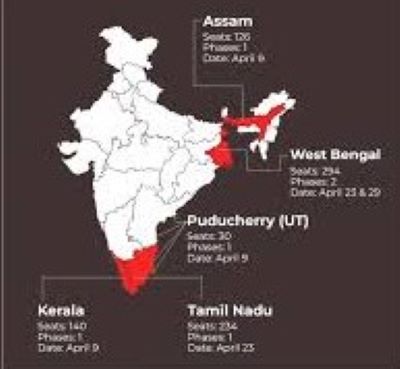
 India woke up today to one of its most breathtaking electoral mornings in decades. As counting of votes began across West Bengal, Tamil Nadu, Kerala, Assam and Puducherry, it quickly became clear that the voters of these five states had decided to rewrite history in ways that no poll, no pundit, and no political veteran had fully anticipated. Three of the four states holding legislative assembly elections are set for a change in government leads show a major upset in West Bengal, with the BJP ending Mamata Banerjee’s 15-year rule, actor Vijay making a blockbuster political debut in Tamil Nadu, and trends in Kerala showing the Left Democratic Front voted out in favour of the Congress-led United Democratic Front. This is the story of those wonders, one electrifying state at a time.
Of all the shocks delivered on May 4, 2026, none has stunned India more profoundly than what is unfolding in West Bengal. For fifteen years, Mamata Banerjee “Didi” to millions has been the undisputed, seemingly unbreakable iron queen of Bengal politics. She has survived floods, opposition coalitions, central government pressure, and wave after wave of BJP assault. And yet, today, that reign appears to be over. The BJP is poised for a big win in West Bengal, all set to oust Mamata Banerjee-led Trinamool Congress from power, having comfortably crossed the majority mark of 148 in the West Bengal Assembly after fielding its top leaders including Prime Minister Narendra Modi and Union Home Minister Amit Shah.
Mamata Banerjee’s Trinamool Congress, fighting a 15-year incumbency and a controversial voter-roll revision, has been pushed back to just 97 seats as the BJP surged past the majority mark, leading in 193 seats. The scale of it is staggering. A woman who has defined Bengal’s political identity for a generation and a half now faces the very real prospect of walking away from power. Banerjee, who was seeking a fourth straight term, refused to concede defeat in early trends, asking party workers to “wait and watch” as counting continued even as BJP supporters gathered outside her residence to celebrate.
The election itself was fought under a thick cloud of controversy. The elections witnessed a 92.47 per cent voter turnout and drew intense scrutiny in the aftermath of the Special Intensive Revision of electoral rolls, which led to the deletion of nearly 91 lakh names from West Bengal’s voter list a flashpoint that sharply polarised political discourse, with the BJP maintaining the revision helped eliminate illegal voters while the TMC alleged that the Centre had effectively disenfranchised genuine minorities and migrant workers. Whatever the final verdict on that controversy, what the numbers show today is a Bengal that voted for change on a scale few believed possible.
If Bengal is the story of a dynasty falling, Tamil Nadu is the story of something entirely new being born. For more than half a century, Tamil Nadu’s politics has been a two-party affair a pendulum swinging between the DMK and the AIADMK, between the Stalins and the Jayalalithaas, with no third force ever strong enough to disturb the duopoly. That half-century of certainty has been shattered today by a man who, until recently, was known only for leaping between motorcycles on cinema screens. Actor-politician Vijay’s Tamilaga Vettri Kazhagam is delivering a political earthquake in the Tamil Nadu Assembly Election 2026, leading in 107 constituencies and emerging ahead of both Dravidian heavyweights DMK and AIADMK, with the majority mark at 118.
Tamil Nadu on April 23 recorded a voter turnout of 84.6 per cent the highest since Independence a reflection of the extraordinary energy that Vijay’s entry injected into the electorate, particularly among students and first-time voters. The ruling DMK of Chief Minister M K Stalin, which entered this election as the government in power and the favourite, has been stunned. The ruling DMK has been relegated to third place with 47 leads, while the AIADMK has mounted a significant recovery to lead in 81 seats, creating a fierce three-cornered fight for the Secretariat.
In a plot twist straight out of the masala films Vijay is most famous for, political veteran Vaiko said on May 1 in an interview, “TVK will be a force to reckon with, and it may produce surprises when the results are declared there is a swing among students and first-time voters in favour of TVK.” Those words proved to be prophetic understatement. If the trends hold, Vijay could pull off one of the biggest electoral upsets in Tamil Nadu history, echoing the watershed elections of 1967 and 1977 — when C N Annadurai led the first non-Congress government, and M G Ramachandran formed the first AIADMK government after unseating the DMK. What “Thalapathy” has done on his very first attempt at electoral politics is nothing short of historic.
Kerala had its own surprise to offer. The Left Democratic Front, led by the CPI(M), had come into these elections nursing an extraordinary ambition to become only the second government in Kerala’s history to win a third consecutive term, after having already made history by winning back-to-back in 2016 and 2021. That ambition has been denied. Trends in Kerala show the Left Democratic Front voted out in favour of the Indian National Congress-led United Democratic Front. The UDF has crossed the majority mark in Kerala, ending the LDF’s historic bid for a third consecutive term.
Alongside the broad Congress sweep, Kerala also produced a more localised but historically significant surprise. The BJP secured a significant breakthrough in the 2026 Kerala Assembly elections, winning key constituencies such as Nemom and Kazhakkoottam, along with a surprise victory in Chathannoor riding an anti-incumbency wave against the LDF, and managing to win three seats previously held by the ruling party. For a party that had won exactly one seat in the Kerala Assembly in 2016 winning three seats marks a meaningful expansion of its footprint in a state traditionally dominated by two ideologically opposed fronts.
In Assam, the surprise was not a defeat but a magnitude of victory that surpassed expectations. The BJP moved towards a record hat-trick of wins in the northeastern state, with the Saffron Party alone securing a comfortable majority, with the NDA close to touching the 100-mark in the 126-seat Assembly, while Congress led in just 24 seats. Chief Minister Himanta Biswa Sarma’s personal dominance of Assam’s political landscape has been emphatically confirmed.
One of the campaign’s most startling sub-plots was the crushing defeat of Congress state president Gaurav Gogoi in Jorhat. Congress’s Gaurav Gogoi lost in Jorhat by over 23,000 votes a result that signals the depth of the Congress collapse in a state where it was once the natural ruling party. For the BJP, Assam has now become bedrock territory, with the party having achieved what no government in the state had done in the modern era three consecutive terms with growing majorities.
No account of the 2026 elections would be complete without reckoning with the controversy that haunted them from beginning to end. The Special Intensive Revision of electoral rolls conducted by the Election Commission of India in advance of polls required all voters in poll-bound states to resubmit their particulars in order to be included in the electoral rolls, attracting fierce criticism from opposition parties who argued that minority voters were being deliberately disenfranchised. In West Bengal alone, more than 9 million voters were excluded from the revised electoral rolls. The opposition argued that this was electoral manipulation; the ruling party and the Election Commission maintained it was a legitimate exercise in cleansing voter lists of bogus entries.
Encyclopedia Britannica
The truth of this controversy will be debated by scholars and litigated in courts for years. But what it did, undeniably, is cast a long shadow over results that might otherwise have been celebrated with unmixed enthusiasm. When governments fall and new forces rise, the legitimacy of the process that produced those outcomes matters as much as the outcomes themselves — and in 2026, that legitimacy has been fiercely contested.
Taken together, the 2026 state elections represent one of the most consequential electoral moments in India since the 2014 Lok Sabha elections. The 2026 state elections are important because they serve as a key political test for both national and regional parties ahead of the Lok Sabha elections in 2029. The saffron map has now stretched further east, with Bengal joining the BJP column. The DMK has been humbled on its home turf. The Congress has recovered in Kerala. And an actor named Vijay has walked off the cinema screen and directly into the heart of Indian democracy, taking with him millions of young voters who had never before felt that politics belonged to them.India’s election field in May 2026 has delivered wonder after wonder — confirming once again that in a democracy of 1.4 billion people, the voters are always the last and greatest surprise.