
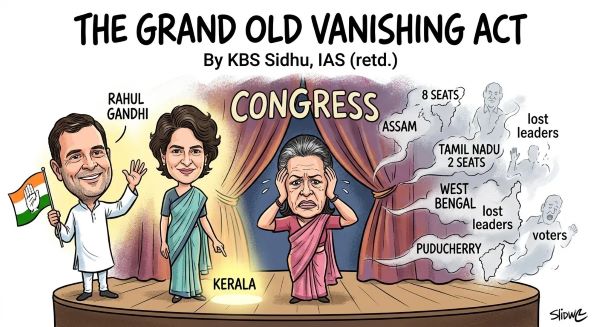
 There is a magic trick that has been fascinating political observers for the better part of a decade, and it goes something like this. A party steps onto the stage. Drums roll. Curtains part. Voters cast their ballots. The results arrive — and the party is gone. Not eliminated, mind you. Not routed. Just… gone. A seat here. A whisper there. A brave candidate in some corner constituency holding aloft the tricolour hand symbol like a lighthouse keeper who has not yet heard that the ships stopped coming.
Ladies and gentlemen, the Indian National Congress — one hundred and forty-one years old, constitutionally magnificent, electorally mystifying — has done it again.
The Election Commission of India’s results board on the evening of 4 May 2026, with counting still under way, tells a story that no spin doctor alive is adequately paid to handle. Five states. One resounding verdict. The Grand Old Party has been reduced, in the aggregate, to a presence so spectral it would struggle to haunt its own headquarters.
At the time of writing, across all five poll-bound states — Assam, Kerala, Tamil Nadu, West Bengal, and Puducherry — the Congress stood at a combined tally of approximately 88 seats won and leading. Of these, 63 belong to Kerala alone, where the party-led UDF has swept to a majority. Strip out Kerala, and the Congress’s harvest from the remaining four states — 824 seats between them — is a number so modest it would embarrass a district-level panchayat result. The counting is not yet complete. One watches, not with suspense, but with a kind of melancholy curiosity, to see whether the final arithmetic offers any consolation.
It will not offer much.
Let us take the tour, state by state, as one might walk through the ruins of a formerly magnificent palace, pointing at crumbling cornices and saying: “That used to be something.”
Assam: A Supporting Role Nobody Asked For
In Assam, Congress has managed a handful of seats in a 126-seat house. The party once governed this state with the easy authority of a landlord who never imagined a tenant rebellion. The BJP swept to its third consecutive majority, helped along — in a detail that must constitute some form of political comedy — by senior Congress leaders who quietly walked across to the ruling party weeks before polling. Not in the dead of night. In broad daylight. With press conferences.
The Congress high command’s response to this steady haemorrhage of leadership? Observers are still waiting. The silence has been so resounding it could qualify as a heritage monument.
Tamil Nadu: The Ghost at the Feast
In Tamil Nadu, Congress is a courtesy guest at the DMK’s table — invited out of historical sentiment, seated near the kitchen, and served last. More remarkably, Actor Vijay — a man whose previous greatest political act was delivering dialogue on screen — has, in his very first election, comprehensively buried the Congress as the second pole of Tamil politics. The thespian has, one might say, performed the Grand Old Party off the stage.
West Bengal: Death by a Thousand Squeezes
Now we arrive at the truly spectacular exhibit in this museum of misfortune. In a 294-seat house, Congress’s presence can be counted without removing one’s shoes. In a state where Congress once formed governments, where Subhas Chandra Bose walked the same political earth, where the party has roots stretching back to the nationalist movement itself — the result is a number that does not require a calculator, a psephologist, or indeed a political scientist. It requires only a moment of quiet contemplation, and perhaps a glass of water.
The party has been squeezed into irrelevance between Mamata Banerjee’s Trinamool on one side and the BJP’s formidable machinery on the other. Squeezed is perhaps too gentle a word. Pulverised might be more accurate, though less polite.
Puducherry: Invisible
In Puducherry, Congress does not feature among the top five parties on the results screen. This is either a reflection of brutal electoral arithmetic, or the party is engaged in a particularly committed form of political minimalism. Either way, in a 30-seat Union Territory, the party of Nehru has achieved what Nehru himself could not: complete philosophical detachment from electoral outcomes.
Punjab: Snatching Defeat From the Jaws of Opportunity
And now, a brief interlude for Punjab — not a poll-bound state today, but one that deserves its own exhibit in this gallery of self-inflicted misfortune, if only because it illustrates the Congress’s extraordinary gift for losing ground it has not yet been asked to contest.
In the 2024 Lok Sabha elections, the Congress won 7 of Punjab’s 13 parliamentary seats — a performance that, in any self-respecting political party, would be treated as a launching pad. A foundation. A reason for quiet confidence as the state heads into its February 2027 Vidhan Sabha election.
Instead, what Punjab Congress has delivered in the intervening months is a masterclass in competitive self-destruction. Its leaders are not preparing for government. They are preparing for each other — locked in a succession of feuds, factions, and finely calibrated acts of public sabotage that would be entertaining if the stakes were not quite so serious. Every press conference is a declaration of war against a colleague. Every statement to the media is a carefully aimed dart at a fellow Congressman. The party’s Punjab unit appears to have concluded that the most urgent electoral threat to Congress in 2027 is not the AAP government, not the BJP, but the Congress itself — and it is addressing that threat with admirable thoroughness.¹
Meanwhile, the BJP — which has already secured something rather more consequential than a few Lok Sabha seats — watches with the patient satisfaction of a chess player whose opponent is removing his own pieces. The AAP’s implosion, dramatic even by Punjab’s baroque political standards, has functioned as a warm invitation for the saffron party, and Punjab Congress has responded to this gift-wrapped opportunity by looking the other way and arguing about who gets the ribbon.
Kerala: The Last Lamp
And then there is Kerala. Kerala, bless it, where the Congress-led UDF has swept to a thumping majority. The one state where the hand symbol still waves with confidence, where Congress workers still have a reason to distribute sweets, where the party’s war room did not, for once, look like a scene from a disaster film.
Credit where it is due — and credit here must go primarily to Priyanka Gandhi Vadra. The Congress general secretary’s sustained ground campaign in Kerala, her chemistry with the electorate, her instinctive retail politics, delivered what no amount of high-command communiqués could have manufactured. While her brother Rahul Gandhi’s yatras have generated impressive optics and diminishing electoral returns, Priyanka’s Kerala engagement has produced actual seats. The difference between the two siblings’ political styles has never been so starkly illustrated: one marches across India to inspire; the other stays put in one state and wins.
Kerala, then, is the Congress’s last lamp — burning brightly, defiantly, and in magnificent isolation. Like a lighthouse on a coast where the harbour has been decommissioned.
The Curious Case of the Missing Leader
Which brings us to the inevitable question that follows every such result: where, precisely, is Rahul Gandhi?
After this rich haul — the kind of aggregate that a moderately successful municipal councillor might consider a personal achievement — one imagines the Leader of the Opposition might be at the party war room, sleeves rolled up, offering a forensic post-mortem. Or releasing a statement of steely resolve. Or at the very least, appearing on camera with the particular expression of a man who has processed disappointing news but is determined to carry on.
Instead, if history is any guide, the probability is that Rahul Gandhi is on a holiday. It is not a calumny; it is almost an established pattern. When the results are inconvenient, the silences tend to be scenic. One does not begrudge a man his rest — the human body requires recuperation. But one does wonder, with genuine curiosity, whether the Congress party’s approach to electoral defeat has been formally codified as “strategic withdrawal to an undisclosed location pending further reflection.” If so, the locations have reportedly been pleasant.
The Vanishing Trick, Explained
What the 4 May 2026 results confirm — even with counting still under way — is that the Indian National Congress is no longer a national party in any meaningful operational sense. It is a single-state enterprise with legacy offices in several other states, a Lok Sabha opposition bench, and an organisational structure that mistakes committee meetings for political work.
The party’s particular talent — its peculiar, practised political prestidigitation — is to make its own voters disappear. In state after state, the Congress has demonstrated a genius for alienating the very constituencies it claims to champion: minorities squeezed by delimitation in Assam, youth captured by regional alternatives in Tamil Nadu, urban voters in Bengal who simply stopped believing.
The architecture of decline is not mysterious. It was diagnosed, dissected, and a specific remedy offered — entirely free of cost and entirely unsolicited — in an earlier essay that the High Command has presumably not read, or read and filed under “interesting but not urgent,” which in Congress terminology means “never.” That essay argued that the High Command culture — the feudal architecture of a party that wrote devolution into the Constitution but forgot to apply it to itself — was the structural cause of this seemingly eternal atrophy. Nothing in today’s results suggests the diagnosis was wrong.
The full eight-page analysis, including a ledger of lost leaders, the Rajasthan catastrophe, and a three-point structural remedy that the party remains free to ignore, is available here.
The vanishing trick is impressive. After one hundred and forty-one years of practice, the Indian National Congress has mastered it completely. The only problem — the small, nagging, existential problem — is that in politics, unlike in theatre, the magician cannot take a bow if the audience has already left.
¹ A Note on Punjab’s Arithmetic for the Analytically Inclined
The structural threat to Congress in Punjab 2027 deserves sober examination beneath the sardonic surface. The AAP government’s Rajya Sabha implosion — in which 7 of Punjab’s 10 AAP MPs have merged with the BJP, leaving the ruling party’s parliamentary representation in tatters — ought, in rational political calculus, to represent a historic opening for the Congress. An incumbent government discredited by mass defection of its own elected representatives is, by any conventional standard, a sitting target.
Yet Congress’s ability to capitalise is constrained by a factional paralysis that has become almost structural. The party’s Punjab unit has cycled through organisational presidents and legislature party leaders with a frequency that suggests confusion rather than strategy. No dominant leader commands uncontested authority over the organisation. The result is a party that is simultaneously the most credible alternative to AAP and the least organised to prosecute that advantage.
The BJP, meanwhile, has secured an omnibus acquittal of sorts in Punjab’s political landscape — not through electoral victory but through the absorption of AAP’s parliamentary wing. Seven of ten AAP Rajya Sabha MPs from Punjab have effectively migrated to the BJP’s orbit, providing the saffron party with a Punjab footprint it could not have engineered through direct electoral contest. This is political judo of a high order: using the ruling party’s own weight to build an opposition platform.
For Punjab Congress, the February 2027 election is therefore not simply a contest against a weakened AAP government. It is a race against its own internal contradictions — and against a BJP that has been handed, at no electoral cost, the very leverage it needed to present itself as a serious Punjab alternative. Whether Congress can resolve its leadership question, unite its factions, and convert its 2024 Lok Sabha momentum into an assembly-level organisation before the model code kicks in is the defining question of Punjab’s political year. On current evidence, the answer is not reassuring.