
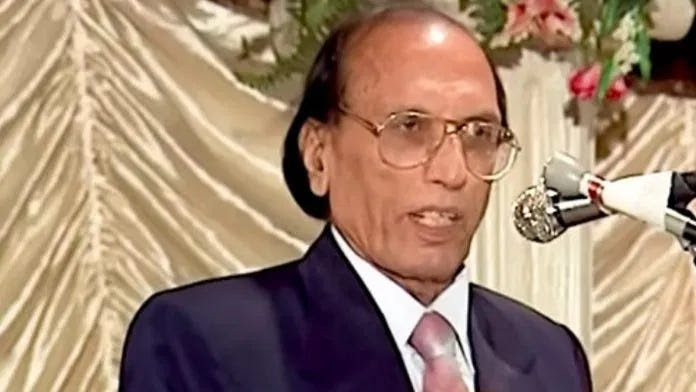
 Bashir Badr spent a lifetime writing about memory. He wrote about the light it casts, the lanes it lingers in, and the unnamed dusk when it finally fades. On the morning of 28 May 2026 — Eid al-Adha, of all days — memory took him too. He was 91. The poet who could not, in his final years, recall a single line of his own verse, left behind nearly 18,000 of them.
There is a particular cruelty in that arithmetic.
Syed Muhammad Bashir — pen name Badr, Arabic for the full moon — was born in 1935 in Ayodhya. He studied at Aligarh Muslim University, taught Urdu at Meerut College for seventeen years, and in 1987 watched the communal riots of that city consume his home, his books, and manuscripts that no one will ever read. He moved to Bhopal. He kept writing. In 1999, the Sahitya Akademi honoured his collection Aas, and the Government of India bestowed the Padma Shri. Neither award captures what he actually was: the poet who returned the Urdu ghazal to the people it had always been written about.
That is the distinction that matters. Classical Urdu verse can be a heavily ornamented affair — allusive, courtly, demanding of the reader. Badr stripped it back. His language was contemporary. His metaphors came from lived life, not libraries. When Javed Akhtar wrote this week that “our language Urdu has become a little poorer,” he was not speaking of scholarship. He was speaking of that quality — rare in any tradition — by which a couplet of twenty syllables makes a stranger feel entirely understood.
Prime Ministers quoted him. So did presidents across the border. Jagjit Singh set his ghazals to music and carried them into drawing rooms that had never opened a diwan. Lyricist Prasoon Joshi said this week: “The way he connected everyday life with poetry was something only Bashir Sahib could do.” That connection was not accidental. It was a considered artistic choice, made against the grain of a tradition that often prizes difficulty over feeling.
Dementia claimed the last chapter quietly. By 2018, he could no longer recognise his own verses in conversation. The man who had written “ujale apni yaadon ke hamare saath rehne do” — let the light of your memories stay beside me — was living out the other half of that same couplet: “na jaane kis gali mein zindagi ki shaam ho jaaye.” Who knows in which lane the evening falls.
It fell, on Eid morning, in Bhopal. He was buried that same evening at Bada Bagh Cemetery. He is survived by his wife Dr Rahat Badr and his children. He is survived, more permanently, by 18,000 couplets that will outlive all of us.
There are poets who are admired, and then there are poets who are used — reached for in the dark, pressed into the hands of someone you love, recited under your breath when prose is not enough. Bashir Badr was the second kind. That is the rarest kind. That is the kind that does not really leave.