
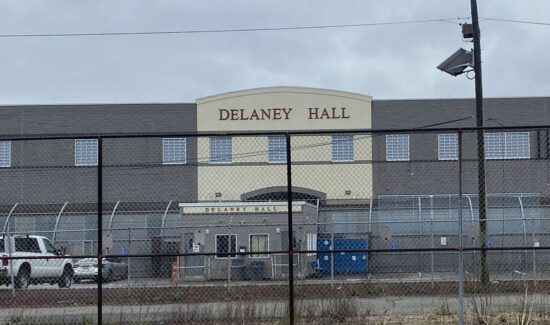
 Delaney Hall Detention Facility in Newark, New Jersey, has become the latest lightening rod of criticism over ICE’s aggressive enforcement agenda and inhumane detention practices by the agency and its contractors. Local and state officials have expressed concern over ICE’s and GEO Group’s staunch resistance to even basic facility inspections. People held inside the facility, many of whom are currently on a hunger and labor strike, report maggots in the food, severe lapses in medical care (the facility has already experienced one death in December), unsanitary conditions, and disregard for basic due process and access to legal counsel. ICE, for its part, rolled out recycled claims that it needs Delaney Hall to facilitate the arrest, detention, and deportation of “murderers, rapists, pedophiles, and drug traffickers.”
This post examines the basic information about Delaney Hall, including a close look at who is being held inside, how they got there, and where Delaney Hall fits within ICE’s northeast detention network.¹ The data for this post comes from the Deportation Data Project and Detention Reports. Although the most recent data is two-to-three months old, it is sufficient for contextualizing what is happening at the facility now. As always, feel free to use the findings and graphs from this post with attribution.
Delaney Hall’s history precedes this current administration. GEO Group originally operated Delaney Hall as an ICE facility from 2011 to 2017, but the contract was not renewed and the facility was used for other purposes and eventually sat dormant. Less than a month after Trump took office, GEO Group was awarded possibly the largest-ever single ICE detention contract for Delaney Hall, a $1 billion agreement over 15 years of operation. Don’t be too fast to pin this on the Trump administration or Stephen Miller. The original solicitation for this facility went out during the Biden administration, in the summer of 2024, despite widespread concerns by immigrant rights groups even at the time that predicted precisely the controversies that are driving protests now. During the final year of the Biden administration, ICE was busy laying the logistical foundations for the massive growth in detention realized under the Trump administration—and Delaney Hall was part of that.
The contract was signed on April 2, 2025. You can get a copy of part of the contract between ICE and GEO Group from Detention Reports (DHDFNJ_2025-05-09.pdf).
Since Delaney Hall reopened, it has been the site of ongoing controversy. Given well-documented historical and nationwide concerns about detention conditions in ICE facilities, it will come as no surprise that state and local leaders have sought to inspect the facility to ensure humane conditions and compliance with applicable laws. ICE and GEO Group have been recalcitrant to this. In May of last year, shortly after it reopened, Mayor Ras Baraka was arrested while attempting to inspect the facility. Since then, ICE and GEO Group have denied entry to a long list of both routine inspectors and high-profile visits, including Governor Mikie Sherrill and Representative LaMonica McIver. Senator Andy Kim was recently pepper sprayed amid protests outside the facility.
Concerns about detention conditions are not theoretical. People held inside have sounded the alarm many times over inhumane conditions inside, often forced to resort to coordinated action to raise awareness and advocate for better treatment. Evidence of poor treatment include the death of Jean Wilson Brutus, a Haitian national held there, who died at a nearby hospital in December. A lack of changes and possibly deteriorating conditions prompted a hunger and labor strike protesting detention conditions in May. All of these conditions are entirely predictable result of the privatization of civil detention and have been excruciatingly well documented across years of research and across many of ICE’s detention facilities by my colleagues Deirdre Conlon and Nancy Hiemstra in their book “Immigrant Detention, Inc.”
When ICE initially awarded GEO Group the contract, GEO’s press release in February 2025 said that the facility had a capacity of 1,000 beds. However, earlier court filings from 2024 said the facility “has a permitted use capacity of approximately 1,196 beds.” Not a huge difference, but since reporters are using both numbers (typically without citation), now you know why. I would accept numbers in a court filing over numbers in a press release, so I’ll use 1,196 as the capacity until I have better data. ICE reports that the facility has a guaranteed minimum of 700 people.
Data from Detention Reports shows that Delaney Hall is the largest ICE detention facility on the East coast, with an estimated recent population of about 850 people. Only Moshannon Valley in rural Pennsylvania is larger, with a population of over 1,600, but located far from the coast. All other facilities between Baltimore and Boston hold less than 500 people, and most hold less than 100.
See Detention Reports facility report for DHDFNJ.
Using detention stint date, we can see that once Delaney Hall opened, it quickly became the primary detention facility in the New York City-Newark region. The detained population reached 694 in the first month and reached a high of 1,047 in December 2025. The most recent population based on detailed data was 844. The other two facilities in the immediate area are Elizabeth, a long-time detention facility, and Brooklyn MDC, another new (but smaller) facility in New York City. Over the same time period, the Elizabeth facility has not grown very much, in part because it’s capacity appears to be around 300 beds.
Does Delaney Hall hold “murderers, rapists, pedophiles”?
In a press release from Monday (May 25), ICE pushed back on criticisms of detention condition at Delaney Hall, claiming that this was a “political stunt” and that there was “NO hunger strike.” The press release went further to claim that rather than criticizing the ICE facility, local leaders should praise ICE for its enforcement surge.
“These sanctuary politicians should be thanking ICE law enforcement for removing murderers, rapists, pedophiles, and drug traffickers from their communities. We need these sanctuary politicians to stop peddling this garbage and cooperate with us to get these criminals out of their state.” —Acting Assistant Secretary Lauren Bis
The press release attempted to provide evidence for this claim by including a cherry-picked list of people with serious criminal histories arrested by ICE in the region. The press release did not provide any underlying evidence for its claims, and does not specify whether the criminal violation by people in its list of serious criminals resulted in convictions, charges, or whether these were merely ICE’s own allegations. Of the 16 individuals featured in the press release, ICE emphasized crimes such as homicide, sexual assault and sexual offenses of minors, drug trafficking, robbery, and aggravated assault—all serious allegations, if true. But ICE conveniently did not say that these individuals reflected the population at Delaney Hall, they merely insinuated it as a justification for the facility.
But we don’t have to insinuate. We have data. And for this post, I’m going to add more analysis than usual to address occasional criticism that analysis using ICE’s three criminal history categories (conviction, charges only, immigration violations only) is not sufficiently detailed given the additional data that could be incorporated. In particular, there is concern that the category of people with criminal convictions is often treated as a black box that hides a tremendous amount of internal difference. Let’s start at the beginning and get into the details.
Based on the most recent data available, the vast majority of people at the facility have no conviction (88.3%) and the large majority have no criminal history whatsoever (70.5%). Just 11.7% have convictions (more on that in a minute). This tracks with my own findings about the national trend in recent months, but it’s even more acute in the sense that the proportion of people with criminal histories is much lower than the national average (29%) and the proportion of people with only immigration violations is much higher than the national average (40%). To put it simply, if you were looking for an ICE facility that holds a large number of dangerous criminals, Delaney Hall just isn’t it.
Relatedly, the vast majority of people in the facility are classified at ICE’s lowest security level, Level A—ICE’s own determination that the individuals, including those with non-serious criminal convictions, are not a threat to the population and do not need to be segregated. Thus, even regardless of criminal history, it would seem that ICE does not find the vast majority of people held at Delaney Hall as constituting a threat within the facility, either. (It will be curious to see if these numbers change with the next publication of ICE detention data, whenever that happens. It would be plausible that ICE would reclassify anyone participating in the hunger and labor strike.)
But we can go further. Let’s look more specifically at the compositional data on people with criminal charges as of March using stint data from the Deportation Data Project.Of the 99 people with criminal convictions,² the most serious convictions listed are: 39 (39%) are for traffic offenses (DUIs and general traffic offenses), 11 for illegal entry, 7 for larceny, 6 for public order, 6 for shoplifting, 2 for assault, 2 weapons charges, and 5 drug convictions, and smaller numbers of other convictions. Not a single conviction for homicide, sexual assault, or drug trafficking was present. Most of these convictions (69%) were misdemeanors, just 9 were felonies, and another 17 were left unclassified.
Only one person was flagged with an aggravated felony, and that appears to be connected to an identity theft conviction. Margaret Stock mentioned aggravated felonies in our conversation the other day in response to my question about what Congress should fix. She explained that aggravated felonies (aka, “agg fells”) are unique to immigration law and are very often neither aggravated nor felonies, but rather a bucket of things that the courts have thrown into it over time.
The analysis above is limited to the population in mid-March, which reflects our most current understanding about the facility. But what about everyone that has passed through Delaney Hall? I went back and looked at all of the cases of people who have come through the facility since it re-opened last year to produce a more complete analysis of Delaney Hall’s characteristics over a longer period.
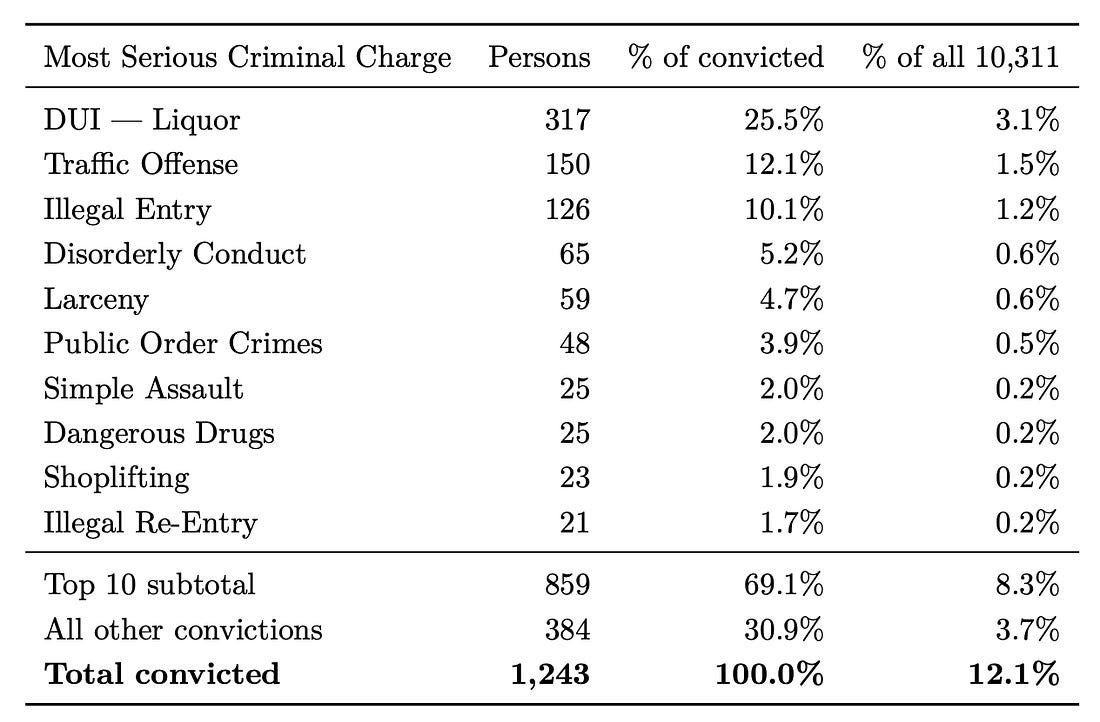
Over the entire population of 10,311 people who have passed through Delaney Hall since it re-opened, 1,243 out of 10,311, or 12.1%, had a conviction (fairly close to the most recent population). With respect to ICE’s claims about enforcement in the region, just two (0.02%) were recorded as having a homicide conviction (0.07% if you include all manslaughter), 24 (0.2%) people had a sexual assault conviction (including those against minors), 19 (0.2%) for drug trafficking, 9 (0.09%) for robbery and 12 (0.1%) for aggravated assault. The table below summarizes convictions for crimes that ICE used as emblematic of people in Delaney Hall. Again, even if we take the most generous interpretation of the data from ICE’s perspective, we find that ICE’s narrative fits less than 1% of the people ever held at the facility for any length of time.
Total people who have passed through Delaney Hall by criminal history.
ICE says it’s holding “murderers, rapists, pedophiles, and drug traffickers” at Delaney Hall, but the data simply does not support that. So who is ICE actually holding?
To repeat: the vast majority of people ever held have absolutely zero criminal convictions according to ICE’s own data. And those with criminal conviction do not fit ICE’s narrative. The table below shows the top 10 convictions—mostly the types of not-so-exciting crimes that are distributed throughout the population (the percent of DUIs is on par with the general population) and shaped by the inequalities within policing and the criminal legal system.
Make what you will of these convictions, but they hardly reflect Acting Assistant Secretary Lauren Bis’s claim that they desperately need Delaney Hall to deport “murderers, rapists, pedophiles, and drug traffickers.” If Bis wanted to be consistent with the data, what she should have said is, “the Trump administration believes it’s worth a billion dollars of taxpayer money to hold mostly people with no criminal conviction and a handful of people with low-level offenses that don’t represent a threat to public safety or national security.” That would at least be honest. Instead, the administration continues to treat extreme exceptions as the rule, and gaslight the public about who is actually impacted by mass deportation efforts.
When I write about the criminal histories of people in ICE detention, I usually emphasize the stark contrast between the Trump administration’s rhetoric and the reality of what ICE’s data says. But in the context of civil unrest, we can push this analysis further. Protest against Delaney Hall—like protests and anti-deportation activism in Minneapolis, rural Maryland, and across the country—can be understood as a symptom of ICE’s declining legitimacy for a growing number of Americans who view this type of immigration enforcement as clashing with American ideals of fairness, proportionality, and democracy.
How many people inside Delaney Hall have a final removal order?
ICE claims that it needs immigrant detention to facility mass deportation. Yet many of the people in ICE custody across the country still have pending cases in the immigration courts or federal courts. As of mid-March, the vast majority of people held at Delaney Hall—84.2%—did not have a final removal order and therefore were languishing in detention even though ICE could not remove them.³ Again, this may have changed somewhat from mid-March, but probably not dramatically.
Where were people in Delaney Hall arrested?
As I said above, the Delaney Hall facility is located in Newark, New Jersey, not that far from Manhattan, and is the largest ICE facility on the East Coast. But ICE facilities can hold people arrested anywhere in the United States. For those people who are at Delaney Hall now, one question I received was: where were they originally arrested? This is important for understanding which communities, cities, and states have ties to the facility and may have an investment in how people inside are treated.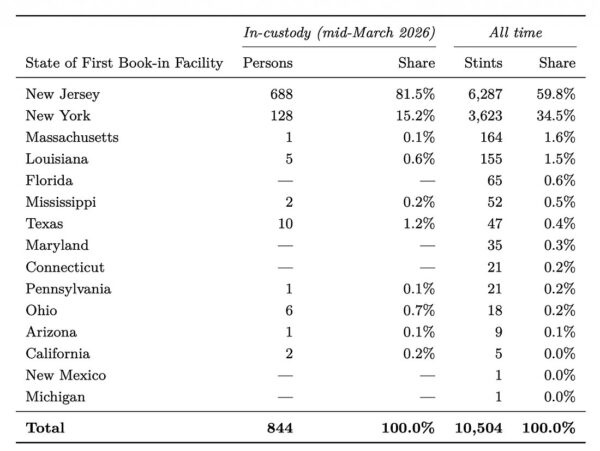
Using the initial book-in facility and state information, we can see that Delaney Hall is primarily use for people arrested in New Jersey and New York (>95%), with much smaller numbers of people originally arrested in the northeast and across the country. There is an important difference between the recent detained population versus the detained population at Delaney Hall for all time. The most recent population more heavily draws from arrests in New Jersey (81.5%) while the data for all time draws more heavily on New York State (34.5%). Thus, the vast majority of people held in Delaney Hall now and over the past year draw almost exclusively from residents in New Jersey and New York.
For the recently-detained population only, I wanted to drill into the specific initial book-in facility just to understand the pathway that people took to get to Delaney Hall. Based on this, the largest share of people were arrested straight into Delaney Hall and did not go to another facility first. But many also came from ICE hold rooms first, either in New Jersey or in Manhattan. about 80% of the people held in Delaney Hall in mid-March were arrested in New Jersey, mostly in the Newark area, and another 15% were arrested in the NYC area. Note that there are a very small number of cross-state arrests (e.g., Newark DCO arresting in New York State).
Delaney Hall Wrap-Up
I hope the data in the report is useful to reporters, researchers, policymakers, elected leaders, and the broad public. Feel free to use any of these tables and graphs with attribution. If you see any issues in the analysis above, please let me know. I would have liked to do much more analysis here, but I’m trying not to let the good be the enemy of the perfect. Comments welcome below.
 The data for this analysis comes from Detention Reports and the Deportation Data Project. Neither data source is as comprehensive or as up-to-date as we would need to answer every questions. Such is the nature of this work. Detention Reports is current as of April 2, but ICE has not released subsequent data, allegedly due to DHS budget negotiations. DDP’s data is more detailed but it is older, current through March 10. So the most recent data we have is two or three months old. A lot can change in a detention facility in two or three months, as we have seen over the past two years. Despite this, the data presented in this post is reliable enough for our purposes because we have not seen that much change recently in detention numbers so it is more likely today that data from two months ago roughly reflects reality today than it would have a year ago. That said, if you are citing these numbers, just be sure to correctly note the date of the data. Also remember that this lack of data isn’t a neutral observation, it’s a consequence of the lack of transparency within the immigration system.

The current dataset does not include information about pending charges. The agency could proactively release this data instead of forcing the public to go to great lengths to litigate for it, at great expense to the American taxpayer. But due to ICE’s deathly allergy to transparency and strong preference for cherry-picking stories that fit its rhetoric, ongoing litigation is the only way for the public to understand even basic, non-political facts about how immigration enforcement works.ICE is deporting people in a variety of ways that violate the law, too, so the gap between what is legal and what ICE will do seems to widen by the day.