
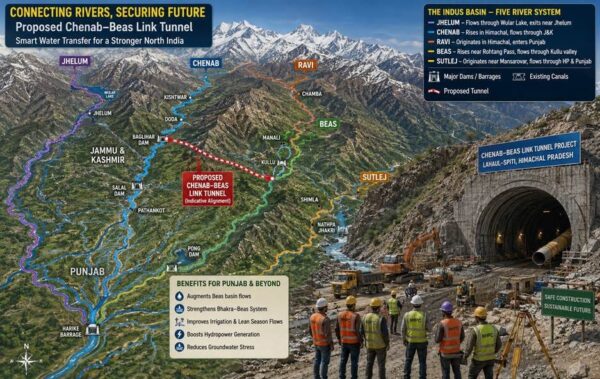
When Prime Minister Narendra Modi stood in Jalandhar in 2017 and promised that waters flowing into Pakistan would be brought for the farmers of Punjab, many laughed. Some dismissed it as election rhetoric. Others called it impossible. Nearly a decade later, that promise is no longer a slogan. It is beginning to take shape as policy, planning, tenders, canals, and tunnels. The proposed Chenab–Beas Link Tunnel is the first visible sign of that shift. It is not merely an engineering project. It is part of a larger national water doctrine: India’s rivers must first serve India’s farmers, citizens, and strategic interests.
Punjab fed India when the nation needed food security. It carried the burden of the Green Revolution, filled the national granaries and made India self-reliant in food. But that achievement came at a terrible ecological cost. Paddy expanded in a region where it should never have dominated. Tube wells multiplied. Free power, assured procurement and central food-security compulsions locked Punjab into a water-guzzling cycle. Today, Punjab’s fields may still look green, but its aquifers are collapsing.
Punjab’s groundwater extraction has crossed dangerous levels. This is not a routine agricultural problem; it is an ecological emergency. Punjab does not need sympathy. Punjab needs water security.That is why the Chenab–Beas Link must be understood through Punjab’s eyes.
The most concrete project now moving is the Chenab–Beas Link Tunnel at Koksar in Lahaul-Spiti. NHPC has initiated the tender process for civil works involving barrage structures, river diversion, power intake, a water-diversion tunnel and outfall structures. The project seeks to divert surplus flows from the Chandra, a headwater tributary of the Chenab, into the Beas basin. Once water enters the Beas, it strengthens the wider Beas–Sutlej–Bhakra–BBMB system. Punjab’s benefit will come through better storage, increased hydropower generation, improved lean-season canal reliability and reduced pressure on groundwater.
This must be stated accurately. The tunnel will not create a direct canal from the Chenab into Punjab’s fields. That would be an exaggeration. Its real value lies in strengthening the existing northern water grid. For a state facing severe groundwater stress, even indirect augmentation of the Beas–Bhakra system is a major gain.
But this tunnel is only the first visible step. Reports also speak of a far more ambitious 113-km Chenab–Ravi–Beas–Sutlej canal proposal, presently at feasibility stage. If pursued, it could connect surplus flows from Jammu & Kashmir with the Ravi–Beas–Sutlej network and eventually benefit Punjab, Haryana and Rajasthan. That would be the real conversion of Modi’s Jalandhar promise into a northern water architecture.
Other projects fit into the same doctrine. The Ranbir Canal expansion and greater Chenab utilisation in Jammu may not bring water directly to Punjab, but they signal that India is finally examining how to use more of the western-river waters that were long left under-utilised. The Ujh Multipurpose Project and the proposed second Ravi–Beas Link below Ujh are equally important. Ujh is a tributary of the Ravi, not Chenab or Jhelum, but its revival strengthens India’s use of Ravi waters and can support the broader Ravi–Beas system. Shahpur Kandi Dam is another crucial piece, because it helps stop Ravi water — already India’s under the Indus Waters Treaty — from flowing unutilised into Pakistan. It strengthens Punjab’s irrigation, power and canal network.

Taken together, these are not isolated works. They form a strategic chain: Chenab–Beas, Chenab–Ravi–Beas–Sutlej, Ujh, Shahpur Kandi, Ranbir Canal and the accelerated Chenab hydropower projects such as Pakal Dul, Ratle, Kiru and Kwar. Some are tendered. Some are completed. Some are under construction. Some are at feasibility stage. But the direction is unmistakable: India is moving from passive entitlement to active utilisation.
This is the heart of the matter.
For decades, India exercised restraint under the Indus Waters Treaty. Pakistan did not answer that restraint with peace. Terrorism, hostility and diplomatic obstruction continued. After the 2025 terror attack, India’s decision to place the Treaty in abeyance marked a decisive shift. Prime Minister Modi’s doctrine that blood and water cannot flow together is not a slogan. It is strategic realism.
Punjab has a special stake in this correction. It has paid the heaviest price for water politics. Partition severed its natural river geography. The 1966 reorganisation created the Ravi–Beas dispute. The SYL canal became a wound that entered Punjab’s political bloodstream, deepened mistrust and scarred a generation. The Indus Waters Treaty added another external constraint by allocating the western rivers largely to Pakistan, even though these waters rise from Indian territory.
For too long, Punjab was asked to serve India’s food-security needs while being left to manage the ecological consequences alone. That must change.
If India wants Punjab to move away from paddy, Punjab must be given reliable irrigation alternatives, canal modernisation, assured procurement for pulses and oilseeds, and transitional support for farmers. A farmer cannot be asked to abandon paddy merely through speeches. He must be given water security, price security and policy confidence.
That is why Modi’s commitment matters. In 2017, he articulated the vision in Punjab. In 2025, his government gave that vision strategic force. In 2026, projects like the Chenab–Beas Link show that the idea is moving from speech to structure.
This is not about reckless construction. The Himalayas are fragile. Lahaul-Spiti, Koksar, the Chandra headwaters, the Chenab basin and the Ravi–Ujh belt require serious geological, seismic, glacial and environmental safeguards. Fast-tracking must not mean cutting corners. But environmental caution cannot become a permanent veto on national water security. India must build carefully, but it must build.
The Chenab–Beas Link is more than an 8.7-km tunnel. The proposed 113-km canal is more than a feasibility study. Ujh, Shahpur Kandi and the Chenab hydropower projects are more than local works. Together, they represent a long-delayed correction: India is finally preparing to use its waters for its own people.
Punjab gave India food security. India must now help give Punjab water security.
That is the real meaning of this moment. Modi’s 2017 promise is moving from dream to reality. Punjab should welcome it firmly, intelligently. India’s waters must first serve India’s farmers and Punjab’s farmers must be among the first beneficiaries.