
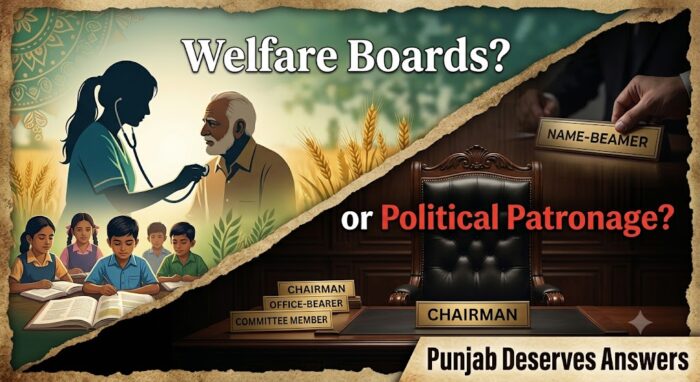
 The recent announcement by the Aam Aadmi Party (AAP) government in Punjab regarding the formation of Welfare Boards and the appointment of thousands of chairmen and office-bearers has raised serious questions about the government’s priorities. At a time when Punjab is facing enormous challenges such as unemployment, mounting debt, an agrarian crisis, drug abuse, and the migration of youth abroad, the government appears to be focused on creating a massive network of political appointments.
According to reports, the government is planning to appoint around 3,000 chairmen to various boards and committees while preparing a structure consisting of nearly 38,000 office-bearers. Such a move has naturally generated concern among the people of Punjab, who are wondering whether these appointments are genuinely intended for public welfare or are simply a mechanism to reward party loyalists and strengthen political control at the grassroots level.
The people of Punjab voted for change with the expectation that governance would become more efficient, transparent, and people-oriented. Instead, many observers see the creation of an army of chairmen and office-bearers as an attempt to expand political influence while placing an additional burden on the state exchequer. Every chairman and office-bearer comes with administrative costs, logistical support, and other expenses that are ultimately borne by taxpayers.
Critics argue that if the government truly wishes to improve the welfare of various communities, it should focus on strengthening existing institutions, improving public services, creating employment opportunities, and ensuring that welfare schemes reach deserving beneficiaries. Welfare cannot be achieved merely by creating new positions and distributing titles. Real welfare requires effective policies, accountability, and measurable results.
Many citizens also feel that the government is playing with the sentiments of Punjabis by presenting these appointments as a welfare initiative. People are increasingly asking whether Punjab needs thousands of chairmen or thousands of jobs for unemployed youth. They question whether the state’s scarce resources should be spent on expanding political structures when schools, hospitals, farmers, and small businesses require urgent support.
The move also raises concerns about transparency. The government must clearly explain the criteria for these appointments, the responsibilities attached to each position, and the financial implications involved. Without such transparency, suspicions of political favoritism and patronage will continue to grow.
Punjab’s history has shown that excessive political appointments often serve party interests more than public interests. Governments come and go, but the financial burden created by such decisions remains on the shoulders of ordinary citizens. Therefore, the people of Punjab have every right to demand accountability and justification for any large-scale expansion of government-appointed positions.
The AAP government must remember that public trust is earned through performance, not through the distribution of posts and designations. Punjabis expect solutions to their real problems, not the creation of a vast network of political appointees. If these Welfare Boards become instruments of political patronage rather than genuine public service, the people will rightly view them as an attempt to make a fool of the electorate rather than a sincere effort to improve welfare.
Punjab deserves governance that prioritizes development, employment, education, healthcare, and agriculture. The government should focus on delivering tangible results rather than creating an ever-growing army of chairmen and office-bearers. The people of Punjab are watching closely and will judge whether these decisions serve the public interest or merely the interests of those in power.
Disclaimer: The photographic elements used in the accompanying graphic are for symbolic and illustrative purposes only. The individuals depicted do not imply actual endorsement, involvement, or association with substance