
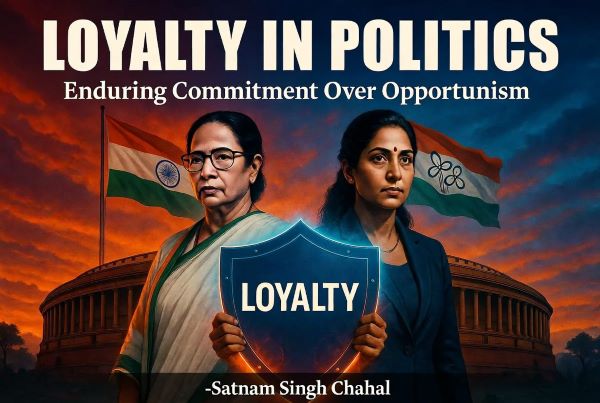
 Indian politics has long been marked by the phenomenon of political defections. Leaders rise within a party, enjoy positions of power and prominence, and then, when circumstances change, switch loyalties in search of personal gain or political survival. The story of the All India Trinamool Congress (AITC) is no exception. Over the years, several prominent leaders who once stood shoulder-to-shoulder with West Bengal Chief Minister Mamata Banerjee have left the party, joined rival camps, or openly challenged the leadership that helped build their political careers.
The history of AITC is filled with examples of leaders who benefited from the party’s organisational strength and Mamata Banerjee’s mass appeal, only to abandon the party when political opportunities appeared elsewhere. Many Members of Parliament and senior leaders who won elections under the Trinamool Congress banner later distanced themselves from the party. Such departures have repeatedly sparked debates about loyalty, ideology, and the growing culture of political opportunism in India.
In this environment, the political journey of Mahua Moitra stands out. Regardless of whether one agrees with her political views, few can deny that she has emerged as one of the most recognizable and influential political voices in contemporary India. Through her speeches, parliamentary interventions, and public engagements, Mahua Moitra has built a national profile that extends far beyond the boundaries of West Bengal. Today, she is among the most widely discussed leaders of the opposition, commanding attention across the country.
What makes her position particularly notable is that despite numerous political storms and controversies, she has remained firmly aligned with Mamata Banerjee and the Trinamool Congress. At a time when many leaders have chosen different paths, Mahua Moitra has continued to defend the party leadership and challenge those who have turned against it. Her public statements frequently reflect her commitment to the party’s political direction and her willingness to confront critics and former colleagues alike.
Political observers often point out that loyalty has become a rare commodity in modern politics. Electoral victories, cabinet positions, and political influence often tempt leaders to shift allegiances whenever the political winds change. In such an atmosphere, leaders who remain committed to their party through difficult periods naturally attract attention. Supporters of Mahua Moitra argue that her steadfastness demonstrates a level of political conviction that is increasingly uncommon in today’s political landscape.
The Trinamool Congress has witnessed several high-profile defections over the years, especially during periods of intense political competition with the Bharatiya Janata Party (BJP). Many former leaders who once praised Mamata Banerjee later became her fiercest critics. Such transitions often raise questions about whether political ideology is taking a back seat to personal ambition. Critics argue that frequent defections weaken democratic institutions by turning politics into a marketplace of opportunities rather than a contest of principles.
Within the Trinamool Congress, however, a core group of leaders has remained firmly with Mamata Banerjee. Figures such as Abhishek Banerjee, Sudeep Bandopadhyay, Kalyan Banerjee, and Mahua Moitra continue to be seen as key pillars of the party. Their continued support sends a message of stability and continuity at a time when political loyalties across India appear increasingly fluid.
Interestingly, political influence cannot always be measured by the number of rallies addressed or public meetings attended. Some leaders gain prominence through organizational work, while others build their reputation through parliamentary performance and public advocacy. Mahua Moitra’s supporters often argue that her impact comes less from the quantity of her appearances and more from the force of her arguments and her ability to articulate the party’s position on national issues.
The larger debate surrounding turncoat politicians is not limited to West Bengal or the Trinamool Congress. It is a national phenomenon affecting nearly every major political party. From state assemblies to Parliament, defections have become a recurring feature of Indian democracy. While leaders have every democratic right to change parties, voters often question the moral legitimacy of such decisions when they appear motivated primarily by power rather than principle
Ultimately, the contrast between political defectors and leaders who remain loyal highlights an important question for Indian democracy: should politics be guided by conviction or convenience? For many supporters of the Trinamool Congress, Mahua Moitra represents the politics of conviction a leader who, despite challenges and controversies, has chosen to stand with the party and its leadership. Whether history ultimately judges this loyalty as political wisdom or political risk, it has undoubtedly distinguished her from many contemporaries who chose a different path.
In an era when political allegiance often changes with electoral calculations, loyalty itself has become a political statement. The ongoing discussion around Mahua Moitra and the leaders who left the Trinamool Congress serves as a reminder that voters continue to value consistency, commitment, and the courage to stand by one’s political beliefs, even when doing so may not be the easiest choice.
Disclaimer: The photographic elements used in the accompanying graphic are for symbolic and illustrative purposes only. The individuals depicted do not imply actual endorsement, involvement, or association with substance