
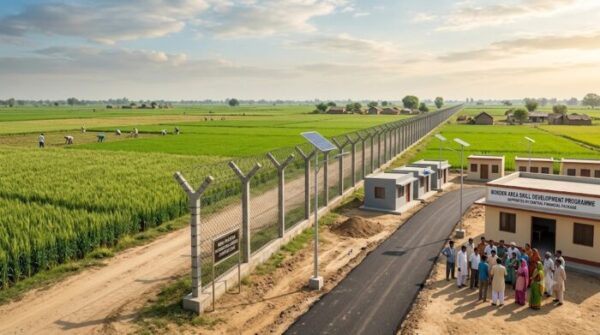
 India’s border regions continue to face unique geographical, economic, and security-related challenges that set them apart from other parts of the country. In this context, the long-standing demand for Special Category Status (SCS) and a dedicated financial package for border areas has once again come into focus. Leaders and policy observers argue that such support is essential to ensure balanced development and strengthen national security at the same time.
Border states such as Punjab, Jammu & Kashmir, Rajasthan, and the northeastern regions play a vital role in safeguarding India’s international boundaries. Among them, Punjab holds particular strategic importance due to its 553-kilometre border with Pakistan. At the same time, Punjab has historically contributed significantly to India’s food security through agriculture, earning its reputation as the “food bowl of India.” Despite this, concerns remain that the level of central assistance does not fully reflect the state’s strategic and economic contributions.
Special Category Status was introduced in 1969 to support states that face structural disadvantages such as difficult terrain, low population density, strategic border location, and economic backwardness. Under this classification, states receive higher levels of central assistance in development schemes, often with a significantly larger share of funding from the Centre compared to normal states. Although the classification is not part of the Constitution, it has historically been used as an important policy tool to address regional imbalance.
Border areas face multiple challenges that justify the demand for additional financial support. Security requirements often limit industrial development, as large tracts of land are used for defence infrastructure and surveillance. This reduces opportunities for private investment and job creation. As a result, many border districts experience slower economic growth compared to inland regions, leading to migration of youth in search of employment opportunities.
Infrastructure development in border regions also remains a major concern. Roads, healthcare facilities, educational institutions, and connectivity projects often lag behind national averages. In addition, border areas are more vulnerable to geopolitical tensions and emergency situations, which require immediate and substantial government response. These factors together create a strong case for targeted and sustained financial assistance from the Centre.
In recent years, state governments have increasingly demanded not only Special Category Status but also a dedicated border area development package. Such a package is often proposed to include industrial incentives, improved infrastructure, skill development programmes for youth, and special allowances for employees serving in difficult border regions. The objective is to encourage economic activity while also addressing long-standing developmental gaps.
At the policy level, the Centre has indicated that granting full Special Category Status has become difficult due to changes in fiscal frameworks and Finance Commission recommendations. Instead, the government has focused on providing customised financial packages and targeted schemes for specific sectors and regions. However, many states continue to argue that these measures do not fully replace the benefits that SCS once provided.
Overall, the issue of Special Category Status and financial packages for border areas highlights a broader concern of regional inequality and strategic development. Border states are not only geographically sensitive but also play a crucial role in national security and economic stability. Addressing their challenges through strong, sustained, and well-planned financial support is increasingly seen as essential for achieving balanced national development.
India’s border regions face unique economic, geographic, and security challenges. The demand for Special Category Status (SCS) and a dedicated financial package for border areas is once again gaining importance. It is seen as essential for balanced development and national security.
Border states like Punjab, Jammu & Kashmir, Rajasthan, and the Northeast play a key role in protecting India’s international boundaries. Punjab alone shares a long and sensitive border with Pakistan, making it strategically vital for the country.
Special Category Status was introduced in 1969 to support states facing structural disadvantages such as difficult terrain, border sensitivity, and economic backwardness. It allows higher central assistance and greater funding support for development.
Despite this, border areas continue to struggle with limited industrial growth, fewer job opportunities, and slow economic expansion. Security infrastructure requirements also restrict private investment in these regions.
Infrastructure gaps remain a major concern. Roads, healthcare, education, and connectivity in border districts often lag behind national averages, affecting long-term development and quality of life.
Frequent geopolitical tensions and emergency situations make border regions more vulnerable. This increases the need for stronger preparedness, faster response systems, and continuous financial support from the Centre.
Many states now demand not only Special Category Status but also a dedicated border area development package that includes industrial incentives, skill development programs, and infrastructure investment.
Border states are frontline regions for both national security and economic stability. A strong, sustained financial support system is not just a regional demand—it is a national necessity for balanced development.