
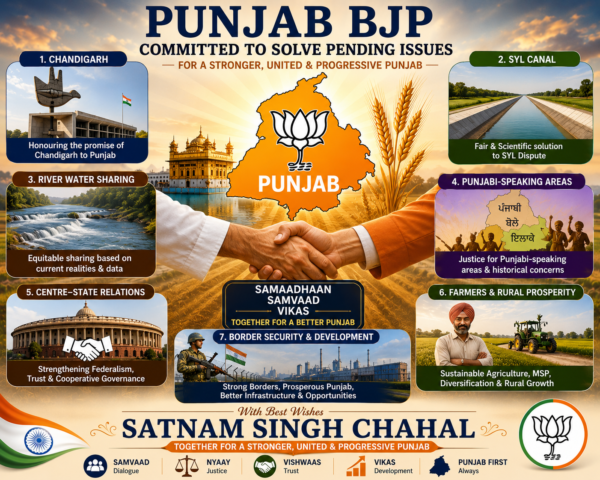
 More than six decades after the reorganisation of Punjab in 1966, several critical issues remain unresolved and continue to influence the state’s political, economic, and social landscape. These include the status of Chandigarh, the Sutlej-Yamuna Link (SYL) Canal dispute, the sharing of river waters, the transfer of Punjabi-speaking areas, and concerns regarding Centre-State relations. Successive governments at both the state and central levels have failed to provide permanent solutions. As the Bharatiya Janata Party (BJP) governs at the Centre with a strong parliamentary mandate, an important question arises: can the BJP finally resolve these long-pending issues and provide Punjab with the justice and stability it has sought for decades?
The reorganisation of Punjab in 1966 was intended to settle linguistic and administrative disputes by creating the new state of Haryana and transferring certain hill areas to what is now Himachal Pradesh. However, rather than ending controversies, the reorganisation left behind several unresolved questions that continue to create political friction. Punjab’s leaders and people have repeatedly argued that the promises made during the reorganisation process were never fully implemented. Consequently, many Punjabis view the issues of Chandigarh, territorial claims, and river waters as unfinished business of the 1966 settlement.
One of the most significant unresolved matters is Chandigarh. The city was built as the capital of Punjab after Partition and became a symbol of Punjabi identity and resilience. However, after the creation of Haryana, Chandigarh was made a Union Territory and shared as the capital of both states. Despite several assurances from various central governments that Chandigarh would eventually be transferred to Punjab, the issue remains unresolved. The BJP government possesses the political strength and administrative authority to initiate a comprehensive settlement. Such a settlement would require balancing the interests of both Punjab and Haryana while honoring past commitments. A clear roadmap, backed by political will, could finally bring closure to a dispute that has lingered for decades.
Another major issue is the Sutlej-Yamuna Link Canal dispute. Punjab has consistently opposed the construction of the canal, arguing that the state does not possess surplus water to share. Haryana, on the other hand, insists that it is entitled to its allocated share. The matter has been the subject of prolonged legal battles and political confrontations. The BJP, being in power at the Centre and influential in Haryana, is uniquely positioned to facilitate meaningful dialogue between stakeholders. Instead of allowing the issue to remain trapped in courtrooms and political rhetoric, the Centre could commission a fresh scientific assessment of water availability and pursue a solution based on current realities rather than outdated assumptions.
The broader issue of river water sharing is equally important. Punjab’s farmers face increasing challenges due to declining groundwater levels, changing climate conditions, and rising agricultural costs. Many experts argue that water-sharing agreements framed decades ago no longer reflect present realities. Punjab has consistently maintained that it should not be compelled to share water it does not have. A BJP-led central government could establish an independent national commission comprising hydrologists, agricultural experts, environmental scientists, and representatives of affected states to review existing arrangements. Such an evidence-based approach could help replace political confrontation with scientific and sustainable policymaking.
The question of Punjabi-speaking areas also remains unresolved. During the linguistic reorganization process, many Punjabi leaders alleged that several Punjabi-speaking villages and regions were left outside Punjab due to political considerations and controversies surrounding language declarations during census exercises. During the census controversies of the 1950s and 1960s, sections of Punjabi Hindu opinion were encouraged to declare Hindi rather than Punjabi as their mother tongue. Influential figures such as Lala Jagat Narain and sections of the press played a significant role in shaping public opinion during this period. Many Sikh and Punjabi organizations have long argued that these circumstances affected the determination of linguistic boundaries. If the BJP genuinely wishes to address historical grievances, it could consider establishing an impartial commission to review archival records and examine whether any legitimate concerns remain regarding territorial adjustments.
Centre-State relations constitute another critical area of concern. Punjab has historically advocated greater federal autonomy and has often expressed apprehension regarding excessive centralization of power. Disputes over agriculture, taxation, law and order, and administrative authority have periodically strained relations between the state and the Centre. The BJP has frequently emphasized cooperative federalism as a guiding principle. Demonstrating this commitment through greater consultation with state governments, respecting constitutional federalism, and engaging constructively with Punjab’s concerns could help reduce long-standing tensions and build trust.
The agricultural sector provides another area where decisive intervention is required. Punjab’s economy remains heavily dependent on farming, yet farmers continue to face declining profitability, groundwater depletion, and uncertainty regarding crop diversification. A comprehensive package from the Centre that includes guaranteed support for diversification, investments in agro-industries, irrigation modernization, and rural infrastructure could address many of the economic concerns fueling political dissatisfaction. The BJP government has the financial capacity and policy instruments necessary to launch such initiatives.
Border security and economic development are also interconnected challenges. As a border state, Punjab faces unique security concerns while simultaneously requiring greater industrial investment and employment opportunities. The BJP government could introduce a special economic package for border districts, strengthen infrastructure, encourage manufacturing, and expand trade opportunities where feasible. Such measures would not only improve economic conditions but also enhance national security by creating stronger and more prosperous border communities.
The success of any effort to resolve Punjab’s pending issues will ultimately depend on political sincerity and consensus-building. Legal authority alone cannot solve disputes that have accumulated emotional, historical, and political significance over many decades. Genuine consultation with political parties, farmers’ organizations, civil society groups, and constitutional experts will be essential. Any solution perceived as unilateral is unlikely to gain lasting acceptance.
The unresolved questions of 1966 continue to shape Punjab’s politics and public discourse even today. Chandigarh remains unresolved. The SYL dispute remains unresolved. River water sharing remains disputed. Punjabi-speaking areas remain outside Punjab according to many claimants. Centre-State tensions continue to resurface periodically. These realities demonstrate that the promises associated with Punjab’s reorganization have not been fully settled. If the BJP wishes to leave a lasting legacy in Punjab, it has an opportunity to address these historic issues through dialogue, fairness, and constitutional statesmanship. Whether it succeeds will depend not merely on political power but on the courage to pursue just and durable solutions that respect the aspirations of all stakeholders while safeguarding Punjab’s interests.