
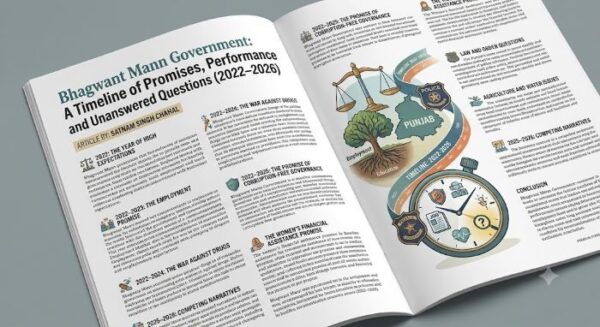
 When the Aam Aadmi Party (AAP) swept to power in Punjab in March 2022, it did so on the promise of bringing a structural change to the state’s political culture. Chief Minister Bhagwant Mann took office promising honest governance, an absolute end to corruption, decisive action against drugs and organised crime, and abundant employment opportunities for the youth. Additionally, the administration pledged to deliver better healthcare, improved public education, and direct financial relief for ordinary families. Four years into the mandate, the government boldly claims it has fulfilled all major electoral guarantees and successfully transformed governance across Punjab. Conversely, opposition parties strongly argue that several key promises remain unfulfilled, asserting that the gap between official rhetoric and ground realities continues to widen as the state heads toward its next electoral cycle.
After assuming office with a historic mandate, the Mann government immediately announced an aggressive anti-corruption drive, highlighted by the launch of a dedicated anti-corruption helpline. The newly formed administration promised transparent recruitment processes, an uncompromising stance against the drug menace, and an immediate end to the entrenched “VIP culture” that had dominated Punjab politics for decades. Simultaneously, the government promised massive employment avenues for the youth, pledging to transform Punjab into a model state. Backed by widespread public dissatisfaction with previous traditional governments, citizens expected rapid, visible, and systemic change across all administrative sectors.
Job creation stood as one of the cornerstone promises of the AAP election campaign. The government has consistently maintained that tens of thousands of government jobs have been provided through strictly transparent recruitment processes completely free of bribery and political nepotism. By 2026, official government statements proudly claimed that more than 65,000 government jobs had been successfully allocated purely on merit.
However, opposition parties continue to challenge these figures, questioning whether these appointments have genuinely made a dent in the state’s overall unemployment rate. Critics point out that private-sector investment has not kept pace, failing to create long-term economic opportunities for Punjab’s wider youth population. Consequently, the large-scale migration of young Punjabis seeking better prospects abroad remains an unaddressed and deeply troubling concern.
The AAP administration entered power promising a definitive, time-bound victory over drug trafficking and organized crime. Over the next two years, multiple high-profile anti-drug campaigns were launched, with the administration frequently highlighting increased arrests, multi-crore contraband seizures, and stricter enforcement measures as concrete evidence of its progress.Despite these intensive enforcement drives, drug addiction remains one of Punjab’s most painful and enduring social challenges. Opposition leaders, healthcare professionals, and social activists argue that the supply chain has not been broken, pointing out that the crisis continues to claim lives and devastate families across rural and urban sectors alike.
The Mann government consistently projected itself as a clean alternative to the traditional political establishment, claiming to have rooted out institutional graft. The administration frequently points to its merit-based hiring systems and rapid bureaucratic anti-corruption initiatives as historic milestones for the state.Critics, however, paint a different picture, arguing that corruption complaints continue to surface regularly across various local departments. They assert that while top-tier political corruption may have been targeted, deep-seated systemic reforms have failed to fully materialize, leaving ordinary citizens facing familiar grievances in their day-to-day interactions with government functions.
Perhaps the most heavily debated welfare guarantee from the 2022 campaign was the promise of direct financial assistance for women. Opposition parties have repeatedly seized on this issue, alleging that the monthly stipend has not been implemented in the manner or scale originally projected during the election rallies.For a large segment of the electorate, this pending guarantee has evolved into a central symbol of the wider political debate over whether the ruling government’s landmark pre-poll promises have been fully delivered or strategically delayed.
The state administration maintains that Punjab’s internal security has significantly improved through extensive police modernization, targeted anti-gangster operations, and stricter legal enforcement.However, recurring high-profile crimes, brazen incidents involving organized gangsters, and rising extortion complaints from the business community continue to generate acute public anxiety. Critics argue that despite official claims of an improved security apparatus, Punjab still grapples with significant law-and-order vulnerabilities that threaten public safety and investor confidence.
Punjab’s critical agrarian sector continues to face existential threats regarding water management, rapid groundwater depletion, inequitable canal distribution, and a lack of meaningful agricultural diversification. The Mann government has countered these concerns by highlighting the expansion of canal irrigation networks and targeted financial support for farmers as major achievements.Nevertheless, long-standing disputes relating to interstate river waters, the contentious Sutlej-Yamuna Link (SYL) canal issue, and the broader long-term economic sustainability of Punjab’s paddy-heavy agricultural system remain unresolved, leaving the state’s farming community in a state of ongoing uncertainty.
By 2026, the government presented a comprehensive four-year report card, confidently declaring that all major guarantees had been successfully honored. It highlighted universal free domestic electricity, thousands of merit-based government jobs, the expansion of healthcare clinics, education reforms, and infrastructure upgrades as undeniable proof of its success.At the exact same time, opposition parties intensified their offensive, countering that skyrocketing state debt, persistent unemployment, law-and-order lapses, unfulfilled welfare promises for women, and the unchecked brain drain of youth remain the defining realities of modern Punjab.
The ongoing political discourse surrounding the Bhagwant Mann government is ultimately a direct clash between two irreconcilable narratives. The government firmly maintains that it has delivered unprecedented, clean reforms and systematically fulfilled its sacred promises to the people. Conversely, the opposition insists that fundamental structural challenges have been ignored in favor of public relations exercises.As Punjab steadily marches toward its next Assembly election, the ultimate verdict rests with the voters. The defining question for the electorate will not merely be what was written in the initial manifesto, but whether the actual pace of governance has matched the monumental expectations that accompanied the historic 2022 mandate.