
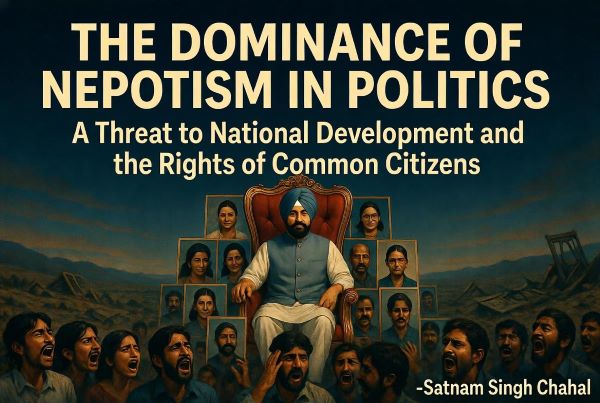
 Nepotism in politics refers to the practice where power, influence, and opportunities are concentrated within specific families or close networks, rather than being based on merit, capability, or public service. Over time, this pattern has become deeply embedded in many political systems, particularly in democracies where electoral success often gets converted into family inheritance. While democracy is meant to ensure equal opportunity for all citizens, nepotism undermines this principle by limiting access to leadership positions to a select few families.
One of the most serious consequences of political nepotism is the weakening of democratic values. When leadership positions are repeatedly passed within families, talented and deserving individuals from ordinary backgrounds are often pushed aside. This creates a system where loyalty to a family or dynasty becomes more important than loyalty to the public or the nation. As a result, governance suffers because decision-making is influenced more by personal or familial interests than by merit or public welfare.
Nepotism also directly affects national development. Leaders who come into power through family connections may lack the experience, training, or accountability required to govern effectively. In many cases, resources are misallocated, policies become short-sighted, and corruption risks increase. Most importantly, the voice of the common citizen becomes weaker, as political representation becomes concentrated in the hands of a few influential families.
There are several well-known examples of nepotism in politics across the world. In India, the most frequently cited example is the Nehru–Gandhi family, where multiple generations have held top leadership positions in the Congress party. Similarly, in regional politics, the Badal family in Punjab’s Shiromani Akali Dal, the Karunanidhi–Stalin family in Tamil Nadu’s DMK, and the Yadav family in Uttar Pradesh and Bihar politics are often cited as examples of dynastic control over political parties. These families have produced multiple Chief Ministers, Members of Parliament, and party leaders across generations.
Internationally, nepotism can also be observed in various forms. In several countries, political leadership has been passed within families, such as in the case of the Bhutto family in Pakistan or the Bush family in the United States. While supporters of such families argue that political legacy brings experience, critics maintain that it limits fair competition and discourages new leadership from emerging.
The most concerning impact of nepotism is on ordinary citizens. When political systems become dominated by a few families, public trust in democracy declines. Young and capable leaders without family background find it difficult to enter politics, even if they have strong public support or good intentions. This creates frustration among citizens and weakens the idea of equal opportunity, which is the foundation of democratic governance.
In conclusion, nepotism in politics is not just a moral issue but a structural challenge that affects governance, development, and democratic fairness. If countries want true progress, political systems must encourage merit, transparency, and equal opportunity rather than inherited power. Only then can the rights of common people be protected and democracy truly serve its purpose.
Disclaimer: The photographic elements used in the accompanying graphic are for symbolic and illustrative purposes only. The individuals depicted do not imply actual endorsement, involvement, or association with substance