
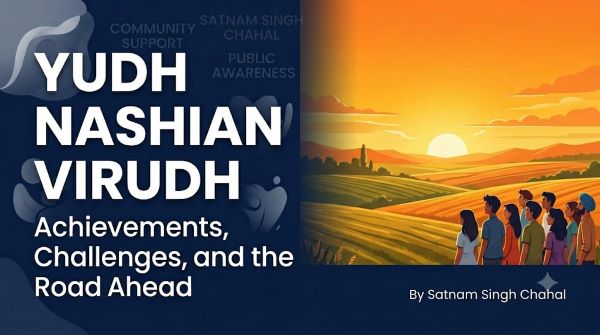
 Punjab’s battle against drugs has remained one of the most pressing social, economic, and political challenges facing the state for more than two decades. The menace of narcotics has affected thousands of families, weakened communities, and cast a shadow over the future of Punjab’s youth. Recognising the gravity of the problem, the Punjab government launched the “Yudh Nashian Virudh” campaign with the stated objective of eliminating drug trafficking and rehabilitating those trapped in addiction. The campaign represents one of the most ambitious anti-drug drives undertaken in recent years, but its success must ultimately be measured not by statistics alone, but by its long-term impact on society.
The campaign has been built on three principal pillars: strict enforcement against drug traffickers, treatment and rehabilitation of addicts, and public participation in the fight against narcotics. This multi-dimensional approach acknowledges that drug addiction is not merely a law-and-order issue but a complex social and public health challenge requiring coordinated action across various sectors.
From an enforcement perspective, the Punjab government has undertaken extensive operations against drug networks across the state. Police agencies have conducted raids, registered cases, and arrested thousands of individuals allegedly involved in drug trafficking and distribution. Large quantities of heroin, opium, synthetic drugs, and other narcotics have been seized. Authorities have also sought to target the financial foundations of the drug trade by attaching properties and tracing illegal money flows. Such measures are intended to weaken organized criminal networks that profit from addiction and exploit vulnerable communities.
The government argues that these actions demonstrate its commitment to dismantling drug cartels rather than merely arresting small-time peddlers. By targeting the financial infrastructure behind narcotics trafficking, officials aim to ensure that criminal organizations lose both their operational capacity and economic strength. This strategy reflects lessons learned from previous anti-drug campaigns, which often focused narrowly on arrests without sufficiently disrupting larger networks.
One of the distinguishing features of the “Yudh Nashian Virudh” campaign has been its emphasis on rehabilitation. The government has expanded de-addiction centres and Outpatient Opioid Assisted Treatment facilities to provide medical and psychological support to individuals struggling with substance abuse. The recognition that addicts require treatment rather than punishment marks an important shift in policy. Rehabilitation programs that include counseling, vocational training, and social reintegration can help recovering individuals rebuild their lives and reduce the likelihood of relapse.
However, rehabilitation alone cannot solve the crisis if the underlying causes of addiction remain unaddressed. Punjab’s drug problem is intertwined with issues such as unemployment, economic uncertainty, social pressures, and lack of opportunities for young people. Many experts argue that unless meaningful employment and educational opportunities are created, vulnerable sections of society may continue to fall prey to addiction. Therefore, anti-drug efforts must be integrated with broader strategies for economic development and youth empowerment.
Community participation has emerged as another important component of the campaign. Village panchayats, educational institutions, religious organizations, and civil society groups have been encouraged to participate in awareness programs and anti-drug initiatives. Public involvement is essential because law enforcement agencies alone cannot monitor every village or neighborhood. Sustainable success requires communities to actively resist drug trafficking and support those seeking recovery.
Despite these efforts, several challenges continue to confront Punjab’s anti-drug mission. One of the most significant is the state’s geographical location along the international border. Drug smugglers have increasingly used sophisticated methods, including drones, to transport narcotics across the border. The persistence of cross-border trafficking means that state-level efforts must be complemented by strong border management and cooperation between various security agencies.
Another challenge lies in measuring the true success of the campaign. Arrest figures and drug seizures provide evidence of government action, but they do not necessarily indicate a decline in addiction or drug availability. The ultimate indicators of success should include reduced overdose deaths, lower rates of substance abuse, improved health outcomes, and stronger communities. Such changes often take years to become visible and require sustained commitment across political administrations.
Critics of the campaign argue that previous governments also launched anti-drug drives with varying degrees of success. They caution that unless systemic reforms are implemented and anti-drug efforts remain consistent over time, the problem may resurface. Supporters of the campaign, however, contend that its comprehensive approach—combining enforcement, rehabilitation, and community engagement—represents a more effective strategy than earlier initiatives.
The road ahead requires a long-term vision. Punjab must strengthen rehabilitation infrastructure, expand employment opportunities, improve educational outreach, and enhance border security. Greater coordination between the state government, central agencies, civil society, and local communities is essential. Furthermore, policies aimed at sports promotion, skill development, and youth engagement can help provide positive alternatives to substance abuse.
The fight against drugs is not a battle that can be won overnight. It demands patience, perseverance, and collective responsibility. Governments may initiate campaigns, but lasting change requires active participation from society as a whole. Parents, teachers, religious leaders, and community organizations all have a role to play in safeguarding future generations.
The “Yudh Nashian Virudh” campaign represents an important step in Punjab’s continuing struggle against narcotics. Whether it ultimately succeeds will depend not merely on the number of arrests or seizures but on whether Punjab’s youth are given the opportunity to live healthier, more productive lives. The true victory in this war will be achieved when addiction no longer robs families of their loved ones and when Punjab’s future is defined by prosperity, resilience, and hope rather than the scourge of drugs.