
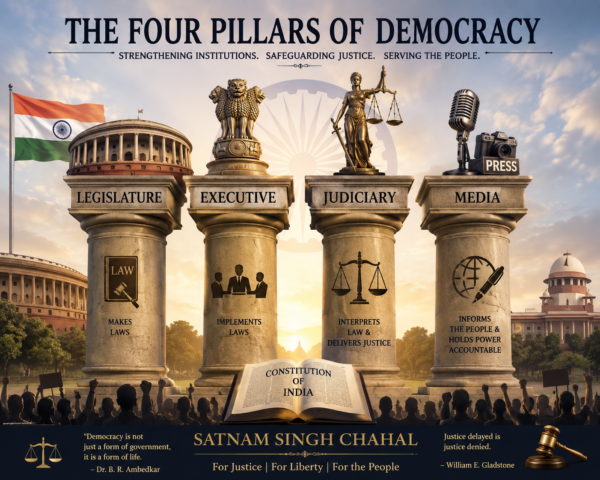
 Democracy is often described as the government of the people, by the people, and for the people. However, the success of any democratic system depends not merely on elections but on the proper functioning of its institutions. In a democratic nation, four pillars play a vital role in maintaining constitutional balance, protecting citizens’ rights, and ensuring justice. These four pillars are the Legislature, the Executive, the Judiciary, and the Media. Each pillar has a distinct role, and democracy flourishes only when all four function independently and responsibly.
The Legislature is responsible for making laws. In countries like India, Parliament and State Legislatures represent the will of the people through elected representatives. The legislature debates policies, passes laws, approves budgets, and holds the government accountable. It serves as the voice of the citizens and is expected to legislate in the public interest rather than for political or partisan gains. When legislators work honestly and transparently, they strengthen democracy and ensure that governance remains responsive to people’s needs.
The Executive is entrusted with implementing laws and administering the country. It consists of the government, including ministers, bureaucrats, and various administrative agencies. The executive ensures that policies are translated into action and that public services reach citizens effectively. A strong and accountable executive is essential for maintaining law and order, economic development, and social welfare. However, executive power must always remain subject to constitutional limitations and democratic oversight.
The Judiciary acts as the guardian of the Constitution and the protector of citizens’ rights. Courts interpret laws, settle disputes, and ensure that actions of the legislature and executive conform to constitutional principles. An independent judiciary is the backbone of justice because it provides citizens with a forum to challenge arbitrary actions of the state. Judicial independence ensures that even the most powerful individuals or institutions remain accountable under the rule of law.
The Media, often referred to as the fourth pillar of democracy, plays a crucial role in informing citizens, exposing corruption, and holding those in power accountable. A free and independent press acts as a bridge between the government and the people. Investigative journalism often uncovers wrongdoing and promotes transparency. However, media must exercise its freedom responsibly by adhering to facts and ethical standards rather than sensationalism or political bias.
The doctrine of separation of powers is fundamental to democracy. The legislature makes laws, the executive implements them, and the judiciary interprets them. This separation prevents concentration of power in one institution and creates a system of checks and balances. Democracy survives not because institutions are powerful, but because their powers are limited and balanced against one another.
A major concern arises when the legislature and judiciary become hand in glove with each other or fail to maintain institutional independence. If any two pillars begin to function in collusion, the delicate balance of democracy is disturbed. Justice requires impartiality and independence. If the judiciary loses its autonomy or appears to align too closely with the legislature or executive, public confidence in the justice system erodes. Citizens begin to fear that legal decisions are influenced by political considerations rather than constitutional principles and evidence.
Justice can only be delivered when judges remain free from external pressures and lawmakers respect the independence of the courts. A judiciary that merely endorses legislative or executive actions without adequate scrutiny risks undermining the rule of law. Equally, a legislature that interferes excessively in judicial matters weakens democratic institutions. The health of a democracy is measured not by the harmony between institutions but by their ability to independently check and balance one another.
History across the world has shown that whenever institutions become subservient to each other, democratic values suffer. Concentration of power often leads to abuse, corruption, and erosion of civil liberties. Therefore, preserving the independence of all four pillars is not merely a constitutional requirement but a moral obligation toward future generations.
In conclusion, the four pillars of democracy are the foundation upon which free societies are built. Their strength lies in their independence, accountability, and commitment to public welfare. Democracy thrives when each pillar performs its constitutional duties without fear or favor. If any pillar compromises its independence or forms alliances that weaken checks and balances, justice becomes difficult to achieve. A truly democratic society demands institutions that serve the Constitution and the people above all else. Only then can democracy deliver justice, equality, and liberty to every citizen.