
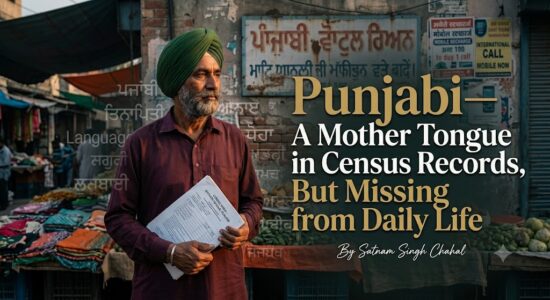
Punjabi is far more than a language; it is the soul of a civilization that has given the world saints, poets, philosophers, warriors, and scholars. It carries within it the teachings of the Sikh Gurus, the verses of Sufi saints, and the cultural memory of millions across the globe. Yet, despite its rich heritage and global presence, Punjabi has repeatedly faced efforts to diminish its status, portray it as inferior, or limit its growth. These efforts have taken different forms over time—political, communal, educational, and social.
The attempts to belittle Punjabi are not new. Throughout history, various arguments have been advanced to portray Punjabi as lacking the sophistication or historical depth of other Indian languages. However, these claims have been challenged by scholars from diverse backgrounds. One of the most notable voices in defense of Punjabi was Prof. O. P. Kahol, a leader associated with the Hindu Mahasabha. In his 1955 book Hindus and the Punjabi State, published by the Hindu Prachara Sabha, Ambala Cantonment, Kahol strongly defended Punjabi language and its script, Gurmukhi.
Prof. Kahol’s support for Punjabi is significant because it demonstrates that the language transcends religious and communal identities. He wrote: “Our language has immense potentialities and is pregnant with a rare linguistic genius if only we care to nurture and develop it. Let it not be said that the race of Panini—the Punjabi savant, who gave the world the most concise treatise on grammar—is extinct in the land of its origin.” Through these words, Kahol reminded readers that Punjab is the land of Panini, one of the greatest grammarians in human history, and that Punjabi is the inheritor of an ancient intellectual tradition.
Kahol further argued for the creation of a Punjabi-speaking state, not on religious grounds but on linguistic and cultural ones. He famously stated: “We want a Punjabi State for the unfoldment of Punjabi genius—nothing more, nothing less.” This assertion emphasized that the demand for a Punjabi state was rooted in the desire to preserve and promote the language and culture of the region, much like linguistic movements elsewhere in India.
One of the strongest arguments presented by Kahol concerned the antiquity of Punjabi. He examined linguistic evidence from Buddhist, Gupta, and Jain literature and concluded that Punjabi preserved many ancient words and forms. According to him, “The vocabulary of Punjabi is much the same as that of Pali and Prakrit.” These observations suggested that Punjabi was not a recent development but rather a language deeply connected to the earliest linguistic traditions of the Indian subcontinent.
Kahol also challenged the claims of those who sought to establish the superiority of Hindi over Punjabi. After studying examples from Sanskrit and Hindi, he concluded that Punjabi vocabulary was, in many respects, older than Hindi. He argued that while many Hindi words were relatively recent in origin, several Punjabi word forms were thousands of years old. In his view, Punjabi maintained a more organic connection with Sanskrit, whereas Hindi’s closeness to Sanskrit was often literary and reconstructed. While modern linguists may debate aspects of these claims, there is broad agreement that Punjabi is among the oldest and richest languages of South Asia.
The debate over Punjabi was never confined to language alone; it also involved script and identity. The Gurmukhi script, standardized by the Sikh Gurus, became a focal point of cultural and political disputes. Critics occasionally dismissed Gurmukhi as limited or unsuitable for modern needs. Yet history has proven otherwise. Today, Gurmukhi supports a vast body of literature, journalism, education, and digital communication, serving millions of readers worldwide.
The politics of language became especially visible during the colonial and post-independence periods. The Census of India of 1931 documented campaigns encouraging people to register Hindi rather than Punjabi as their mother tongue. A handbill published by Arya Samaj Wachhowali and reproduced in the census report reflected the linguistic contestations of the era. Similarly, sections of Punjabi Muslims identified Urdu as their mother tongue, influenced by social and political considerations. Thus, language in Punjab became intertwined with religious and communal identities in a manner rarely seen elsewhere.
The issue intensified during the 1951 and 1961 censuses, when vigorous campaigns reportedly urged people—particularly Hindus in Punjab—to register Hindi instead of Punjabi as their mother tongue. These campaigns had significant consequences because census figures influenced government policies, educational priorities, and the eventual reorganization of states. Unlike other regions of India, where linguistic identities generally aligned with spoken language, Punjab witnessed a unique situation in which mother tongue became a politically charged declaration.
The struggle for Punjabi eventually culminated in the creation of the Punjabi-speaking state of Punjab in 1966. However, the linguistic debates did not end there. Even today, Punjabi faces new challenges that are less political and more social in nature. The growing dominance of English as a language of upward mobility and globalization has affected many Indian languages, including Punjabi. Increasingly, urban families speak less Punjabi at home, while younger generations often become more comfortable in English or Hindi.
A matter of particular concern is the role of some private schools, where Punjabi is reportedly given secondary importance or, in some cases, subtly discouraged. Students may be encouraged to communicate exclusively in English, creating an impression that speaking Punjabi is less prestigious or less useful. Such practices can weaken the connection of young people with their linguistic and cultural heritage. While proficiency in English is undoubtedly valuable in a globalized world, it should not come at the cost of one’s mother tongue.
Language preservation does not require opposition to other languages. Punjabis can proudly speak Punjabi while also mastering English, Hindi, or any other language. Multilingualism enriches societies rather than dividing them. The challenge lies in ensuring that Punjabi receives the same respect and institutional support that other regional languages enjoy in India.
Timeline of Punjabi Language and Identity
Ancient Era (5th–4th Century BCE): Panini, believed to be from the greater Punjab region, develops one of the world’s earliest and most sophisticated grammatical systems.
Buddhist and Jain Periods: Linguistic traditions of Pali and Prakrit contribute to the evolution of Punjabi.
16th Century: The Sikh Gurus standardize the Gurmukhi script, strengthening Punjabi literature and identity.
1604: Compilation of the Guru Granth Sahib establishes Punjabi as a major literary and spiritual language.
1931: Census of India documents campaigns promoting Hindi or Urdu identification over Punjabi.
1951 Census: Mother tongue declarations become politically sensitive in Punjab.
1955: Prof. O. P. Kahol publishes Hindus and the Punjabi State, defending Punjabi language and culture.
1961 Census: Renewed campaigns influence linguistic declarations in Punjab.
1966: Reorganization of Punjab creates a Punjabi-speaking state.
Present Day: Concerns grow over declining use of Punjabi in homes and private schools despite its global expansion through the diaspora.
Punjabi has survived invasions, partitions, political disputes, and changing social trends. Its resilience lies in the love and pride of its speakers. The future of Punjabi will depend not only on government policies but also on families, educators, and communities choosing to speak, teach, and celebrate their mother tongue. As Prof. O. P. Kahol observed decades ago, the objective is not the supremacy of one language over another, but the natural unfolding of Punjabi genius—a legacy that deserves preservation for generations to come.