
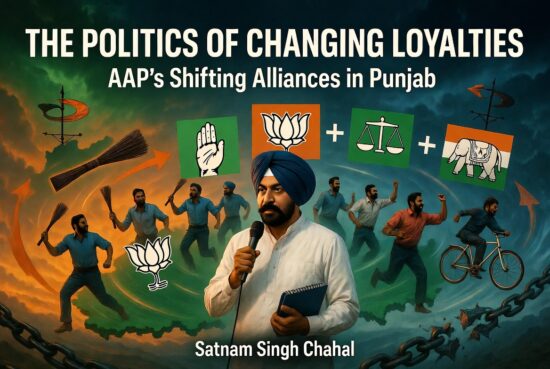
Indian democracy is built on the foundations of debate, ideological differences, and the freedom of political expression. In a vibrant democracy, it is natural for leaders to disagree, form alliances, and even change their positions over time. However, in recent years, a growing trend has emerged in which some political leaders publicly support a party or an individual one day and sharply criticize the same person or party the next. Such frequent reversals have raised serious questions about political morality, ideology, and public trust.
The issue is not limited to any single political party or ideology. Across the political spectrum in India, leaders have been seen praising former rivals when political circumstances demand cooperation and later attacking them when alliances collapse. While politics is often described as the “art of the possible,” excessive shifts in loyalty can create confusion among voters and weaken faith in democratic institutions.
The phenomenon of changing political loyalties is not new to India. In fact, one of the earliest examples dates back to 1967 when Haryana legislator Gaya Lal switched political parties multiple times within a short span. The incident gave rise to the famous phrase “Aaya Ram, Gaya Ram,” which has since become synonymous with political opportunism in India. The frequent defections of legislators during that period eventually led to the enactment of the Anti-Defection Law in 1985, aimed at curbing unprincipled party switching.
During the 1970s, Indian politics witnessed another major shift. Following the Emergency imposed by Prime Minister Indira Gandhi from 1975 to 1977, several opposition parties united to form the Janata Party and successfully defeated the Congress government in the 1977 elections. Leaders who had stood shoulder-to-shoulder against the Congress soon developed internal differences and turned against one another. Within a few years, the government collapsed, demonstrating how alliances built primarily on opposition to a common enemy often struggle to survive.
The era of coalition politics that emerged in the late 1980s and 1990s further intensified this trend. Governments increasingly depended on support from multiple regional parties with differing ideologies. Political allies often withdrew support unexpectedly, bringing down governments and altering political equations overnight. Leaders who had once praised each other in public rallies suddenly became critics when political interests diverged.
The period between 1998 and 2004 saw the formation of the National Democratic Alliance (NDA) under the leadership of the Bharatiya Janata Party (BJP). Several regional parties joined the alliance, only to leave later over political disagreements. Similarly, some parties that had once fiercely opposed the BJP later aligned with it when electoral circumstances changed. These shifts reflected the complex nature of coalition politics but also fueled criticism that ideology was taking a back seat to political expediency.
A similar pattern was visible during the United Progressive Alliance (UPA) era from 2004 to 2014. Various regional parties joined and exited the coalition based on changing political priorities. Leaders who once called each other allies later became opponents, only to occasionally reunite under different circumstances. Such developments reinforced the perception that political relationships in India are increasingly driven by calculations of power rather than long-term principles.
The rise of social media in the last decade has made political reversals more visible than ever before. Unlike earlier times, speeches, interviews, tweets, and public statements remain permanently accessible online. As a result, when leaders change their stance, old videos and statements often resurface, exposing contradictions. Citizens can now easily compare what a leader said yesterday with what they say today, increasing public scrutiny and accountability.
Recent years have witnessed numerous instances where political leaders have praised opponents while forming alliances and later accused the same individuals of corruption, incompetence, or anti-national behavior after political separation. Likewise, politicians who had once strongly criticized a party have later joined it, citing changed circumstances or national interest. Such developments often leave voters puzzled and raise questions about whether political commitments are based on ideology or personal ambition.
This phenomenon is not unique to India. In countries such as Italy, governments have historically changed frequently due to shifting alliances among political parties. In the United Kingdom, coalition arrangements have occasionally brought together parties with differing ideologies. Even in the United States, while party switching is less common, politicians have changed positions on major policy issues in response to public opinion and political realities. However, democracies across the world face similar debates about the balance between pragmatism and principle.
Frequent political reversals have significant consequences for democracy. One of the most serious impacts is the erosion of public trust. When citizens repeatedly witness leaders changing their positions for political convenience, they may begin to question the sincerity of political commitments. This can lead to cynicism, voter apathy, and declining faith in democratic institutions.
Another concern is the weakening of ideology in politics. Political parties are expected to represent certain principles and policy visions. When leaders shift positions too frequently, politics risks becoming centered on personalities and power rather than ideas and governance. This weakens democratic accountability and makes it harder for voters to make informed choices.
At the same time, it is important to recognize that not every change in position is inherently wrong. Leaders may evolve their views due to new evidence, changing national circumstances, or the demands of public welfare. A principled change based on transparency and genuine reflection is different from opportunistic shifts motivated solely by the pursuit of power. Democracies must allow room for political evolution while also demanding accountability from leaders.
Ultimately, democracy thrives when leaders remain consistent in their core values, even if political alliances change. Citizens may forgive political compromises made in the national interest, but they are less likely to accept frequent contradictions that appear driven by self-interest. As India continues to mature as a democracy, voters are increasingly demanding not just political success but also integrity, consistency, and principled leadership.
The future of Indian democracy depends not only on free elections but also on the trust between citizens and their leaders. Political alliances may come and go, but credibility, once lost, is difficult to regain. Leaders who prioritize principles over convenience are more likely to leave a lasting legacy, while those who frequently change sides risk becoming symbols of political opportunism.
Share via: