
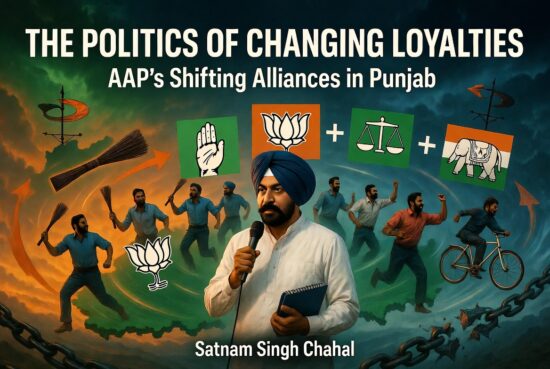
The Aam Aadmi Party (AAP) entered Punjab politics as a disruptive third force, with a clear strategy to avoid pre-poll alliances to maintain its image of clean, anti-corruption politics. Over the years, its approach has shown tactical flexibility contesting alone where it is strong, forming selective national partnerships for broader leverage, and engaging in pragmatic post-poll or issue-based alignments. This has often drawn accusations of opportunism, especially amid internal fractures. In its early phase from 2014 to 2021, AAP positioned itself as a solo disruptor in Punjab. It rejected alliances in both the 2014 Lok Sabha and 2017 Assembly elections, directly challenging the traditional SAD-BJP versus Congress bipolarity. By 2021-22, AAP leaders repeatedly emphasised contesting all 117 seats independently, capitalising on strong anti-incumbency against the ruling Congress and lingering resentment against SAD-BJP over issues like farm laws and sacrilege cases.
The 2022 Assembly elections marked AAP’s biggest success. It secured a historic landslide with 92 out of 117 seats, winning an independent mandate without needing any coalition partners. Bhagwant Mann became Chief Minister, and the party’s Delhi-model promises of free power, healthcare, and education helped break Punjab’s traditional political duopoly.At the national level, AAP joined the Congress-led INDIA bloc ahead of the 2024 Lok Sabha polls. However, in Punjab itself, it largely maintained distance and contested mostly independently, winning three seats while Congress took others. This “allies nationally, rivals locally” formula highlighted AAP’s pragmatic approach. After the 2024 results, AAP exited the INDIA alliance in 2025, describing the partnership as temporary.
In the current 2025-2026 phase, AAP has faced significant internal challenges including high-profile defections of leaders and Rajya Sabha MPs (some joining BJP), yet it demonstrated resilience by dominating the 2026 municipal elections with around 48% of wards. No major state-level alliances have been formed for the upcoming 2027 Assembly polls, with AAP preferring to go solo once again while banking on its governance record.AAP’s alliance strategy in Punjab is driven by a balance between its core anti-establishment ideology and political pragmatism. Strong regional sentiments and Punjab-specific issues make deep alliances with traditional parties risky for its brand. While it uses national partnerships for visibility and anti-BJP coordination, it protects its stronghold in the state through independence. Looking ahead to 2027, AAP is expected to contest alone, with Congress emerging as the main challenger and BJP-SAD possibly reviving through defections. Punjab’s fluid politics means loyalties remain unpredictable, but AAP’s grassroots performance in recent civic polls gives it a solid base for now.
Predictions for the 2027 Punjab Assembly ElectionsWith elections scheduled for February 2027, AAP is widely expected to contest all seats independently, leveraging momentum from its strong 2026 civic body performance. However, recent opinion polls (as of mid-2026) present a challenging picture for the incumbent AAP.Multiple surveys project Congress as the frontrunner with 52–59 seats, followed by AAP with 32–36 seats, SAD with 14–21 seats, BJP with 9–12 seats, and others taking the rest. These projections reflect growing anti-incumbency on issues like unemployment, law and order, and farmer distress, alongside Congress’s organizational revival.AAP’s strong showing in urban civic polls provides it a solid base in cities and semi-urban areas, but rural and Malwa regions remain contested.
A hung assembly (no party reaching the 59-seat majority) is a distinct possibility due to the four-cornered contest. In such a scenario, post-poll alliances could emerge, though AAP has historically resisted them in Punjab.Overall, while AAP starts with incumbency and welfare scheme visibility, current trends suggest it may struggle to retain its 2022 majority. Congress appears best positioned to challenge for power, with BJP and SAD playing key roles as potential kingmakers or spoilers. Punjab’s famously fluid politics means final outcomes will depend heavily on campaign momentum, voter turnout, and any last-minute realignments.