
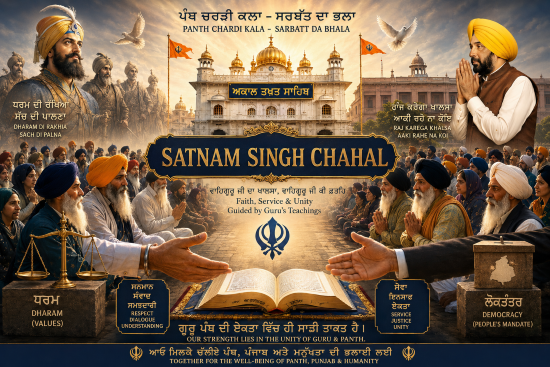
 The recent controversy involving Punjab Chief Minister Bhagwant Mann and the directives issued by Akal Takht Sahib has generated intense debate across Punjab and among Sikhs worldwide. The issue has gone beyond politics and entered the realm of religious authority, community identity, and the relationship between elected governments and Sikh institutions. While reactions vary, a significant section of the Sikh Sangat appears to view the matter through the lens of respect for Sikh institutions rather than party politics.
The Akal Takht Sahib occupies a unique place in Sikh history and tradition. Established by Guru Hargobind Sahib in 1606, it serves as the supreme temporal seat of the Sikh Panth. Historically, Sikhs have looked toward the Akal Takht for guidance on religious and Panthic matters. Over centuries, its authority has survived invasions, colonial rule, and political upheavals. For many Sikhs, disagreement with an individual office holder may be acceptable, but questioning the institution itself is often viewed differently.
The controversy involving Bhagwant Mann emerged after allegations and videos related to his conduct became subjects of discussion. When religious authorities at the Akal Takht took cognizance of the matter and reportedly issued directives, political reactions quickly followed. Supporters of the Punjab government argued that political motives could be influencing the controversy, while critics maintained that all Sikhs, irrespective of political affiliation, should respect the decisions of the Akal Takht Sahib.
Among the Sikh Sangat, reactions appear to be diverse but generally fall into several broad categories. A large number of Sikhs, especially those with strong religious affiliations, emphasize that the sanctity and authority of the Akal Takht Sahib must remain above politics. For them, the issue is not whether an individual agrees with a particular Jathedar or political party, but whether the institution’s authority is respected.
Another section of the Sangat believes that institutions should remain free from political influence. These Sikhs express concern whenever religious bodies become entangled in political disputes. However, even among such individuals, there is often a distinction made between criticizing individuals managing institutions and questioning the institution itself.
Supporters of the ruling party, particularly members and sympathizers of the Aam Aadmi Party, tend to view the controversy through a political lens. They argue that elected leaders derive legitimacy from the people’s mandate and should not be subjected to politically motivated campaigns. Nevertheless, many of these supporters also acknowledge the historic importance of the Akal Takht Sahib and call for dialogue rather than confrontation.
The Sikh diaspora in countries such as Canada, United States, and the United Kingdom has also been closely watching developments. Diaspora Sikhs often place significant importance on preserving Sikh institutions because these institutions help maintain identity far from Punjab. Consequently, reactions abroad frequently stress the need to protect the dignity of both democratic offices and religious institutions.
Historically, whenever tensions have arisen between political leaders and the Akal Takht Sahib, Sikh society has generally preferred reconciliation over prolonged confrontation. The Sikh tradition places great emphasis on humility, dialogue, and collective decision-making through the Panth. Many observers believe that any dispute involving religious authority should be resolved in a manner that preserves the dignity of all sides while upholding Sikh principles.
The current episode highlights a broader challenge facing Punjab: balancing democratic governance with the deep religious sentiments of the Sikh community. Political leaders come and go, governments change, and parties rise and fall. However, institutions such as the Akal Takht Sahib hold a centuries-old place in Sikh history. At the same time, elected governments represent the democratic will of the people. The long-term stability of Punjab may depend on ensuring that political disagreements do not evolve into institutional conflicts.
Ultimately, the majority sentiment among the Sikh Sangat appears to favor maintaining respect for the Akal Takht Sahib while expecting fairness, transparency, and due process in all matters. Regardless of political preferences, many Sikhs believe that preserving the dignity of Sikh institutions and maintaining communal harmony should remain the highest priority.
Disclaimer: This article and accompanying images are for informational and illustrative purposes only. Some visuals may be AI-generated or digitally enhanced and may not depict actual events or persons. Views expressed are based on publicly available information and analysis.