
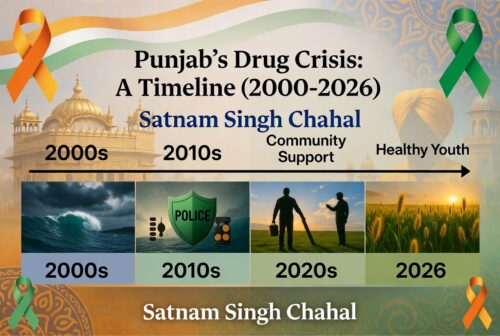
 Punjab’s War Against Illegal Drugs: Achievements, Challenges, and the Road Ahead
For more than two decades, Punjab has been battling the growing menace of illegal drugs. Successive governments have launched anti-drug campaigns, increased police action, and established rehabilitation centers to address the crisis. The current government’s campaign, often referred to as the “War Against Drugs,” has intensified efforts against drug trafficking and addiction. However, despite these initiatives, an important question remains: how much of the drug problem has actually been eliminated, and how much still remains unresolved?
The Punjab government and law enforcement agencies have reported significant achievements in recent years. Thousands of cases have been registered under the Narcotic Drugs and Psychotropic Substances (NDPS) Act, and large quantities of heroin, synthetic drugs, and narcotic tablets have been seized. Hundreds of alleged drug traffickers have been arrested, and properties linked to drug smuggling have been attached or demolished in some cases. These actions indicate that the authorities are actively targeting the supply side of the drug trade.
At the same time, the large number of seizures and arrests also highlights the continuing scale of the problem. If drugs continue to be seized in large quantities year after year, it suggests that while law enforcement may be disrupting trafficking networks, illegal drugs have not been completely eliminated from Punjab. Experts believe that drug addiction is not merely a law-and-order issue but a social, economic, and public health challenge that requires a comprehensive approach.
A significant amount of public money has been spent on anti-drug campaigns in Punjab. The government allocates funds for police operations, intelligence gathering, awareness campaigns, treatment programs, and rehabilitation facilities. Crores of rupees have been invested in strengthening de-addiction infrastructure and launching public awareness initiatives. While these expenditures demonstrate the seriousness with which governments have approached the issue, questions remain regarding transparency and the long-term effectiveness of these investments.
One of Punjab’s major achievements has been the establishment of an extensive network of drug de-addiction and rehabilitation centers. The state now has hundreds of de-addiction facilities, including government-run and private centers. In addition, numerous Outpatient Opioid Assisted Treatment (OOAT) clinics operate across the state to provide medication and counseling to individuals struggling with addiction. The expansion of treatment infrastructure reflects recognition that addiction must be treated as a health issue rather than solely a criminal matter.
The performance of these de-addiction centers presents a mixed picture. On the positive side, thousands of individuals have reportedly undergone treatment and many have successfully returned to normal life. Families that had lost hope have seen loved ones recover and reintegrate into society. However, addiction treatment is often a long-term process, and relapse remains a major challenge not only in Punjab but worldwide. Without continuous support, counseling, and employment opportunities, some recovering addicts may return to substance abuse.
Experts have repeatedly emphasized that rehabilitation cannot end with medical treatment alone. Former addicts often need skill development, job opportunities, mental health services, and social acceptance to rebuild their lives. In the absence of employment and support systems, vulnerable individuals may again fall into addiction or become involved in criminal activities. Therefore, rehabilitation must include economic and social reintegration.
Another challenge is measuring the actual success of anti-drug campaigns. Governments frequently release figures on arrests, seizures, and treatment numbers, but less information is available regarding long-term recovery rates or relapse statistics. The true measure of success should not only be how many kilograms of drugs were seized, but also how many individuals remain drug-free years after treatment.
The fight against drugs in Punjab has undoubtedly produced important results. Law enforcement actions have disrupted trafficking networks, treatment facilities have expanded, and public awareness has increased. Yet, the drug menace has not been completely eradicated. The persistence of drug abuse indicates that much work remains to be done.
Ultimately, creating a drug-free Punjab will require more than police action alone. It will demand coordinated efforts involving government agencies, healthcare professionals, educational institutions, community organizations, families,
and society at large. Only through sustained commitment, transparency, rehabilitation, and economic opportunities can Punjab hope to permanently overcome the challenge of illegal drugs and secure a healthier future for its
younger generations.
Disclaimer: This article and accompanying images are for informational and illustrative purposes only. Some visuals may be AI-generated or digitally enhanced and may not depict actual events or persons.
Views expressed are based on publicly available information and analysis.