
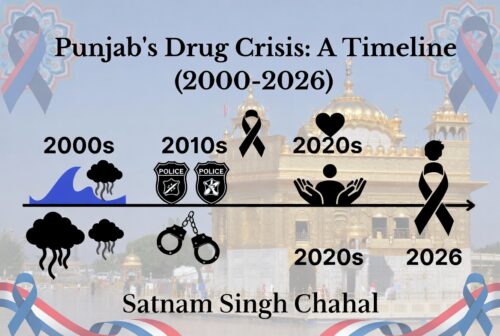
 Punjab’s Drug Crisis: A Timeline (2000–2026)
Punjab’s struggle against illegal drugs has been one of the state’s greatest social and public health challenges over the past two decades. What began as isolated concerns in the early 2000s gradually evolved into a widespread crisis affecting thousands of families, particularly among the youth. The drug problem has had social, economic, and political dimensions, prompting governments, law enforcement agencies, and civil society organizations to take various measures over the years. The following timeline traces the major developments in Punjab’s drug crisis from 2000 to 2026.
In the early 2000s, Punjab began witnessing an increase in the use of traditional intoxicants such as opium and poppy husk (bhukki). Although these substances had been consumed in some rural communities for decades, concerns started emerging about the growing misuse of pharmaceutical drugs and narcotics. Punjab’s geographical location along the India-Pakistan border made it vulnerable to drug trafficking routes originating from the “Golden Crescent,” comprising Afghanistan, Pakistan, and Iran.
By the mid-2000s, heroin—commonly known as “chitta”—started making significant inroads into Punjab. Drug trafficking networks became increasingly organized, and reports of addiction among young people, particularly in rural areas, began to rise. Families and local communities started noticing the harmful effects of addiction, but the issue had not yet become a major public concern.
Between 2010 and 2012, the drug problem moved into the public spotlight. Media reports highlighted rising cases of addiction, overdose deaths, and family distress linked to drug abuse. Civil society organizations and health experts warned that Punjab was facing a serious drug epidemic. Political parties also began raising the issue, making it an important topic during elections.
Recognizing the severity of the crisis, authorities strengthened anti-drug efforts around 2013. Specialized units and task forces were established to investigate trafficking networks and increase enforcement under the Narcotic Drugs and Psychotropic Substances (NDPS) Act. The focus was largely on arrests, seizures, and dismantling supply chains, although experts emphasized that enforcement alone would not solve the problem.
By 2014, alarming statistics underscored the magnitude of the crisis. Punjab accounted for a disproportionately high number of drug-related cases and convictions under the NDPS Act. Public concern deepened as reports of overdose deaths and addiction-related social problems continued to emerge.
A major turning point came in 2015 with the Punjab Opioid Dependence Survey (PODS). The survey estimated that approximately 230,000 individuals in Punjab were dependent on opioids, with most users belonging to the 18–35 age group. The findings shocked policymakers and the public alike, revealing the widespread nature of addiction and the urgent need for treatment and rehabilitation.
In 2016, the release of the Bollywood film Udta Punjab brought national and international attention to the state’s drug crisis. Although fictional, the film sparked intense debate about the reality of addiction in Punjab and increased public awareness of the issue.
The years 2017 through 2019 saw an expansion of de-addiction and rehabilitation infrastructure. Governments increased investments in treatment facilities, counseling services, and awareness campaigns. The recognition that addiction was a public health issue, rather than merely a law-and-order problem, gained wider acceptance among policymakers and experts.
The COVID-19 pandemic in 2020 and 2021 created new challenges. Lockdowns disrupted trafficking routes temporarily, but addiction treatment services also faced operational difficulties. Experts observed shifts toward synthetic drugs and pharmaceutical misuse, while concerns grew about relapse among recovering addicts due to social and economic stress.
A new phase began in 2022 when the newly elected government in Punjab intensified anti-drug efforts. Large-scale campaigns targeted drug traffickers, leading to thousands of arrests and increased seizures of heroin and other narcotics. Authorities also initiated actions against properties allegedly linked to drug smuggling networks.
During 2023 and 2024, security agencies increasingly reported the use of drones for cross-border smuggling of heroin, weapons, and cash into Punjab. This development highlighted the evolving nature of the drug trade and the growing involvement of organized crime networks. Law enforcement agencies responded by strengthening surveillance and coordination with border security forces.
In 2025, Punjab launched the campaign “Yudh Nashian Virudh” or “War Against Drugs,” combining enforcement with treatment and public awareness. The campaign led to thousands of arrests, increased drug seizures, and expanded rehabilitation efforts. Additional beds were added to de-addiction centers, and the state further strengthened its treatment infrastructure.
By 2026, Punjab had developed one of India’s largest networks of de-addiction and Outpatient Opioid Assisted Treatment (OOAT) centers. Thousands of individuals had reportedly received treatment, reflecting the government’s emphasis on recovery and rehabilitation. However, experts cautioned that addiction remains a long-term challenge requiring sustained efforts in prevention, treatment, employment generation, and social reintegration.
The history of Punjab’s drug crisis from 2000 to 2026 is both a story of struggle and resilience. While significant progress has been made in enforcement and rehabilitation, the challenge is far from over. The ultimate success of Punjab’s war against drugs will depend not merely on the quantity of drugs seized or the number of arrests made, but on whether future generations can grow up in a healthier, drug-free environment.
Disclaimer: This article and accompanying images are for informational and illustrative purposes only. Some visuals may be AI-generated or digitally enhanced and may not depict actual events or persons.
Views expressed are based on publicly available information and analysis.