
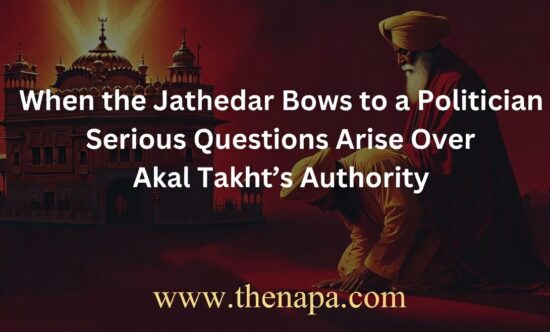
 For many Sikhs across the world, one question has been repeatedly coming to mind in recent days: Why did the present Jathedar of Sri Akal Takht Sahib touch the feet of political leader Sucha Singh Langah? Regardless of the circumstances surrounding the meeting, the image of the highest temporal authority of the Sikh Panth bowing before a politician has disturbed many members of the Sikh community. The concern is not merely about one individual or one incident; it is about the dignity, independence and supreme authority of Sri Akal Takht Sahib.
Sri Akal Takht Sahib was established by the Sixth Guru, Sri Guru Hargobind Sahib Ji, as the highest seat of Sikh temporal authority. Throughout Sikh history, kings, rulers and political leaders have appeared before the Akal Takht in humility. The institution has symbolized justice, equality and fearlessness. Traditionally, political leaders seek guidance from the Akal Takht, not the other way around. Therefore, when the head of this revered institution is seen touching the feet of a political figure, many Sikhs feel that the symbolic stature of the Akal Takht has been diminished.
The controversy becomes even more sensitive because of Sucha Singh Langah’s past history with the Akal Takht. In 2017, Langah was excommunicated after being booked in a rape case and after an objectionable video became public. At that time, Sikh clergy concluded that his conduct had damaged the image of the Sikh community. The decision was widely viewed as an assertion of the Akal Takht’s moral authority over political leaders.
In November 2022, Langah sought forgiveness before the Akal Takht. Following Sikh traditions of repentance and reform, he was awarded religious punishment (tankhah), directed to perform seva, publicly acknowledge his mistake and remain barred from SGPC committee membership for five years. After completing the prescribed process, he was restored to the Sikh fold. Supporters of this decision argued that Sikhism believes in forgiveness and rehabilitation once an individual sincerely repents and accepts responsibility.
However, restoration to the Sikh fold and public reverence are two entirely different matters. Many Sikhs who accepted the decision to readmit Langah still find it difficult to understand why the Jathedar of Sri Akal Takht Sahib would touch the feet of a politician whose actions had once led to excommunication. Their argument is that while Sikh principles allow forgiveness, they do not require the highest religious authority to place itself in a position that could be interpreted as subordination to political power.
The issue is not about personal respect. Sikh culture encourages respect for elders and humility toward all human beings. Yet public office carries symbolic significance. The Jathedar of Sri Akal Takht Sahib is not viewed merely as a private individual; he represents an institution that commands respect from millions of Sikhs worldwide. Every public gesture made by the office holder is therefore scrutinized through the lens of institutional dignity rather than personal conduct.
The incident has also revived a broader debate regarding the relationship between Sikh religious institutions and political leadership. Many Sikhs have long expressed concern that political influence over religious institutions has weakened public confidence in those institutions. Images suggesting closeness or deference toward political figures often reinforce these concerns, whether justified or not.
Ultimately, the question being asked by many members of the Sikh community is simple: Should the custodian of Sri Akal Takht Sahib be seen bowing before a politician, especially one who was previously punished by the same institution for conduct deemed harmful to the Sikh community’s image? Different people may offer different answers, but the fact that this question continues to resonate demonstrates the deep reverence Sikhs hold for Sri Akal Takht Sahib and their desire to preserve its independence, dignity and supreme authority above all political considerations.
Disclaimer: This article and accompanying images are for informational and illustrative purposes only. Some visuals may be AI-generated or digitally enhanced and may not depict actual events or persons. Views expressed are based on publicly available information and analysis.