
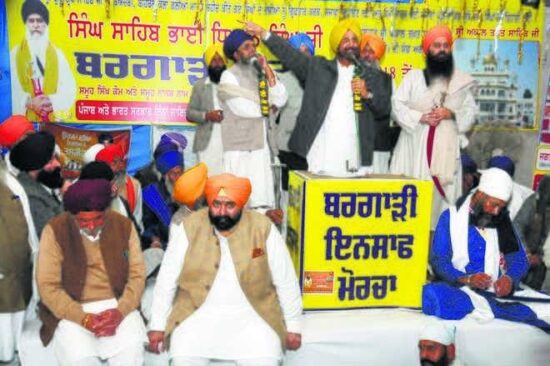
The Bargari sacrilege and subsequent police firing incidents of 2015 remain one of the most sensitive and unresolved chapters in Punjab’s recent history. Over the years, the case has moved through multiple investigative agencies, commissions, and courts, yet it continues to face delays in final judicial closure. This prolonged process has kept the issue alive in public debate, with repeated questions being raised about accountability, political responsibility, and the pace of justice.
The sequence of events began in mid-2015 when reports emerged of the theft of a “bir” of Sri Guru Granth Sahib from a gurdwara in Faridkot district, followed by incidents of posters and torn pages of the holy scripture being found in Bargari and nearby villages. These events triggered widespread protests across Punjab. The situation escalated sharply on 14 October 2015, when police firing at Kotkapura and Behbal Kalan during protest demonstrations resulted in the deaths of two protesters and injuries to several others. The incidents deeply impacted public sentiment and led to statewide unrest.
In the years that followed, the investigation shifted between agencies. The Central Bureau of Investigation (CBI) initially took over certain aspects of the probe in 2015, while later a Justice Ranjit Singh Commission examined the incidents and submitted detailed findings in 2018. Based on its recommendations, the Punjab government ordered further action and also transferred key investigations to a Special Investigation Team (SIT). However, legal complexity increased when jurisdictional disputes arose over withdrawal and reinstatement of investigation authority between state agencies and the CBI.
From 2019 onwards, the case saw repeated procedural delays due to ongoing legal challenges in higher courts. A major turning point came when multiple related FIRs and trial proceedings were shifted to Chandigarh courts following judicial directions aimed at consolidating hearings. In 2025–2026, proceedings were further impacted when the Supreme Court stay on certain trial proceedings remained in effect due to pending petitions, resulting in repeated adjournments. As a result, both the sacrilege-related cases and the connected police firing cases continue to remain under trial without final verdicts.
At the same time, successive governments have announced policy measures, compensation packages, and stricter legal provisions on sacrilege prevention. However, these measures have largely focused on future prevention rather than concluding the pending criminal trials of 2015. This distinction has also contributed to public perception that administrative responses and judicial outcomes are moving on separate tracks.
Timeline of Key Events (2015–2026)
Key milestones in brief:
2015: Sacrilege incidents, protests, and Kotkapura–Behbal Kalan firing incidents
2016–2017: Early investigations and political transitions in Punjab
2018: Justice Ranjit Singh Commission report; renewed SIT and CBI-related actions
2019–2021: Ongoing investigations and partial legal proceedings
2022: Political change in Punjab; renewed promises of faster justice
2023: Transfer of key cases to Chandigarh courts for consolidated hearings
2024: Continued trial delays; procedural consolidation of firing cases
2025: Supreme Court-related stays and intensified legal complexity
2026: Ongoing hearings, adjournments, and pending final adjudication
Overall, the Bargari case reflects how complex criminal investigations involving multiple agencies, political transitions, and layered legal challenges can significantly delay final justice outcomes. The matter continues to remain sub judice, with courts still engaged in trial-stage proceedings.
Disclaimer: This article and accompanying images are for informational and illustrative purposes only. Some visuals may be AI-generated or digitally enhanced and may not depict actual events or persons.
Views expressed are based on publicly available information and analysis.