
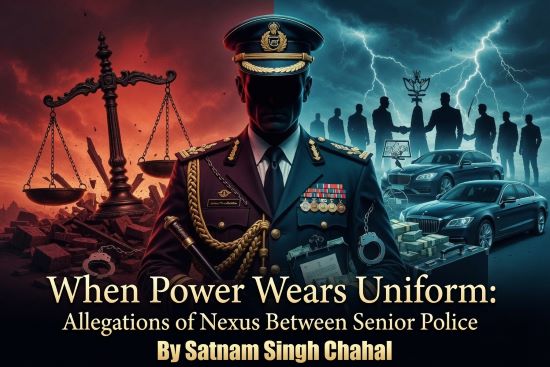
The ongoing controversy in Punjab involving the Chief Minister and the Akal Takht has once again raised serious questions about the integrity of institutions responsible for law, order, and justice. At the centre of the storm are allegations denied by official sources but widely debated in political circles that sections of the police hierarchy, including officers at senior ranks such as Police Commissioners, may have been compromised or influenced in cases involving sensitive forensic evidence.
The dispute began after the Akal Takht declared that a controversial video linked to Punjab Chief Minister Bhagwant Mann was “authentic” based on a forensic examination conducted by two laboratories. This triggered a political and religious firestorm, with the ruling party rejecting the findings and claiming that independent forensic analysis conducted outside Punjab suggests the video does not depict the Chief Minister at all, but instead shows an impersonator or manipulated content.
In this already polarised environment, allegations have emerged in public discourse questioning whether certain elements within the police and investigative machinery could have been influenced or misused—particularly in the handling, certification, or interpretation of forensic reports. Critics argue that if senior police officers or commissioners were to act in coordination with political interests or anti-social networks, it would seriously damage the credibility of criminal justice institutions.
The concern becomes more serious when viewed in the broader context of forensic disputes in India, where conflicting reports are not uncommon. In the current case, one set of forensic findings has been cited to support the Akal Takht’s position, while another set commissioned by the state government contradicts it. This contradiction has fueled suspicion among various stakeholders, each accusing the other of selective evidence use and manipulation.
However, it is important to underline that no verified judicial finding has established any wrongdoing by any serving Police Commissioner or IPS officer in relation to “fake forensic reports” in this case. All allegations remain politically charged claims and counter-claims, not proven facts.
What makes the situation more sensitive is the intersection of religion, politics, and policing. The Akal Takht, as the highest temporal authority of Sikhism, carries deep emotional and institutional influence. Any dispute involving its edicts automatically escalates beyond administrative boundaries into mass public sentiment. When such issues are coupled with allegations of forensic inconsistencies, trust in policing institutions comes under pressure.
Experts in governance argue that the solution lies in independent forensic oversight mechanisms, transparent chain-of-custody procedures, and judicially supervised investigations so that neither political parties nor religious institutions feel that evidence is being selectively interpreted.
Ultimately, the controversy highlights a larger structural concern: in politically sensitive cases, even the perception of bias or collusion within law enforcement can be as damaging as proven misconduct. Restoring public confidence requires not only denial of allegations but demonstrable transparency in how forensic science is applied and how investigative agencies function.
Until such mechanisms are strengthened, every high-profile dispute in Punjab risks becoming a battleground of competing narrativeswhere truth itself becomes secondary to perception.
Disclaimer: This article and accompanying images are for informational and illustrative purposes only. Some visuals may be AI-generated or digitally enhanced and may not depict actual events or persons.Views expressed are based on publicly available information and analysis.