
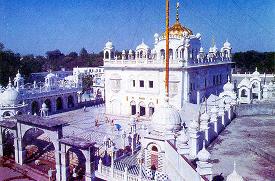
 Hazur Sahib, officially known as Takht Sachkhand Sri Hazur Abchalnagar Sahib, is one of the five Takhts the highest religious seats of authority in Sikhism. It stands on the banks of the Godavari River in Nanded, Maharashtra, built at the very place where Guru Gobind Singh Ji died. For the Sikh faithful across the world, this is not merely a historic monument. It is the ground where their tenth and final human Guru breathed his last, where the eternal Guruship was conferred upon the Guru Granth Sahib, and where the soul of their faith found its most sacred southern home. When the Maharashtra government announced plans to repeal the seven-decade-old law governing this shrine and replace it with entirely new legislation, it did not just provoke a legal dispute. It ignited a confrontation between state authority and one of the oldest living traditions of Sikh religious sovereignty.
The history of Hazur Sahib is deeply intertwined with the final days of Guru Gobind Singh Ji. After the Battle of Chamkaur in 1704, the Guru journeyed to Nanded, establishing it as his spiritual abode. It was here that he declared the Guru Granth Sahib as the eternal Guru of the Sikhs, ensuring that the holy scripture would guide the community henceforth. The journey to Nanded itself was part of the Guru’s accompaniment of Emperor Bahadur Shah on his southern campaign. The two camps arrived at Nanded towards the end of August 1708. Bahadur Shah proceeded onward to Golkonda, but the Guru stayed behind. Here he converted a Vaishnavite Bairagi recluse, Madho Das, who after initiation into the Khalsa fold received the name of Banda Singh.
It was in Nanded that the Guru’s earthly journey came to a violent and premature end. Two Pathans hired by Wazir Khan of Sirhind, who felt threatened by the conciliatory negotiations between the Emperor and Guru Gobind Singh, attended the evening diwan in disguise and attacked the Guru. Though the Guru fought back, the wounds he sustained proved fatal. A few days before his heavenly departure, Guru Gobind Singh Ji ended the line of personal Guruship by appointing the Granth Sahib as his official successor with the status of “Eternal Guru.” He departed on October 7, 1708 at Nanded. With that act, Nanded was forever sealed into the spiritual geography of Sikhism. The Guru himself named Nanded “Abchalnagar” literally “immortal or everlasting city” after the first word of a hymn read at random on the occasion of conferring Guruship upon the holy scripture.
After the Guru’s passing, a small but devoted community of Sikhs remained in Nanded and refused to let the memory fade. They established a room over the platform where the Guru had held his final court and placed the Guru Granth Sahib there, calling it Takhat Sahib. Their unwavering dedication ensured that this site became one of the five Takhts in Sikhism, a place of immense spiritual authority. Over the following century, administration of the shrine passed through several hands. Around 1823, Raja Chandu Lal, Diwan of the Hyderabad state, had the management made over to the Udasi priests and secured for the Gurdwara an endowment of about 525 acres of land. After the Nizam enlisted a troop of Sikhs in his army, the Udasi influence receded and Sikhs assumed responsibility for religious services once more.
The shrine’s physical magnificence owes much to Maharaja Ranjit Singh. The gurdwara as it stands today was built between 1832 and 1837 under his patronage, with skilled artisans and labour sent from Punjab to create a structure that would honour the Guru’s memory for all time. The Takht houses both the Sri Guru Granth Sahib and the Sri Dasam Granth, and within its inner vault are the personal weapons and sacred belongings of Guru Gobind Singh Ji including a chakra, a broad sword, a steel bow, a steel arrow, a gurz, and five gilded swords. Today it is regarded as the principal Sikh pilgrimage centre in South India and, due to its deep spiritual importance, is referred to as the “Kashi of the South.”
As Nanded was absorbed into the newly independent Indian state, the question of how a shrine of this magnitude should be formally administered became urgent. In 1956, an Act was passed by the legislature of Hyderabad under which the management of the Takhat Sahib and other historical Gurdwaras was legally placed under a 17-member Gurudwaras Board and a five member Managing Committee. This was the Nanded Sikh Gurdwara Sachkhand Sri Hazur Abchalnagar Sahib Act, 1956 a charter that gave democratic and institutional form to the community’s right to govern its own most sacred site. Crucially, it enshrined the roles of elected and nominated Sikh representatives, drawing participation from the SGPC, the Chief Khalsa Diwan, the Hazuri Sachkhand Diwan, and Sikh Members of Parliament. For nearly seven decades, this Act has been the legal backbone of the Takht’s independence. Wikipedia
The current controversy did not emerge without warning. It is the latest episode in a long-running effort by the Maharashtra state government to reshape the administrative framework of Hazur Sahib. Similar attempts to alter the Act were made in 2018 and 2019, but were foiled each time. The most serious recent episode came in early 2024. In February 2024, the Maharashtra government made an amendment to enable direct nomination of 12 of 17 members of the board, while reducing the SGPC’s nomination and abolishing the membership roles of the Chief Khalsa Diwan, the Hazuri Sachkhand Diwan, and Sikh MPs. The Sikh community responded with organised outrage. Following a massive protest by the SGPC and other local Sikh organisations, the government was compelled to roll back the amendment. That retreat was read as a victory but one that evidently did not end the state’s appetite for reform. Within two years, the government returned with an even bolder proposal: not to amend the Act, but to abolish it entirely.
On June 23, 2026, the Maharashtra Cabinet made its move. In a meeting chaired by Chief Minister Devendra Fadnavis, the Cabinet approved the proposal to repeal the 70-year-old Nanded Sikh Gurdwara Sachkhand Sri Hazur Abchalnagar Sahib Act, 1956. The existing Act would be replaced with a new legislation titled the “Takht Sachkhand Sri Hazur Abchalnagar Sahib Gurdwara Act,” marking a structural reset of the legal regime governing the Takht. The government presented its case through Revenue Minister Chandrashekhar Krishnarao Bawankule, who argued that several provisions of the 1956 Act had become outdated, that pilgrim footfall had increased manifold, and that the expanded administrative scope demanded an entirely new regulatory framework. The push for the new law drew on recommendations of a state-appointed committee the Justice Bhatia panel which had examined governance, management, and the electoral framework of the gurdwara board. The government maintained it was acting in the interest of transparency and efficiency. The draft of the new law was expected to be finalised in consultation with the Law and Justice Department before being tabled in the legislature during the monsoon session.
The Sikh response was swift and unambiguous. The very next day, on June 24, 2026, the caretakers of Takht Sri Hazur Sahib invoked one of the most powerful instruments in all of Sikh religious tradition. A high-level congregation was convened, involving the Panj Pyare the Guru’s five beloved ones senior clergy, and representatives of various Sikh religious bodies. After deliberations, a unanimous resolution was adopted, firmly calling for the retention of the original 1956 Act. The gurmata considered a binding collective decision taken in the name of the Guru was formally read out by Singh Sahib Giani Ram Singh in the presence of Takht Jathedar Giani Kulwant Singh.
A gurmata is not an ordinary resolution. Historically invoked at moments of supreme communal crisis, it carries a spiritual authority that transcends any individual voice or institution. When pronounced at a Takht in the presence of the Panj Pyare, it is considered binding upon all Sikhs. By choosing this instrument over a mere press statement or political protest, the leadership of Hazur Sahib was signalling to both the Maharashtra government and the wider Sikh world that this was not a matter of administrative preference it was a matter of faith.
The gurmata’s content went to the heart of the dispute. It stated that the existing administrative framework of Hazur Sahib is rooted in principles laid down by Sikh scholars and guided by the vision of Guru Gobind Singh, and that the proposed legislation risks undermining these foundations. Senior functionaries associated with the Takht described the government’s move as an attempt to dilute the shrine’s established traditions, with a clear apprehension that it is driven by vested interests seeking to interfere in Takht affairs. The organisations collectively described the move as a direct intrusion into the religious autonomy of one of Sikhism’s five Takhts and warned against any attempt to alter its maryada its religious code or its administrative independence.
The SGPC, which stands as the apex body of Sikh gurdwara management in northern India, added its voice to the chorus. SGPC president Harjinder Singh Dhami appealed to Chief Minister Fadnavis to immediately stop the move, insisting that before taking any decision related to the Takht’s management and religious autonomy, it is necessary to consult Sikh institutions, the Takht Jathedar, and the SGPC. Dhami did not mince his words, alleging that governments were making desperate efforts to weaken Sikh institutions.
Beneath the immediate controversy lies a question of profound constitutional importance. Article 26 of the Indian Constitution guarantees every religious denomination the right to manage its own affairs in matters of religion. For the Sikh community, the governance of their Takhts sits squarely within that protected sphere. A state legislature rewriting the rules that govern their most sacred institutions without meaningful consultation with Sikh religious bodies is experienced not as administrative modernisation, but as an act of appropriation. The very fact that the 2024 amendment had to be rolled back under mass pressure suggests that the government itself understood, at some level, that it had crossed a line. The decision to go further and repeal the entire foundational Act has, from the Sikh community’s perspective, only deepened that transgression.
The monsoon session of the Maharashtra legislature will be the next critical moment. If the government proceeds to table the new Gurdwara Act, it will face a Sikh community that is now legally, spiritually, and institutionally mobilised. The gurmata issued at Hazur Sahib is not simply a statement it is a mandate to the faithful. History, in this case, offers a guide. In 2018, 2019, and 2024, organised Sikh opposition succeeded in turning back the state’s advances. Each time, the community demonstrated that its unity, when sufficiently provoked, outweighs the government’s administrative calculus. Whether the Maharashtra government chooses to heed that history, or press forward into a deeper confrontation, will determine whether this sacred site on the banks of the Godavari continues to be governed as the Sikh community has always insisted from within, by faith, and on its own terms
Referances:Wikipedia,The Tribune,