
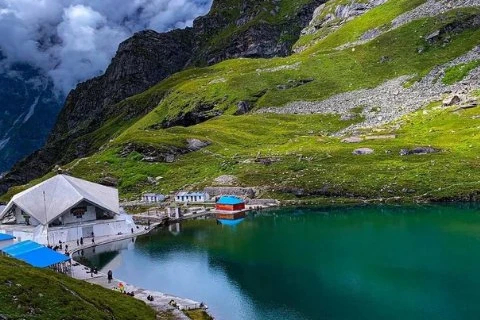
 Hemkund Sahib, one of the holiest pilgrimage sites of the Sikh faith, has recently become the centre of an intense debate on social media and in political circles. Amid the controversy, a widely circulated claim has emerged that the first Granthi of Hemkund Sahib was not a Sikh but Nanda Singh Chauhan of Byundar village in Joshimath block of Chamoli district, Uttarakhand. The claim is being shared as a reminder of the historical cooperation and mutual respect that existed between residents of the Himalayan region and Sikh pilgrims who helped develop and maintain the sacred shrine.
Historically, the rediscovery and development of Hemkund Sahib in the early twentieth century involved the contributions of both Sikh devotees and local inhabitants. The remote and inaccessible terrain of the Garhwal Himalayas made the assistance of local villagers indispensable. Residents of Byundar, Govindghat, Pandukeshwar, and surrounding villages often guided pilgrims, carried supplies, and assisted in the construction and maintenance of the pilgrimage route. The mention of Nanda Singh Chauhan is therefore being highlighted to emphasize that the foundation of Hemkund Sahib was built upon cooperation rather than division.
Those sharing this information argue that the present controversy should not be viewed as a conflict between the people of Uttarakhand and the Sikh community of Punjab. For decades, the relationship between Sikh pilgrims and local Himalayan communities has been characterized by mutual respect, hospitality, and shared economic and cultural interests. Every year, thousands of Sikh devotees visit Hemkund Sahib, contributing significantly to the local economy while also fostering bonds of friendship with residents of the region.
At the same time, it is important to recognize that any individual accused of wrongdoing must be judged according to the law, irrespective of religion, caste, region, or community. A democratic society functions on the principle that no individual receives protection simply because of his or her community identity. Equally, an entire community should not be blamed for the actions of a few individuals. If mistakes have been committed, legal institutions must investigate and act fairly, without prejudice or political interference.
The controversy has also triggered concerns regarding the growing tendency to communalize local disputes. In the age of social media, isolated incidents can quickly be transformed into larger narratives that pit one community against another. Such narratives often overlook historical realities and the long-standing relationships that have existed between different groups. The danger lies in allowing emotional reactions and political agendas to overshadow facts and reason.
Many observers are now questioning whether the timing and intensity of the controversy are linked to broader political calculations. With Punjab Assembly elections approaching next year, some analysts believe that attempts may be underway to create emotional and identity-based issues capable of influencing public opinion. Polarization has often been used as an electoral strategy in various parts of India, where political narratives are framed around religion, language, region, or community identity rather than governance and development.
If political forces are indeed seeking to exploit the issue for electoral gains, it would be deeply unfortunate. The legacy of Hemkund Sahib is one of spiritual devotion, sacrifice, and universal brotherhood. Turning such a sacred symbol into a tool for political mobilization would undermine the values it represents. The focus should instead remain on preserving communal harmony, respecting historical facts, and ensuring that justice is delivered fairly in any dispute.
The lesson from the history of Hemkund Sahib is clear. The shrine stands as a symbol of cooperation between people from different backgrounds who came together in service of faith and humanity. Remembering the contributions of local residents such as Nanda Singh Chauhan should inspire unity rather than division. As public debate continues, citizens must remain vigilant against attempts to convert isolated controversies into broader communal confrontations.
Ultimately, the real challenge is not merely resolving a single controversy but safeguarding the spirit of harmony that has defined Hemkund Sahib for generations. Whether in Uttarakhand, Punjab, or elsewhere, peace and mutual respect must prevail over political polarization. Communities that have shared history, friendship, and cooperation for decades should not allow temporary controversies to damage relationships that have been built over generations.
Disclaimer: This article and accompanying images are for informational and illustrative purposes only. Some visuals may be AI-generated or digitally enhanced and may not depict actual events or persons.
Views expressed are based on publicly available information and analysis.