
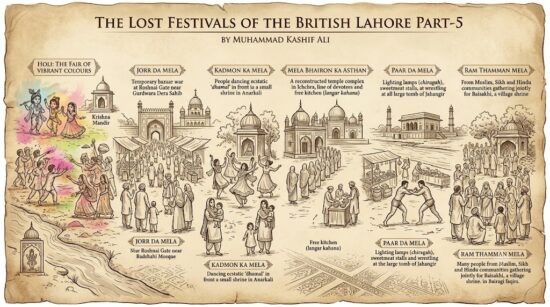
 This study is primarily concerned with the lost and forgotten fairs and carnivals of pre-partition Lahore. For a long time, Lahore has been a place of different festivals for Indian subcontinent residents and visitors. Before the partition of British India, three major communities (Muslims, Sikhs, and Hindus) coexisted peacefully in old Lahore.
However, the partition of the Punjab (1947) resulted in a large population shift, and the city had to deal with the relocation of three communities. Sikhs and Hindus were forced to relocate from Lahore to Charda (eastern) Punjab in India, while Muslims were forced to relocate from various parts of Eastern Punjab to Lahore and other areas of Lehnda
(western) Punjab. This shift of the population drastically affected the cultural landscape of Lahore. Lahore in next decades faced a great loss in festivals. the festivals had a facet of the old city since Hindu Shahi era (perhaps beyond this era) to Muslim Rule and then to Sikh and British periods. Festivals like Bhadar Kali fair, Jorr da Mela, Paar da Mela etc.were sparkling features of the city, now elapsed. The modern Lahore is a Muslim metropolitan and non-Muslim (especially the Hindu and Sikh with some exceptional cases)festivals have buried in debris of history.
Some fairs and festivals lost due to partition of the Indian sub-continent while other elapsed in the name of modernization.The development of festivals and their effects on people are referred to as festivalisation. The festivalisation is integrally linked to human culture. Festivals have
always been an important part of human culture and have been linked to religion. Festivals are examples of intangible culture because they showcase art and community symbols (Cundy, 2016, 11-13).
Lahore is (and was) the Indian subcontinent’s most festive city. For over a millennium, Lahore has been a religious melting pot. Lahore was a Hindu-dominated town prior to Islam. Since the Ghaznavid era until the reign of Mughal Emperor Akbar, Lahore has been a mingling of two large communities: Hindus and Muslims, and since Akbar’s Ancient Punjab – Volume 10, 2022 53 reign, a new religious community, the Sikhs,has been added to the socio-religious mosaic of ancient Lahore. The British Lahore experienced another western group (English), all
communities contributed to Lahore’s cultural life and left their marks on the cultural landscape of Lahore. Festivals or fairs were one of them; fairs were many and varied in nature; social and religious. For a long time, Hindus, Muslims, and Sikhs coexisted peacefully until political instability erupted as a result of the freedom movement, which was at its peak at the mid of the 20th century. Eventually, the Indian subcontinent gained independence, and the (combined) Punjab was partitioned into Muslim and Sikh Punjab.
As a result of the partition, there was a huge migration; the Sikhs and Hindus had to leave their beloved Lahore for India, while Muslims from other parts of India fled to seek safety in the newly formed state of Pakistan. New settlers filled the void in Lahore, transforming it from a pluralistic to a Muslim city. It had an impact on the town’s cultural life; non-Muslim festivities faced extinction. Here is a quick historical overview of those festivals that have died or are disappearing slowly but steadily. Only one mela (Ram Thamman) is taken from outside contemporary Lahore; during the partition, Tehsil Kasur was part of District Lahore.
This is a qualitative study for which the historical descriptive method was adopted.Both primary and secondary sources were consulted, personal observations of the fairs (post-partition period) were also incorporated. There are very few scattered studies on the fairs and festivals of the British Lahore. Though the book of John Campbell deals with ethno-history of the British India but he discusses three fairs of Lahore; Bhadar Kali, Mela Chiraghan and Kadmon Ka mela. The Colonial Lahore is one of the finest works (Talbot & Kamran) on the British Lahore but least it deals with fairs and festivals of the British Lahore. Naqoosh Lahore Number is a basic source to study Lahore from ancient times to 1960s and one essay deals with fairs and festivals of Lahore till 1960s. The Lahore Gazetteer was published in the nineteenth century and some old Lahore fairs are briefly discussed in this compilation. Syed Ali Raza has submitted his MPhil dissertation (Raza,2008) on religious and non-religious festivals of Lahore, though he gives a detailed study of current fairs and festivals but some old festivals are missing as his major focus was the post partition period or current fairs and festivals.