
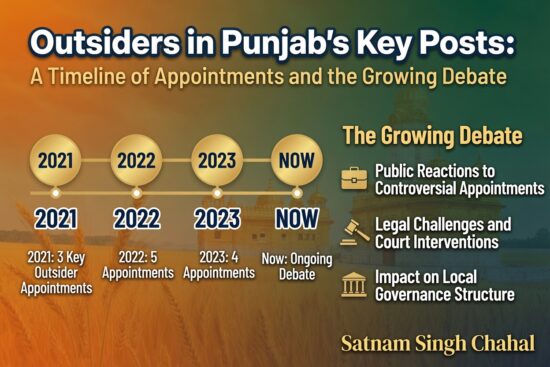
 When the Aam Aadmi Party (AAP) came to power in Punjab in March 2022 with a historic mandate, it promised a new era of transparent governance, employment generation, and opportunities for Punjab’s youth. The party projected itself as a revolutionary alternative to traditional politics, assuring the people that merit would prevail over political patronage. Thousands of educated unemployed youth believed these promises and expected that government jobs and important administrative positions would primarily benefit qualified candidates from Punjab.
However, over the past four years, one issue has repeatedly generated political controversy—the appointment of individuals from outside Punjab to key advisory, regulatory, and administrative positions. While the Punjab government has maintained that appointments are made purely on the basis of merit, experience, and professional competence, opposition parties, employee organizations, and sections of civil society have questioned whether qualified Punjabis are being overlooked despite the state’s large pool of experienced professionals.
The controversy has become even more sensitive because it coincides with repeated protests by unemployed youth, contractual employees, teachers, apprentice linemen, computer teachers, and other job aspirants. Many of these demonstrations witnessed police action, including lathi charges and detentions. Critics argue that while educated Punjabi youth were demanding employment and facing police batons on the streets, influential government positions were being offered to individuals from outside the state, creating a perception of contradiction between the government’s promises and its actions.
The debate began soon after the formation of the AAP government in 2022. Within weeks of assuming office, several advisers and consultants associated with the party’s national leadership were appointed to assist the Punjab government. These appointments immediately sparked political criticism, with opposition parties alleging that Punjab’s administration was increasingly being influenced by individuals who had little direct connection with the state.
As the government entered its second year, criticism expanded beyond political advisers. Various appointments in statutory bodies, regulatory authorities, and government institutions were questioned by opposition leaders, who argued that Punjab possessed retired bureaucrats, legal experts, engineers, economists, and academicians with decades of experience who deserved consideration before candidates from outside the state.
The debate intensified further with appointments to important regulatory bodies, including the Punjab Pollution Control Board and the Punjab Real Estate Regulatory Authority (RERA). Opposition leaders claimed that such institutions directly affect the lives of Punjabis and therefore should be led by individuals who possess not only administrative expertise but also a thorough understanding of Punjab’s unique economic, environmental, and social challenges.
In 2026, the controversy resurfaced after the appointment of a former Himachal Pradesh Chief Secretary as Chairman of the Punjab State Electricity Regulatory Commission (PSERC). Opposition parties strongly criticized the decision, arguing that Punjab had numerous retired IAS officers, engineers, and power sector experts who were equally qualified for the position. The government, however, defended the appointment, maintaining that experience and competence—not geographical origin—were the deciding factors.
More recently, political attention focused on the constitution of the Punjab Development Council, where reports suggested that a significant number of members hailed from outside Punjab. Critics described the move as another example of the government relying on outsiders for advisory roles, while supporters argued that development councils often include experts from different parts of the country whose professional knowledge can contribute to better governance.
The appointments controversy cannot be viewed in isolation because it overlaps with Punjab’s continuing unemployment crisis. Since 2022, unemployed teachers, contractual employees, apprentice linemen, computer teachers, sanitation workers, and many other categories of educated youth have repeatedly staged protests demanding recruitment, regularisation, or implementation of recruitment promises.
Several of these protests ended in confrontations with the police. Images of young graduates being detained, dragged into police vehicles, or dispersed through lathi charges became recurring headlines. For many critics, these scenes stand in sharp contrast to the government’s willingness to recruit experienced professionals from outside Punjab for prestigious positions.
Those raising concerns argue that Punjab has thousands of highly educated professionals, retired civil servants, judges, engineers, professors, economists, and administrators who possess both the necessary qualifications and a deep understanding of the state’s unique social, agricultural, industrial, and financial challenges. They believe these individuals should receive priority whenever senior positions become vacant.
The Punjab government has consistently rejected allegations that it is ignoring Punjab’s talent. It maintains that appointments are made strictly according to legal provisions, qualifications, administrative experience, and institutional requirements. Government leaders have also highlighted the recruitment of thousands of employees in different departments since 2022 and argue that governance should not be restricted by state boundaries when selecting experts for specialized positions.
Supporters of the government further contend that many regulatory bodies require highly specialized knowledge, and experienced professionals from other states can contribute valuable perspectives and administrative expertise. According to this view, merit should remain the primary criterion rather than regional identity.
The controversy has now evolved into a broader political debate about representation, accountability, and public expectations. Critics argue that a government elected on promises of empowering Punjab should first recognize the capabilities of its own people before looking elsewhere. They believe that repeatedly selecting outsiders for influential positions weakens public confidence and sends an unfortunate message to unemployed Punjabi youth.
Supporters, on the other hand, argue that good governance requires attracting the best available talent regardless of domicile and that competence should always take precedence over regional considerations.The debate over appointments of out-of-state individuals is ultimately about more than administrative decisions. It reflects larger questions regarding employment opportunities, public trust, and whether governments are fulfilling the expectations on which they were elected. For many unemployed young Punjabis, the issue symbolizes a perceived gap between promises and practice.
As Punjab continues to face unemployment, migration of skilled youth, financial challenges, and demands for better governance, greater transparency in appointments and a clear explanation of the criteria used for selecting individuals to important public positions may help reduce controversy and strengthen public confidence in the system.
Disclaimer: This article and accompanying images are for informational and illustrative purposes only. Some visuals may be AI-generated or digitally enhanced and may not depict actual events or persons.Views expressed are based on publicly available information and analysis.