
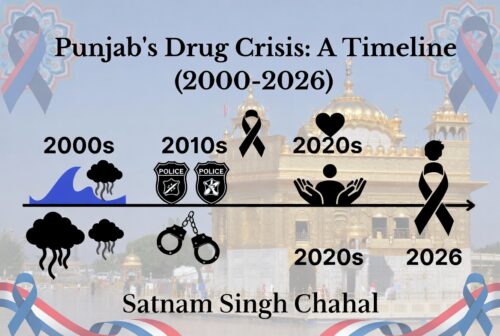
 Punjab’s battle against illegal drugs remains one of the state’s most serious challenges. Although the Punjab Government launched the “Yudh Nashian Virudh” (War Against Drugs) campaign, intending to dismantle drug networks, arrest traffickers, and rehabilitate addicts, the continued recovery of large quantities of heroin, synthetic drugs, pharmaceutical opioids, and drug money suggests that the illegal supply chain remains active. The repeated seizures of narcotics indicate that while law enforcement agencies are intercepting significant consignments, new supplies continue to enter the state through organised criminal networks.
The government’s campaign has undoubtedly resulted in thousands of arrests, the registration of numerous NDPS cases, freezing of assets belonging to alleged drug traffickers, and increased conviction rates. Punjab Police have also targeted hawala operators and financial networks believed to support the narcotics trade. These measures demonstrate a stronger enforcement response than in previous years.
However, the continuing recovery of heroin and synthetic drugs raises an important question: if the supply chain has been dismantled, why do law enforcement agencies continue to recover such large quantities almost every week? Recent official data shows that Punjab accounted for a significant share of heroin seizures in India during 2025, highlighting both the scale of trafficking and the intensity of enforcement.
Drug trafficking is no longer limited to small-scale peddlers. Experts believe the illegal trade operates through a sophisticated chain involving international suppliers, interstate transporters, financiers, hawala operators, local distributors, street-level dealers, and organized criminal gangs. Every time one link is broken, another often emerges, making the network resilient and difficult to eliminate completely.
Punjab’s geographical location also presents unique challenges. The state has long been vulnerable because of its proximity to the international border, while narcotics are also transported through interstate routes. Smugglers increasingly use drones, encrypted communication, courier networks, and digital payment systems, making investigations more complex than conventional policing alone.
Another concern is the increasing availability of synthetic drugs and the misuse of pharmaceutical medicines. Unlike traditional narcotics, synthetic substances can be manufactured or transported through multiple channels, making detection more difficult. This has widened the scope of the drug problem beyond heroin alone.
The economics of drug trafficking also encourage criminal organizations to continue their operations. The enormous profits generated by narcotics far outweigh the risks for many traffickers. Drug money is often invested in real estate, businesses, luxury vehicles, and illegal financial channels, creating a parallel criminal economy. Recognizing this, Punjab Police have increasingly focused on freezing assets and disrupting financial networks, but experts believe sustained financial investigations are essential to permanently weaken organized trafficking.
Demand remains another critical factor. As long as addiction persists, traffickers will attempt to maintain supply. The government reports that tens of thousands of individuals have received treatment through de-addiction and rehabilitation centres under the campaign, reflecting growing efforts on the rehabilitation front. Yet many specialists argue that prevention, mental health support, employment opportunities, and community-based interventions must receive the same priority as policing.
Several observers also argue that enforcement statistics alone cannot be the only measure of success. A rise in arrests and seizures may indicate more effective policing, but it can also reflect the continued availability of illegal drugs. The ultimate benchmark should be whether drugs become significantly harder to obtain, addiction rates decline, overdose deaths decrease, and organized trafficking networks are permanently dismantled.
Going forward, Punjab’s anti-drug strategy may require an integrated approach that combines intelligence-led policing, stronger border management, interstate coordination, financial investigations, faster prosecution, rehabilitation, education, community participation, and employment generation for vulnerable youth. Drug addiction is not merely a law-and-order issue but also a social, economic, and public health challenge.
The “Yudh Nashian Virudh” campaign has intensified enforcement against narcotics, but the continued recovery of drugs across Punjab demonstrates that the illegal supply chain remains active. The challenge before policymakers is not simply to seize larger quantities of drugs, but to permanently disrupt the networks that finance, transport, distribute, and profit from narcotics. Only when both supply and demand are simultaneously reduced can Punjab hope to overcome the drug menace that has affected thousands of families for decades.
Disclaimer: This article and accompanying images are for informational and illustrative purposes only. Some visuals may be AI-generated or digitally enhanced and may not depict actual events or persons. Views expressed are based on publicly available information and analysis.