
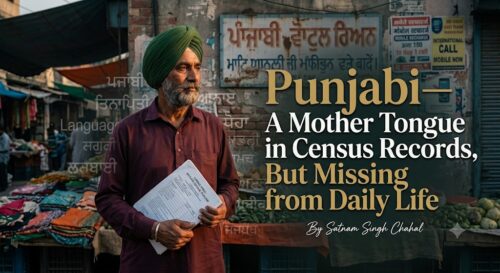
 Milpitas, California / Jalandhar, Punjab-The North American Punjabi Association (NAPA) has expressed serious concern over the reported observations made by Bhasha Vibhag Punjab Director Jaswant Singh Zafar regarding obstacles in implementing Punjabi in government offices.
NAPA Executive Director Satnam Singh Chahal stated that if concerns about bureaucratic resistance are accurate, the Punjab Government must immediately review the implementation of the Punjab Official Language Act and remove every administrative obstacle preventing Punjabi from becoming the true language of governance.
“It is deeply disappointing that decades after the enactment of the Official Language Act, citizens continue to face difficulties obtaining government services in Punjabi. Many government offices continue to rely predominantly on English, and in several cases, officials are reluctant even to communicate with citizens in Punjabi. This situation defeats the very objective for which the language legislation was enacted,” Chahal said.
NAPA observed that Punjabi is one of the world’s fastest-growing languages and is widely spoken by millions across India, Canada, the United States, the United Kingdom, Australia, New Zealand, and Europe. Ironically, while Punjabi communities abroad are investing heavily in preserving their mother tongue, implementation within Punjab’s own administrative system remains incomplete.
The Association welcomed the Director’s reported request that adequate financial resources be allocated to the Bhasha Vibhag, noting that meaningful implementation cannot occur without sufficient staffing, technology, training, and monitoring.
NAPA urged the Punjab Government to:
Fully implement the Punjab Official Language Act in every department.
Ensure that all government correspondence is available in Punjabi.
Make Punjabi the primary language for citizen services.
Provide language training wherever necessary.
Establish an independent monitoring authority to review compliance by every department.
Publish annual implementation reports to ensure transparency and accountability.
“Punjabi is not merely a language; it is the foundation of Punjab’s history, literature, culture, and identity. Governments may change, but the responsibility to preserve the state’s official language remains permanent,” Chahal concluded.
NAPA expressed hope that the present controversy would serve as a turning point and lead to meaningful administrative reforms rather than remaining another unfulfilled promise.