
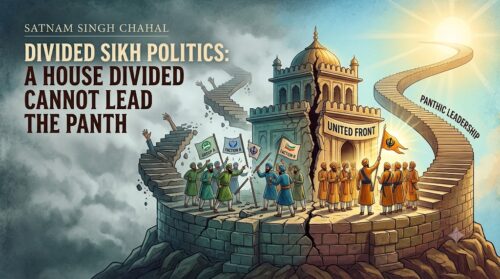
 The Sikh Panth has never been defeated by a lack of courage, faith, or sacrifice. Its history is illuminated by extraordinary examples of resilience in the face of oppression and injustice. Yet today, one of the gravest challenges confronting the community does not come from outside its ranks—it comes from within. The growing fragmentation of Sikh politics has weakened the collective voice of the Panth and diminished the effectiveness of its leadership at a time when unity is needed most.
Every political group claims to speak for the Sikh community. Every faction presents itself as the true guardian of Sikh interests. Yet the more these factions multiply, the less united the Panth appears. Leadership that should be devoted to protecting the dignity, rights, and future of the community is too often consumed by internal rivalries, personal ambitions, and struggles for influence. When individual prestige becomes more important than collective purpose, the Panth pays the price.
There was a time when Sikh leaders spoke with authority because they carried the confidence of the Sangat. When they raised their voices against injustice or highlighted the concerns of the community, governments, institutions, and society listened. That respect was earned through unity, integrity, and moral credibility.
Today, the situation is markedly different. Public disagreements, competing claims of leadership, and factional disputes frequently overshadow the issues that matter most to ordinary Sikhs. The result is a weakened collective voice. When leaders are unable to stand together on matters of common concern, it becomes more difficult to advocate effectively, to build public trust, and to inspire confidence within the community itself.
This fragmentation has practical consequences. Sikhs living across different states and regions continue to face social, legal, and economic challenges that require thoughtful representation and coordinated action. In moments that call for clarity and unity, divided leadership can leave people uncertain about who truly represents their concerns or how best to move forward. A community with a rich tradition of collective responsibility deserves leadership capable of working together despite differences.
The management of Sikh institutions also deserves honest reflection. Gurdwara Sahibs are not merely buildings; they are spiritual, cultural, and humanitarian centres sustained by the faith and generosity of the Sangat. Through langar, education, disaster relief, healthcare, and countless charitable initiatives, these institutions have earned global admiration. Their service has crossed every barrier of religion, caste, nationality, and language.
That legacy must never be overshadowed by political competition or personal interests. The offerings made by the Sangat are sacred trusts. They should be managed with complete transparency, accountability, and a commitment to public service. When questions arise about governance, financial priorities, or decision-making, the response should not be defensiveness or factional conflict but openness and a willingness to strengthen public confidence.
Another concern is the message being sent to the younger generation. Sikh youth are looking for leadership that reflects the values taught by the Gurus—humility, integrity, courage, and service. They want institutions that inspire, not disappoint. If they repeatedly witness internal conflict and public division, many may become disengaged from the very institutions that have preserved Sikh identity for centuries. That is a loss no community can afford.
Political disagreement is natural in any democracy. Diversity of opinion is not a weakness; indeed, it can strengthen decision-making. But there is an important difference between principled debate and destructive division. Debate seeks better solutions. Division often seeks victory over rivals. When rivalry becomes an end in itself, the interests of the community risk being pushed aside.
The Sikh tradition offers a different model of leadership. It honours those who placed duty before personal gain, who united rather than divided, and who regarded leadership as a form of service rather than privilege. That tradition remains as relevant today as ever. It reminds us that the measure of a leader is not the size of a following or the prominence of a title, but the ability to build trust, bring people together, and act in the common interest.
The challenges facing the Panth today are too significant to be addressed through fragmented politics. Strengthening education, supporting youth, preserving Sikh heritage, enhancing humanitarian work, promoting social harmony, and representing the legitimate concerns of the community all require cooperation. No faction, however influential, can achieve these goals alone.
It is time for Sikh politics to rediscover the values that once gave it moral authority. Leaders should compete in service, not in self-promotion. They should be remembered for the institutions they strengthened, the bridges they built, and the confidence they restored—not for the divisions they deepened.
History does not remember those who fought endlessly for positions of influence. It remembers those who rose above personal interests to protect the welfare of their people. The future of the Panth depends not on which faction prevails, but on whether its leaders can restore unity of purpose, transparency in governance, and an unwavering commitment to the principles of justice, humility, and selfless service.
The Sikh Panth possesses immense spiritual strength, remarkable institutions, and a global community committed to service. What it needs now is leadership worthy of that legacy—leadership that understands a simple truth: a divided house cannot provide strong guidance. Only by placing the Panth above personal ambition can Sikh politics regain the respect, credibility, and moral force it once commanded.