
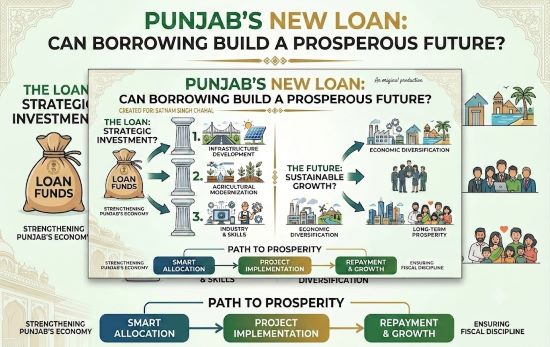
 The Punjab Government has once again decided to raise a fresh loan, adding to the state’s already massive debt burden. While every government justifies borrowing as necessary for development and welfare schemes, an important question remains: Can a state truly become prosperous by continuously surviving on loans? Financial experts have long argued that borrowing is not a problem if it creates productive assets and generates future income. However, when loans are repeatedly used to meet day-to-day expenses, salaries, subsidies, and repayments of previous debts, they become a warning sign rather than a solution.
Punjab’s financial challenges have accumulated over several decades. During the 1990s, the state’s debt was relatively under control, but increasing government expenditure gradually led to greater dependence on borrowing. In the early 2000s, successive governments continued taking loans to finance development projects and welfare commitments instead of expanding revenue through industrial growth and investment. As debt increased, so did the burden of interest payments.
Between 2010 and 2017, Punjab’s financial situation became more serious. Governments borrowed heavily to support power subsidies, agricultural assistance, infrastructure projects, and various public welfare schemes. Although some development work was undertaken, the state’s debt continued to rise faster than its ability to generate income.
From 2017 to 2022, despite repeated promises of fiscal discipline, borrowing remained a regular feature of the state’s finances. Public debt crossed alarming levels, and an increasing portion of the annual budget was spent simply on repaying loans and paying interest. This reduced the amount of money available for education, healthcare, employment generation, and infrastructure development.
Since 2022, the current Punjab Government inherited an already difficult financial situation. However, it has also continued to raise fresh loans while expanding welfare commitments and meeting routine government expenditure. Every new borrowing provides temporary financial relief, but it also increases future repayment obligations. Ultimately, future generations of Punjabis will bear the burden of today’s borrowing through higher taxes, reduced public spending, or additional debt.
The situation raises a fundamental economic principle. Borrowing money is not harmful if it is invested in projects that create wealth, industries that generate employment, modern infrastructure that attracts investment, or irrigation systems that improve agricultural productivity. Such investments eventually produce higher revenues, enabling governments to repay their loans comfortably. The real problem begins when borrowing becomes a permanent method of financing everyday government operations without creating new sources of income.
The same principle applies in everyday life. A businessman who continuously borrows money simply to pay old debts rarely builds a successful enterprise. Similarly, a family that finances its household expenses entirely through loans eventually finds itself trapped in financial difficulty. Governments are no exception. Long-term prosperity depends on earning more, investing wisely, and controlling unnecessary expenditure rather than depending on repeated borrowing.
Punjab today possesses tremendous strengths, including fertile agricultural land, hardworking farmers, skilled youth, successful entrepreneurs, and one of the world’s most prosperous diasporas. Yet these strengths can only translate into economic growth if policies encourage industrial investment, promote manufacturing, support small businesses, modernize agriculture, improve tax collection, and create meaningful employment opportunities. Without structural economic reforms, borrowing alone cannot revive the state’s economy.
Economic history around the world offers an important lesson. Nations and states that rely excessively on debt without expanding their productive capacity eventually face slowing growth and increasing financial stress. On the other hand, governments that invest borrowed money wisely in productive assets are able to strengthen their economies and gradually reduce their debt burden.
Punjab now stands at a crucial crossroads. Every new loan may provide temporary relief, but it cannot replace sound financial management and sustainable economic planning. The state’s future prosperity will depend not on how much money it borrows, but on how effectively it creates wealth, attracts investment, generates employment, and restores fiscal discipline.
There is an old saying in finance that remains as relevant today as ever: “Those who survive only by taking loans rarely achieve lasting success.” For Punjab, the path to prosperity lies not in an endless cycle of borrowing, but in building an economy capable of standing on its own strength.